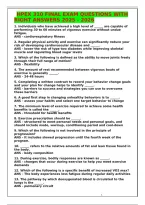
Title: HPEX 310 Final Exam Questions with Verified Answers 2025/2026 – Complete Personal Health & Wellness Study Guide (A+ Guaranteed)
Description:
HPEX 310 FINAL EXAM STUDY GUIDE – Personal Health & Wellness Edition
Are you preparing for the HPEX 310 Final Exam? This comprehensive study guide contains 208 tested questions with verified correct answers for the 2025–2026 academic year. Perfect for last-minute review or full-semester preparation, this document covers every major topic tested on the HPEX 310 final exam.
Whether you are studying personal health, fitness and wellness, exercise science, or health education, this study guide will help you master the most commonly tested concepts and pass your final exam with confidence.
WHY THIS STUDY GUIDE IS A MUST-HAVE:
208 Verified Questions & Answers – Every question includes the correct answer, tested and verified for accuracy.
Exam-Focused – Questions mirror the actual HPEX 310 final exam format.
Comprehensive – Covers all units taught in HPEX 310: cardiorespiratory fitness, exercise prescription, behavior change, body composition, muscular strength, flexibility, nutrition, weight management, cardiovascular disease, stress, environmental health, cancer, special populations, and health communication.
Real-World Scenarios – Includes practical application questions (e.g., Scott joining the Marines, Jesse reducing blood pressure, Alejandro's cholesterol results).
Statistics & Guidelines – Includes specific numbers tested on exams (34% adult obesity, 42% witnessed bullying, 2500 calories per pound of muscle, SPF 15, mammogram at 40).
Instant Download – Word document format, ready to study immediately.
Perfect for Self-Study & Group Review – Use as a standalone reviewer or supplement to your lecture notes.
COMPLETE TOPIC BREAKDOWN (208 Questions):
UNIT 1: CARDIORESPIRATORY FITNESS (Questions 1–22)
Definition of cardiorespiratory fitness
VO2 max: Definition, Benefits, Improvement
Aerobic capacity
Pulmonary circuit: Deoxygenated blood to lungs
Stroke volume: Amount of blood pumped per heartbeat
Heart rate reserve (HRR): Calculation, Formula
Maximal heart rate: 206.9 – (0.67 x age)
Exercise intensity: Key factor in maintaining fitness
Cardiorespiratory endurance: Prolonged aerobic exercise
Cycle ergometer test: Best field test for joint problems
Energy storage: Glycogen in muscle cells
Cardiorespiratory system: Oxygen delivery, Waste removal
Resting metabolic rate (RMR): Resting energy expenditure
Motor units: Function, Control
Muscle contraction: Concentric, Eccentric, Isotonic, Isometric, Isokinetic
Dehydroepiandrosterone (DHEA): Advertised effects
Spotter: Purpose during weight training
Specificity: Muscular strength and endurance
Testosterone: Chemical precursors
PNF: Proprioceptive neuromuscular facilitation
Benefits of increased flexibility
Flexibility: Joint specific
Static stretching: Technique, Duration
Dynamic stretching: Sport-specific movements
Ballistic stretching: Sudden, forceful bouncing
Contract-relax stretching
CRAC stretching: Antagonist contraction
Muscle spindles: Stretch receptors
Golgi tendon organs: Proprioceptors in tendons
Stretch reflex: Involuntary contraction
Low back pain: Chronic definition
Hypokinetic disease: Lack of exercise
Posture: Benefits, Risks
Sarcopenia: Loss of muscle mass due to aging
Presbyopia: Inability to focus on close objects
UNIT 2: EXERCISE PRESCRIPTION & PROGRAMMING (Questions 3–9, 49–58, 130–134)
FITT Principle: Frequency, Intensity, Time, Type
Warm-up: Purpose, Duration
Conditioning period: Aerobic, Resistance, Flexibility
Cool-down: Purpose, Duration
Threshold for health benefits: Minimum exercise
Exercise prescription: Mode, Warm-up, Conditioning, Cool-down
Progression: Principle, Application
Interval training: High-intensity alternated with lower-intensity
Rest between vigorous bouts: 24–48 hours
Exercise for pregnant women: Duration, Intensity, Recommendations
Exercise for older adults: Weight-bearing, Balance support
Adaptive sports: For people with disabilities
Inclusive sports: For people with and without disabilities
Steps to developing a personal fitness plan
Steps to developing a wellness plan
SMART goals: Specific, Measurable, Achievable, Relevant, Time-bound
Measurable goal example: "I'm going to lose eight pounds by the end of May"
Monitoring progress: Tracking habits
Communication with healthcare providers
Selecting exercises: Cardiorespiratory endurance, Muscular strength, Muscular endurance, Flexibility, Body composition
UNIT 3: BEHAVIOR CHANGE & WELLNESS (Questions 5–6, 50, 54, 57, 61, 129, 134, 166)
Stages of Change: Precontemplation, Contemplation, Preparation, Action, Maintenance, Termination
Written contract: Identifying barriers and strategies
First step in changing unhealthy behaviors: Assess habits, Select one target behavior
Barriers to success: Identification, Overcoming
Rewards for reaching goals: Extrinsic and intrinsic
8 Components of Wellness: Physical, Emotional, Intellectual, Spiritual, Social, Environmental, Occupational, Financial
Wellness plan: Establish goals, Select wellness concepts, Plan behavior changes, Monitor progress
Tracking bad habits: 1–2 weeks
Measurable goals: Definition, Examples
Communicating with healthcare providers: Asking questions
Behavior change: Planning, Monitoring
UNIT 4: BODY COMPOSITION (Questions 10, 39–48, 109–128)
Body composition: Relative amounts of fat and lean tissue
Essential fat: Crucial for normal body functioning
Essential fat percentages: 3–5% in men, 8–12% in women
Storage fat: Contained within adipose tissue
Subcutaneous fat: Below the skin
Visceral fat: Surrounding the organs (more dangerous)
Android obesity (apple): Most common in men, Abdominal area, Greater risk for heart disease and diabetes
Gynoid obesity (pear): Most common in women, Hips and thighs
4 Components of Body Composition: Fat, Mineral (bones), Water, Protein
Overweight: Above recommended range for good health based on height
Obesity: Excessive accumulation of body fat (25% for men, 35% for women)
Obesity rates: 34% of adults, 67% of Americans overweight or obese, 33% of children overweight or obese
Creeping obesity: Slow gain of fat over time
BMI: Body Mass Index, Calculation, Limitations
Skinfold assessment: Measures subcutaneous fat
Skinfold sites for women: Supralium, Thigh, Triceps
Waist-to-hip ratio: Measures body fat distribution
DEXA: Gold standard for assessing body composition
Hydrostatic weighing: Old gold standard, Measures total body density
Bod Pod: Air displacement
Bioelectrical impedance analysis: Most popular method
Optimal weight calculation: Free fat mass / (1 – % optimal fat)
Weight loss: Fat, water, and some lean muscle tissue
Body composition assessments: Regularly when trying to lose or gain weight
Scott's case: 21.8% body fat, BMI 27 = Overweight
Alejandro's cholesterol: 260 mg/dL = High risk
UNIT 5: MUSCULAR STRENGTH & ENDURANCE (Questions 21–29, 173–199)
Muscle fiber types: Slow twitch (Type I), Fast twitch (Type IIa), Type IIx
Slow twitch fibers: Contract slowly, Low force, Resistant to fatigue, Aerobic ATP production
Fast twitch fibers: Contract quickly, Large force, Fatigue quickly, Low aerobic capacity
Type IIx fibers: Anaerobic ATP production, Forceful and rapid movement
Type IIa fibers: Intermediate fibers, Contract rapidly, High force, Fatigue resistant
Force generation factors: Size of muscle, Number of fibers recruited
Muscular strength assessment: 1 rep-max test
Muscular endurance assessment: Push-up test, Curl-up/sit-up test
Increasing muscular strength: High resistance, Low reps
Increasing muscular endurance: Low resistance, High reps
Hypertrophy: Increase in muscle fiber size
Hyperplasia: Formation of new muscle fibers
Core muscle groups: Transversus abdominus, Multifidus, External obliques, Rectus abdominus, Erector spinae
Isotonic weight training: Contracting against movable load
Isometric weight training: Contraction at fixed angle against immovable object
Isokinetic weight training: Machines govern speed of movement
Valsalva maneuver: Exhaling against closed airway, Reduced blood flow to brain, Dizziness, Fainting
Muscle fibers: Long thin cells
Fascia: Dense layers of connective tissue
Tendons: Connective tissue attaching muscle to bone
3 Categories of Skeletal Muscle Exercise: Isotonic, Isometric, Isokinetic
Isotonic (dynamic) exercise: Movement of body part at a joint
Isometric (static) exercise: Muscular tension without movement
Isokinetic exercise: Fixed, controlled speed
Isometric contraction: Static, No joint movement
Concentric (positive work) contraction: Muscle shortens
Eccentric (negative work) contraction: Muscle lengthens
UNIT 6: FLEXIBILITY & STRETCHING (Questions 3, 30–36, 200–207)
Flexibility: Ability to move joints freely through full range of motion
Flexibility: Joint specific
Benefits of increased flexibility: Improved joint mobility
Static stretching: Slowly lengthening muscle, Holding position
Static stretch duration: 20–30 seconds
Dynamic stretching: Moving joints through full range of motion to mimic sports
Ballistic stretching: Sudden, forceful bouncing
PNF: Proprioceptive neuromuscular facilitation
Contract-relax stretching: Contracting then relaxing then stretching
CRAC stretching: Contract-relax with antagonist contraction
Muscle spindles: Special muscle receptors that sense stretch
Golgi tendon organs: Proprioceptors in tendons
Stretch reflex: Involuntary contraction from rapid stretching
Structural limitations to flexibility: Shape of bones, Stiff muscle, Connective tissue, Tendons, Tight skin
Flexibility assessment: Sit and reach test, Shoulder flexibility test
Flexibility training frequency: At least 2 days per week
Low back pain: Chronic if lasts longer than 6 months
Hypokinetic disease: Disease associated with lack of exercise
Posture: Benefits, Risks
Sarcopenia: Loss of skeletal muscle mass due to aging
Presbyopia: Inability to focus on close objects caused by age
UNIT 7: NUTRITION (Questions 135–159)
Nutrition: Study of food and nutrients
3 Major Functions of Nutrients: Provide energy, Support growth, Regulate metabolism
Macronutrients: Carbohydrates, Fats, Proteins, Water
Micronutrients: Vitamins, Minerals
Complex carbohydrates: Glycogen, Starch, Fiber
Soluble fiber: Delays stomach emptying, Full feeling
Insoluble fiber: Adds bulk to GI tract, Speeds up stomach emptying
Fiber recommendation: 25–30 grams/day
2 Categories of Fat: Unsaturated, Saturated
Unsaturated fats: Healthier, Mono and polyunsaturated, Doesn't increase blood cholesterol, Double bond
Saturated fats: Solid at room temperature, Unhealthy, Trans fatty acids, Single bond
Basic structure of fats: Fatty acids, Stored as triglycerides
Proteins: Build and repair body tissue, Regulate metabolism, Protect from disease
Amino acids: Essential, Non-essential
Essential amino acids: Body cannot make them
Non-essential amino acids: Body can make them
Complete proteins: Contain all essential amino acids, Animal foods and soy
Incomplete proteins: Missing 1+ essential amino acids, Vegetable sources
Water: Macronutrient needed in highest quantity
Water loss: 5% = distress, 15% = fatal
Water functions: Regulates body temperature, Digestion, Nutrient absorption, Blood formation, Waste elimination
Water recommendation: 12–16 cups daily
Daily food recommendations: Carbohydrates 45–65%
Vitamins: Water-soluble, Fat-soluble
Minerals: Major, Trace
Major minerals: Calcium, Sodium, Chloride, Magnesium
Trace minerals: Iron, Copper, Zinc, Iodine, Fluoride
Factors impacting energy balance: Genetics, Lifestyle, Environment
UNIT 8: WEIGHT MANAGEMENT (Questions 39, 59–68, 160–163)
Energy balance: Energy intake = Energy expenditure
Positive energy balance: Consuming more calories than expended
Negative energy balance: Consuming fewer calories than expended
Resting metabolic rate (RMR): Resting energy expenditure
RMR in men vs. women: Men have higher RMR
RMR with age: Decreases
Leptin: Suppresses appetite, Acts on brain areas controlling hunger
Ghrelin: Triggers nerve signals from gut to brain causing hunger
Fat to kcal ratio: 1 lb of fat = 3500 kcal
Calories to synthesize 1 lb of muscle: 2500 calories
Initial weight loss: Fat, water, and some lean muscle tissue
Obese individual beginning exercise: Low intensity
3 Main Types of Weight-Loss Surgeries: Restrictive procedures (gastric banding), Malabsorption procedures (bypass intestine), Combined restrictive and malabsorption
Tracking bad habits: 1–2 weeks
Keeping records: Triggers for bad behaviors
UNIT 9: CARDIOVASCULAR DISEASE (Questions 69–78, 164)
Cardiovascular disease: Leading cause of death overall
LDL: "Bad cholesterol"
HDL: "Good cholesterol"
Cholesterol risk levels: Total blood cholesterol 260 mg/dL = High risk
Hypertension: Risk factors, DASH diet
DASH diet: Dietary Approaches to Stop Hypertension
Jesse's case: Moderately high blood pressure, Stop eating fast food for lunch
Stroke: Blockage of blood flow to the brain
Coronary heart disease: Blocked vessels supplying the heart due to plaque
Heart attack signs: Not chills and fever
Risk factors for hypertension: Lack of exercise, Salty diet, Obesity
Men at greater risk: Ages 20–50
Cardiovascular disease risk: Men vs. women
UNIT 10: STRESS & MENTAL HEALTH (Questions 79–88)
Eustress: Stress that leads to improved performance
Distress: Negative stress
Stress: Physical and mental tension in response to threat or challenge
Stress response: Cortisol release
Type D behavior: Worry, Anxiety, Discomfort when interacting with others
Stress reduction guidelines: Muscle relaxation, Light-to-moderate-intensity exercise, Meditation
Stress reduction steps: Reducing sources of stress, Using relaxation techniques
Factors affecting stress reaction: Past experiences, Personality, Gender
Spiritual wellness: Activities that promote it
High-intensity activity: Does not promote spiritual wellness
Bullying: Statistics, 42% witnessed bullying
Bullying examples: Not a joke being shared with friends
UNIT 11: ENVIRONMENTAL HEALTH (Questions 89–98)
Heat illness: Also called heat injury
Avoiding heat illness: Not wearing darker colors while exercising
Heat illness prevention: Hydration, Appropriate clothing, Timing
Wet clothing: May lose insulating properties
Body heat loss through head: Up to 40%
Hypothermia: Signs, Symptoms, Management
Altitude sickness: Prevention, Ascend rapidly (what not to do)
Pollution: Strategies for reducing, Not burning leaves
Poison ingestion: Examine victim's mouth for cuts, swelling, burns
Patellofemoral pain syndrome: Poorly aligned quadriceps muscles
Delayed-onset muscle soreness (DOMS): Prevention, Refrain from too strenuous or prolonged exercise
Body temperature during exercise: Highest in high temperature and high humidity
UNIT 12: CANCER (Questions 99–108)
Cancer: Leading causes of death
Lung cancer: Why it contributes to so many deaths, Lack of screening tests, Symptoms not present until after spread
Skin cancer: Most common type of cancer
Skin cancer prevention: Using adequate sunscreen during sun exposure
Sunscreen: SPF 15 minimum
Colon cancer: Third leading cause of cancer deaths, Screening at age 50
Breast cancer: Second most common type of cancer in women
Mammogram: Annual beginning at age 40
Malignant tumors: Containing cancerous cells
Carcinoma: Cancer formed in epithelial cells, Most common type
Carcinogens: Agents that cause cancer
UNIT 13: SPECIAL POPULATIONS (Questions 51–52, 131–133)
Pregnant women: Exercise recommendations, Not basketball
Pregnancy exercise benefits: Less weight gain, Fewer discomforts, Shorter labor, May help prevent and treat gestational diabetes
Pregnancy exercise duration: Up to 30 minutes of moderate aerobic exercise
Pregnancy exercise intensity: Light-to-moderate resistance training
Older adults: Weight-bearing exercises, Balance support to avoid falls
Adaptive sports: Played solely by people with a disability
Inclusive sports: Played by people with and without disabilities
UNIT 14: HEALTH COMMUNICATION & GOAL SETTING (Questions 5, 50, 54, 57, 61, 130–134)
Communicating with healthcare providers: Asking questions about medicines and treatments
Measurable goals: Definition, Examples
SMART goals: Specific, Measurable, Achievable, Relevant, Time-bound
Written contract: Recording behavior change goals
Barriers to success: Identification, Strategies to overcome
Tracking habits: Monitoring progress
Rewards: Extrinsic and intrinsic
Steps to developing a personal fitness plan
Steps to developing a wellness plan
WHO IS THIS FOR?
HPEX 310 Students – Preparing for the final exam
Personal Health & Wellness Students – Undergraduate courses
Fitness and Exercise Science Students – Kinesiology, Exercise Science
Health Education Students – Health promotion, Health behavior
Tutors and Instructors – Seeking a question bank
Anyone needing a comprehensive review of health-related fitness concepts
HOW TO USE THIS STUDY GUIDE:
Review all 208 questions – Cover the answers and test yourself.
Check your answers – Verify with the provided correct answers.
Identify weak areas – Focus on topics where you scored low.
Review and repeat – Retake the exam after studying to measure improvement.
Simulate exam conditions – Time yourself to build speed and accuracy.
DOCUMENT DETAILS:
Format: Word Document (DOCX)
Pages: 15
Questions: 208
Answers: Complete with verified correct answers
Language: English
Difficulty: College/University Final Exam Level
File Type: Digital Download
Compatibility: PC, Mac, Tablet, Smartphone