
BADM 7200 | Exam 2 - Strategic Management & Business Policy 2026/2027 Edition
BADM 7200 Exam 2
Strategic Management & Business Policy
Actual Questions and Answers — Latest Update 2026/2027
120 Multiple-Choice Questions • 100% Guaranteed Pass Edition
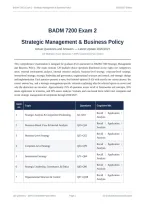
This comprehensive examination is designed for graduate-level assessment in BADM 7200 Strategic Management
and Business Policy. The exam contains 120 multiple-choice questions distributed across eight core competency
areas: external environment analysis, internal resource analysis, business-level strategy, corporate-level strategy,
international strategy, strategic leadership and governance, organizational structure and control, and strategic change
and implementation. Each question presents a stem, four lettered options (A–D) with exactly one correct answer, the
correct answer key, and a strategic-management-specific rationale explaining why the selected option is correct and
why the distractors are incorrect. Approximately 25% of questions assess recall of frameworks and concepts, 55%
assess application to scenarios, and 20% assess analysis. Scenario and case-based items reflect real companies and
recent strategic management developments through 2026/2027.
Secti
Topic Questions Cognitive Mix
on
Recall / Application /
1 Strategic Analysis & Competitive Positioning Q1–Q18
Analysis
Recall / Application /
2 Resource-Based View & Internal Analysis Q19–Q34
Analysis
Recall / Application /
3 Business-Level Strategy Q35–Q52
Analysis
Recall / Application /
4 Corporate-Level Strategy Q53–Q70
Analysis
Recall / Application /
5 International Strategy Q71–Q84
Analysis
Recall / Application /
6 Strategic Leadership, Governance, & Ethics Q85–Q96
Analysis
Recall / Application /
7 Organizational Structure & Control Q97–Q108
Analysis
120 Questions - 100% Guaranteed Pass Edition Page 1 (c) Graduate Business Education
,BADM 7200 | Exam 2 - Strategic Management & Business Policy 2026/2027 Edition
Recall / Application /
8 Strategic Change & Implementation Q109–Q120
Analysis
Section 1: Strategic Analysis and Competitive Positioning
Industry Analysis, Porter's Five Forces, & Strategic Groups (Q1-Q18)
Q1: Helix Aerospace operates in the commercial satellite launch services industry. The industry is
characterized by enormous capital requirements, complex proprietary technology, regulatory licensing
barriers that take 5-7 years to obtain, and a small set of well-established incumbents. A strategic analyst
applying Porter's Five Forces should conclude that the threat of new entrants in this industry is:
A. High, because regulatory barriers are easy to overcome with political lobbying.
B. Low, because capital intensity, technology complexity, and licensing requirements create substantial entry
barriers. **[CORRECT]**
C. Low, because there are already few incumbents in the market.
D. High, because the aerospace supply chain is fully commoditized.
Correct Answer: B
Rationale: Porter's Five Forces treats the threat of new entrants as a function of seven principal barriers: scale economies,
capital requirements, switching costs, product differentiation, network effects, cost disadvantages independent of scale,
and government policy. In commercial satellite launch services, all three factors cited (capital intensity, proprietary
technology, and multi-year regulatory licensing) operate simultaneously as formidable entry barriers. Option A is wrong
because regulatory barriers are structural, not easily bypassed by lobbying. Option C confuses rivalry with threat of entry.
Option D is wrong because the supply chain in aerospace is highly specialized, not commoditized.
Q2: A regional craft coffee roaster is evaluating its competitive environment. Supplier power among specialty
coffee cooperatives in the region is most likely to be HIGH when which of the following conditions holds?
A. The cooperatives sell to many independent roasters, and switching between bean varietals is costless for the buyer.
B. The cooperatives are small and fragmented, with no single co-op holding more than 2% market share.
C. The cooperatives control access to a unique micro-lot bean varietal that consumers prize, and no substitutes
exist. **[CORRECT]**
D. Forward integration by cooperatives into roasting is technically and financially infeasible.
Correct Answer: C
Rationale: Supplier power increases when inputs are unique, when substitutes are unavailable, when the supplier group is
concentrated, when switching costs are high, and when the supplier credibly threatens forward integration. A unique
micro-lot bean varietal with no substitutes gives cooperatives pricing power analogous to a monopoly supplier. Option A
and B describe conditions of low supplier power (fragmented suppliers, low switching costs). Option D would actually
weaken, not strengthen, supplier power because forward integration threat is a key supplier leverage.
120 Questions - 100% Guaranteed Pass Edition Page 2 (c) Graduate Business Education
,BADM 7200 | Exam 2 - Strategic Management & Business Policy 2026/2027 Edition
Q3: In analyzing the global smartphone industry, an analyst notes intense price competition, low switching
costs for consumers, declining per-unit margins, and the presence of powerful chip suppliers like Qualcomm
and TSMC. According to Porter's Five Forces, this industry is best characterized as:
A. Attractive, because high unit volumes ensure long-term profitability.
B. Unattractive, because rivalry is high, buyer power is significant, and supplier power is concentrated.
**[CORRECT]**
C. Attractive, because low switching costs lead to brand experimentation that benefits all incumbents.
D. Attractive, because the absence of substitutes means buyers must purchase from incumbents.
Correct Answer: B
Rationale: Porter's framework assesses industry attractiveness by aggregating all five forces. The smartphone industry
exhibits high rivalry (intense price competition, declining margins), high buyer power (low switching costs), and high
supplier power (concentrated chip suppliers like TSMC and Qualcomm). Three strong forces operating simultaneously
make the industry structurally unattractive despite high volumes. Option A confuses volume with profitability. Option C
misreads low switching costs—they empower buyers, not all incumbents. Option D ignores the presence of substitutes like
refurbished phones, used markets, and emerging wearable computing alternatives.
Q4: Crestline Pharma is constructing a strategic group map for the global biopharmaceuticals industry.
Which combination of variables would be MOST useful as the two axes of the map?
A. Employee headcount and number of corporate social responsibility initiatives.
B. Product breadth (narrow to broad therapeutic portfolio) and geographic scope (domestic to global).
**[CORRECT]**
C. Total assets and number of subsidiaries listed in annual reports.
D. CEO compensation and the size of the board of directors.
Correct Answer: B
Rationale: A strategic group map should use variables that meaningfully differentiate firms' competitive positions and
mobility barriers. Product breadth and geographic scope are the two classic, empirically validated axes used in biopharma
because they capture the scope of the firm's competitive arena and the location of its competitive engagements. Employee
headcount (A), total assets (C), and governance variables (D) describe the firm but do not separate strategic groups within
the industry. Useful strategic group axes must (1) be heterogeneous across firms, (2) reveal mobility barriers, and (3)
correlate with profitability differences.
Q5: A PESTEL analysis of the European electric vehicle (EV) market identifies the following factor: 'The EU
Parliament has passed binding legislation requiring all new car sales to be zero-emission by 2035.' This factor
belongs to which PESTEL category?
A. Economic, because it affects consumer disposable income for EV purchases.
B. Technological, because battery innovation is required to meet the standard.
C. Political/Legal, because the factor is a binding regulatory mandate enacted by a governmental body.
**[CORRECT]**
D. Environmental, because the goal of the regulation is to reduce emissions.
Correct Answer: C
Rationale: PESTEL categorizes macro-environmental factors as Political, Economic, Social, Technological,
Environmental, and Legal. The key to classification is the source and nature of the factor, not its downstream effects. A
binding legislative mandate enacted by a parliament is both Political (government action) and Legal (regulatory law). The
intent of the regulation (environmental) does not change the category of the source factor. Option D is a common student
error: confusing the purpose of a regulation with its PESTEL category. Option B confuses the technological consequence
with the source factor itself.
120 Questions - 100% Guaranteed Pass Edition Page 3 (c) Graduate Business Education
, BADM 7200 | Exam 2 - Strategic Management & Business Policy 2026/2027 Edition
Q6: The industry life cycle model predicts that during the 'Growth' stage of an industry, firms should
typically expect to see:
A. Declining total industry demand, consolidation through exits, and emphasis on process efficiency.
B. Rapidly expanding demand, increasing number of competitors, focus on product performance and
distribution, and improving but still negative or low margins. **[CORRECT]**
C. Stable demand, saturated distribution channels, and emphasis on cost reduction and brand differentiation.
D. Negative growth rate, major divestitures, and emphasis on harvesting cash flows.
Correct Answer: B
Rationale: In the growth stage of the industry life cycle, total demand expands rapidly as new consumers enter the market.
The number of competitors typically increases because new entrants are attracted by the growth opportunity. Strategic
emphasis shifts toward product performance improvements and distribution expansion. Margins improve from the
introductory stage but often remain modest because firms reinvest heavily in capacity and marketing. Option A describes
maturity/decline; Option C describes maturity; Option D describes the decline stage. Recognizing the stage correctly is
essential because strategic prescriptions vary substantially across the life cycle stages.
Q7: Northgate Bank is analyzing the threat of substitutes in the retail payments industry. Which of the
following represents the strongest substitute threat to traditional consumer bank transfers?
A. A new local credit union offering similar wire transfers at slightly lower fees.
B. Mobile peer-to-peer payment platforms like Venmo and Cash App that perform the same function with
greater convenience at lower cost. **[CORRECT]**
C. A foreign bank entering the market with competitive transfer products.
D. An incumbent bank offering promotional discounts on transfers for the first three months.
Correct Answer: B
Rationale: Substitutes are products or services that meet the same basic need through a different approach. The strength of
a substitute threat depends on three factors: (1) the substitute's value proposition (price/performance), (2) the buyer's cost
of switching to the substitute, and (3) the buyer's propensity to switch. Venmo and Cash App meet the same basic need
(transferring money between individuals) via a fundamentally different mobile-first architecture, with greater convenience
and lower cost. Option A and C are direct competitors (same approach, same function). Option D is intra-industry rivalry,
not substitution.
Q8: When applying the Five Forces to assess buyer power in the global commercial aircraft industry (where
buyers are major airlines like Delta, United, and Lufthansa), which factor MOST increases buyer power?
A. High switching costs for airlines to retrain pilots and maintenance crews on a new airframe.
B. Concentrated buyer base—only a few hundred global airlines purchase commercial aircraft—and the
buyer's purchase volume represents a significant share of the seller's revenues. **[CORRECT]**
C. Brand identity and safety reputation of Boeing and Airbus that are highly valued by passengers.
D. Long backlog of orders at Boeing and Airbus that gives sellers pricing leverage.
Correct Answer: B
Rationale: Buyer power increases when buyers are concentrated, when each buyer's purchases represent a significant
share of the seller's revenues, when the product is undifferentiated, when switching costs are low, and when the buyer can
credibly threaten backward integration. The concentrated buyer base in commercial aviation (a few hundred airlines) gives
buyers substantial leverage because losing a single major customer is financially material to Boeing or Airbus. Options A,
C, and D all describe factors that reduce, not increase, buyer power—they represent seller leverage.
120 Questions - 100% Guaranteed Pass Edition Page 4 (c) Graduate Business Education
BADM 7200 Exam 2
Strategic Management & Business Policy
Actual Questions and Answers — Latest Update 2026/2027
120 Multiple-Choice Questions • 100% Guaranteed Pass Edition
This comprehensive examination is designed for graduate-level assessment in BADM 7200 Strategic Management
and Business Policy. The exam contains 120 multiple-choice questions distributed across eight core competency
areas: external environment analysis, internal resource analysis, business-level strategy, corporate-level strategy,
international strategy, strategic leadership and governance, organizational structure and control, and strategic change
and implementation. Each question presents a stem, four lettered options (A–D) with exactly one correct answer, the
correct answer key, and a strategic-management-specific rationale explaining why the selected option is correct and
why the distractors are incorrect. Approximately 25% of questions assess recall of frameworks and concepts, 55%
assess application to scenarios, and 20% assess analysis. Scenario and case-based items reflect real companies and
recent strategic management developments through 2026/2027.
Secti
Topic Questions Cognitive Mix
on
Recall / Application /
1 Strategic Analysis & Competitive Positioning Q1–Q18
Analysis
Recall / Application /
2 Resource-Based View & Internal Analysis Q19–Q34
Analysis
Recall / Application /
3 Business-Level Strategy Q35–Q52
Analysis
Recall / Application /
4 Corporate-Level Strategy Q53–Q70
Analysis
Recall / Application /
5 International Strategy Q71–Q84
Analysis
Recall / Application /
6 Strategic Leadership, Governance, & Ethics Q85–Q96
Analysis
Recall / Application /
7 Organizational Structure & Control Q97–Q108
Analysis
120 Questions - 100% Guaranteed Pass Edition Page 1 (c) Graduate Business Education
,BADM 7200 | Exam 2 - Strategic Management & Business Policy 2026/2027 Edition
Recall / Application /
8 Strategic Change & Implementation Q109–Q120
Analysis
Section 1: Strategic Analysis and Competitive Positioning
Industry Analysis, Porter's Five Forces, & Strategic Groups (Q1-Q18)
Q1: Helix Aerospace operates in the commercial satellite launch services industry. The industry is
characterized by enormous capital requirements, complex proprietary technology, regulatory licensing
barriers that take 5-7 years to obtain, and a small set of well-established incumbents. A strategic analyst
applying Porter's Five Forces should conclude that the threat of new entrants in this industry is:
A. High, because regulatory barriers are easy to overcome with political lobbying.
B. Low, because capital intensity, technology complexity, and licensing requirements create substantial entry
barriers. **[CORRECT]**
C. Low, because there are already few incumbents in the market.
D. High, because the aerospace supply chain is fully commoditized.
Correct Answer: B
Rationale: Porter's Five Forces treats the threat of new entrants as a function of seven principal barriers: scale economies,
capital requirements, switching costs, product differentiation, network effects, cost disadvantages independent of scale,
and government policy. In commercial satellite launch services, all three factors cited (capital intensity, proprietary
technology, and multi-year regulatory licensing) operate simultaneously as formidable entry barriers. Option A is wrong
because regulatory barriers are structural, not easily bypassed by lobbying. Option C confuses rivalry with threat of entry.
Option D is wrong because the supply chain in aerospace is highly specialized, not commoditized.
Q2: A regional craft coffee roaster is evaluating its competitive environment. Supplier power among specialty
coffee cooperatives in the region is most likely to be HIGH when which of the following conditions holds?
A. The cooperatives sell to many independent roasters, and switching between bean varietals is costless for the buyer.
B. The cooperatives are small and fragmented, with no single co-op holding more than 2% market share.
C. The cooperatives control access to a unique micro-lot bean varietal that consumers prize, and no substitutes
exist. **[CORRECT]**
D. Forward integration by cooperatives into roasting is technically and financially infeasible.
Correct Answer: C
Rationale: Supplier power increases when inputs are unique, when substitutes are unavailable, when the supplier group is
concentrated, when switching costs are high, and when the supplier credibly threatens forward integration. A unique
micro-lot bean varietal with no substitutes gives cooperatives pricing power analogous to a monopoly supplier. Option A
and B describe conditions of low supplier power (fragmented suppliers, low switching costs). Option D would actually
weaken, not strengthen, supplier power because forward integration threat is a key supplier leverage.
120 Questions - 100% Guaranteed Pass Edition Page 2 (c) Graduate Business Education
,BADM 7200 | Exam 2 - Strategic Management & Business Policy 2026/2027 Edition
Q3: In analyzing the global smartphone industry, an analyst notes intense price competition, low switching
costs for consumers, declining per-unit margins, and the presence of powerful chip suppliers like Qualcomm
and TSMC. According to Porter's Five Forces, this industry is best characterized as:
A. Attractive, because high unit volumes ensure long-term profitability.
B. Unattractive, because rivalry is high, buyer power is significant, and supplier power is concentrated.
**[CORRECT]**
C. Attractive, because low switching costs lead to brand experimentation that benefits all incumbents.
D. Attractive, because the absence of substitutes means buyers must purchase from incumbents.
Correct Answer: B
Rationale: Porter's framework assesses industry attractiveness by aggregating all five forces. The smartphone industry
exhibits high rivalry (intense price competition, declining margins), high buyer power (low switching costs), and high
supplier power (concentrated chip suppliers like TSMC and Qualcomm). Three strong forces operating simultaneously
make the industry structurally unattractive despite high volumes. Option A confuses volume with profitability. Option C
misreads low switching costs—they empower buyers, not all incumbents. Option D ignores the presence of substitutes like
refurbished phones, used markets, and emerging wearable computing alternatives.
Q4: Crestline Pharma is constructing a strategic group map for the global biopharmaceuticals industry.
Which combination of variables would be MOST useful as the two axes of the map?
A. Employee headcount and number of corporate social responsibility initiatives.
B. Product breadth (narrow to broad therapeutic portfolio) and geographic scope (domestic to global).
**[CORRECT]**
C. Total assets and number of subsidiaries listed in annual reports.
D. CEO compensation and the size of the board of directors.
Correct Answer: B
Rationale: A strategic group map should use variables that meaningfully differentiate firms' competitive positions and
mobility barriers. Product breadth and geographic scope are the two classic, empirically validated axes used in biopharma
because they capture the scope of the firm's competitive arena and the location of its competitive engagements. Employee
headcount (A), total assets (C), and governance variables (D) describe the firm but do not separate strategic groups within
the industry. Useful strategic group axes must (1) be heterogeneous across firms, (2) reveal mobility barriers, and (3)
correlate with profitability differences.
Q5: A PESTEL analysis of the European electric vehicle (EV) market identifies the following factor: 'The EU
Parliament has passed binding legislation requiring all new car sales to be zero-emission by 2035.' This factor
belongs to which PESTEL category?
A. Economic, because it affects consumer disposable income for EV purchases.
B. Technological, because battery innovation is required to meet the standard.
C. Political/Legal, because the factor is a binding regulatory mandate enacted by a governmental body.
**[CORRECT]**
D. Environmental, because the goal of the regulation is to reduce emissions.
Correct Answer: C
Rationale: PESTEL categorizes macro-environmental factors as Political, Economic, Social, Technological,
Environmental, and Legal. The key to classification is the source and nature of the factor, not its downstream effects. A
binding legislative mandate enacted by a parliament is both Political (government action) and Legal (regulatory law). The
intent of the regulation (environmental) does not change the category of the source factor. Option D is a common student
error: confusing the purpose of a regulation with its PESTEL category. Option B confuses the technological consequence
with the source factor itself.
120 Questions - 100% Guaranteed Pass Edition Page 3 (c) Graduate Business Education
, BADM 7200 | Exam 2 - Strategic Management & Business Policy 2026/2027 Edition
Q6: The industry life cycle model predicts that during the 'Growth' stage of an industry, firms should
typically expect to see:
A. Declining total industry demand, consolidation through exits, and emphasis on process efficiency.
B. Rapidly expanding demand, increasing number of competitors, focus on product performance and
distribution, and improving but still negative or low margins. **[CORRECT]**
C. Stable demand, saturated distribution channels, and emphasis on cost reduction and brand differentiation.
D. Negative growth rate, major divestitures, and emphasis on harvesting cash flows.
Correct Answer: B
Rationale: In the growth stage of the industry life cycle, total demand expands rapidly as new consumers enter the market.
The number of competitors typically increases because new entrants are attracted by the growth opportunity. Strategic
emphasis shifts toward product performance improvements and distribution expansion. Margins improve from the
introductory stage but often remain modest because firms reinvest heavily in capacity and marketing. Option A describes
maturity/decline; Option C describes maturity; Option D describes the decline stage. Recognizing the stage correctly is
essential because strategic prescriptions vary substantially across the life cycle stages.
Q7: Northgate Bank is analyzing the threat of substitutes in the retail payments industry. Which of the
following represents the strongest substitute threat to traditional consumer bank transfers?
A. A new local credit union offering similar wire transfers at slightly lower fees.
B. Mobile peer-to-peer payment platforms like Venmo and Cash App that perform the same function with
greater convenience at lower cost. **[CORRECT]**
C. A foreign bank entering the market with competitive transfer products.
D. An incumbent bank offering promotional discounts on transfers for the first three months.
Correct Answer: B
Rationale: Substitutes are products or services that meet the same basic need through a different approach. The strength of
a substitute threat depends on three factors: (1) the substitute's value proposition (price/performance), (2) the buyer's cost
of switching to the substitute, and (3) the buyer's propensity to switch. Venmo and Cash App meet the same basic need
(transferring money between individuals) via a fundamentally different mobile-first architecture, with greater convenience
and lower cost. Option A and C are direct competitors (same approach, same function). Option D is intra-industry rivalry,
not substitution.
Q8: When applying the Five Forces to assess buyer power in the global commercial aircraft industry (where
buyers are major airlines like Delta, United, and Lufthansa), which factor MOST increases buyer power?
A. High switching costs for airlines to retrain pilots and maintenance crews on a new airframe.
B. Concentrated buyer base—only a few hundred global airlines purchase commercial aircraft—and the
buyer's purchase volume represents a significant share of the seller's revenues. **[CORRECT]**
C. Brand identity and safety reputation of Boeing and Airbus that are highly valued by passengers.
D. Long backlog of orders at Boeing and Airbus that gives sellers pricing leverage.
Correct Answer: B
Rationale: Buyer power increases when buyers are concentrated, when each buyer's purchases represent a significant
share of the seller's revenues, when the product is undifferentiated, when switching costs are low, and when the buyer can
credibly threaten backward integration. The concentrated buyer base in commercial aviation (a few hundred airlines) gives
buyers substantial leverage because losing a single major customer is financially material to Boeing or Airbus. Options A,
C, and D all describe factors that reduce, not increase, buyer power—they represent seller leverage.
120 Questions - 100% Guaranteed Pass Edition Page 4 (c) Graduate Business Education


