
WGU D117 | Advanced Health Assessment Documentation Form | 2026/2027 Update Complete Solution Exam
WGU D117 Advanced Health Assessment Documentation
Form
Comprehensive Competency Examination — Complete Solution
Latest 2026/2027 Update | 105 Questions with Detailed Rationales
Western Governors University • Graduate Nursing Program • Advanced Health Assessment Documentation Form
Competency
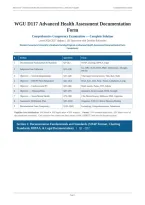
# Section Questions Focus
1 Documentation Fundamentals & Standards Q1-Q12 SOAP, Charting, HIPAA, Legal
CC, HPI, OLDCARTS, PMH, Medications, Allergies,
2 Subjective Data Collection Q13-Q30
FH/SH
3 Objective — General/Integumentary Q31-Q40 Vital signs, General survey, Skin, Hair, Nails
4 Objective — HEENT/Neck/Respiratory Q41-Q54 Head, Eyes, Ears, Nose, Throat, Lymphatics, Lungs
5 Objective — Cardiovascular/PV Q55-Q66 Heart sounds, Pulses, JVD, Edema
6 Objective — Abdomen/Musc Q67-Q78 Quadrants, Bowel sounds, ROM, Strength
7 Objective — Neuro/Mental Health Q79-Q90 CNs, Motor/Sensory, Reflexes, MSE, Cognition
8 Assessment, Differential, Plan Q91-Q100 Diagnosis, ICD-10, Clinical Decision-Making
9 Documentation Form Competency Q101-Q105 Formatting, Comprehensiveness, Submission
Cognitive level distribution: 30% Recall • 50% Application • 20% Analysis. Format: 75% scenario/application, 25% direct recall of
documentation standards. Each question has exactly one best answer. Mark [CORRECT] indicates the keyed response.
Section 1: Documentation Fundamentals and Standards (SOAP Format, Charting
Standards, HIPAA, & Legal Documentation) | Q1 - Q12
Page 1
,WGU D117 | Advanced Health Assessment Documentation Form | 2026/2027 Update Complete Solution Exam
Q1: A nurse practitioner is completing a SOAP note for a patient seen in the WGU D117 simulation clinic. The
patient states, "My chest has been hurting for the past three days, mostly when I climb stairs." Where in the SOAP
note should this statement be documented?
A. In the Objective section because it describes a measurable symptom.
B. In the Subjective section as the chief complaint in the patient's own words, with the HPI elaboration
following. [CORRECT]
C. In the Assessment section as the working differential diagnosis.
D. In the Plan section as the rationale for ordering an ECG.
Correct Answer: B
Rationale: The Subjective section of a SOAP note captures verbatim patient-reported data, including the chief complaint (CC) in
the patient's own words and the history of present illness (HPI) elaboration. Option A is incorrect because the statement is
patient-reported, not measurable by the examiner. Option C is wrong because the Assessment section contains the clinician's
interpretation, not raw patient statements. Option D is wrong because the Plan section outlines diagnostics and interventions,
not the patient's verbatim complaint. WGU D117 rubric scorers specifically verify that the CC is recorded verbatim with
duration.
Q2: A graduate nursing student is preparing to submit the WGU D117 documentation form for a comprehensive
adult head-to-toe assessment. Which of the following entries best reflects HIPAA-compliant documentation?
A. Discussing the patient's HIV status with a colleague in the hospital cafeteria to verify medication dosing.
B. Documenting "Patient informed of abnormal lipid panel results; education provided on lifestyle
modifications" in the EHR after the encounter. [CORRECT]
C. Sharing the patient's full name and date of birth in a group text message to coordinate a home visit.
D. Storing printed lab results in the student's personal vehicle for review before the next clinical day.
Correct Answer: B
Rationale: HIPAA-compliant documentation requires that patient information be recorded accurately in the authorized EHR,
that the patient be informed of findings and education, and that disclosure occur only with appropriate authorization and
within secured environments. Option A violates HIPAA by discussing protected health information (PHI) in a public area. Option
C violates HIPAA by transmitting PHI through unsecured texting platforms without encryption. Option D violates HIPAA by
removing PHI from the secured clinical environment. The D117 rubric requires the student to demonstrate HIPAA-aligned
behavior in every entry.
Q3: A student realizes 36 hours after a clinical encounter that an important finding was omitted from the original
note. According to current charting standards and WGU D117 expectations, what is the correct way to add this
information?
A. Use white-out to erase the original entry and rewrite the section with the missing finding.
B. Delete the original note in the EHR and create a new note with the corrected information.
C. Submit a late entry or addendum labeled with the current date, time, signature, and reference to the
original encounter date. [CORRECT]
D. Ask the clinical preceptor to amend the original note on the student's behalf without any annotation.
Correct Answer: C
Rationale: Late entries and addenda must be labeled with the current date, time, and author signature, and must reference the
original encounter date so the timeline remains transparent and legally defensible. Option A is forbidden because altering or
obliterating an original entry is considered tampering. Option B is forbidden because deleting a signed note destroys the audit
trail. Option D is forbidden because amendments must be made by the original author with clear annotation. The WGU D117
rubric evaluates the student's ability to use addenda correctly when omissions are identified.
Page 2
,WGU D117 | Advanced Health Assessment Documentation Form | 2026/2027 Update Complete Solution Exam
Q4: Which of the following findings should be documented in the Objective section of the WGU D117 SOAP note?
A. "Patient reports pain rated 8/10 in the right lower quadrant."
B. "Patient states she has been feeling tired for the past two weeks."
C. "Bowel sounds hypoactive in all four quadrants; abdomen soft with mild tenderness in the RLQ on deep
palpation." [CORRECT]
D. "Patient believes her symptoms are caused by stress at work."
Correct Answer: C
Rationale: The Objective section contains data that the examiner directly observes, measures, palpates, percusses, or
auscultates, such as bowel sounds, abdominal tenderness, and softness. Options A, B, and D are all patient-reported statements
and must be placed in the Subjective section. The D117 rubric deducts points when subjective data is misplaced into the
Objective section, which is one of the most common documentation errors. Correct anatomical terminology (e.g., RLQ,
hypoactive) and specific descriptors (e.g., deep palpation) must be used.
Q5: During a clinical encounter, the graduate nurse completes the head-to-toe assessment at 0900 but does not
document it until 1530 the same day. According to current charting standards and the WGU D117 rubric, what is the
primary concern with this practice?
A. There is no concern; same-day documentation is always acceptable regardless of the elapsed time.
B. Timeliness is compromised, increasing the risk of inaccurate recall, omissions, and legal vulnerability if the
patient's condition changes. [CORRECT]
C. The note must be back-dated to 0900 to maintain accuracy of the timeline.
D. The student should discard the note and re-perform the assessment to ensure accuracy.
Correct Answer: B
Rationale: Timeliness is a core charting standard; documentation should occur as close to the encounter as possible to ensure
accuracy, support clinical decision-making, and provide a legally defensible record. Delaying documentation by over six hours
increases the risk of recall errors and omissions. Option A is incorrect because elapsed time does matter. Option C is forbidden
because back-dating constitutes falsification. Option D is unnecessary if the assessment was performed correctly; the issue is
the documentation delay. The WGU D117 rubric specifically evaluates timeliness as a competency metric.
Q6: A patient presents with a chief complaint of "shortness of breath." Which of the following entries is the most
appropriate Subjective section documentation for the WGU D117 form?
A. "Patient appears in mild respiratory distress; RR 24, SpO2 91% on room air."
B. "Patient reports gradual onset of shortness of breath over the past four days, worsened by exertion and
relieved by rest, associated with a dry cough and bilateral leg swelling." [CORRECT]
C. "Differential diagnoses include heart failure, COPD exacerbation, and pulmonary embolism."
D. "Order BNP, chest X-ray, and lower extremity Doppler; start supplemental oxygen 2 L nasal cannula."
Correct Answer: B
Rationale: The Subjective section must capture the HPI using OLDCARTS elements (Onset, Location, Duration, Character,
Aggravating factors, Relieving factors, Timing, Severity) along with associated symptoms. Option A is Objective data (measured
vital signs and observed distress). Option C belongs in the Assessment section. Option D belongs in the Plan section. The D117
rubric requires the student to differentiate subjective from objective data and to construct a complete HPI using the OLDCARTS
framework.
Page 3
, WGU D117 | Advanced Health Assessment Documentation Form | 2026/2027 Update Complete Solution Exam
Q7: A student realizes that the diagnosis documented in the Assessment section is incorrect after the encounter has
ended. The EHR has been signed. What is the correct procedure to amend the record?
A. Print the note, cross out the incorrect diagnosis with a single line, write "error," initial, and add the correct
diagnosis.
B. Open the signed note in the EHR, use the formal amendment/addendum function with date, time, and
reason for change, then enter the corrected diagnosis. [CORRECT]
C. Delete the entire note and create a new one with the corrected diagnosis.
D. Verbally notify the preceptor and rely on their memory to verify the change at a later time.
Correct Answer: B
Rationale: In an EHR, corrections are made using the formal amendment or addendum function, which automatically
time-stamps the change, preserves the original entry in the audit trail, and requires a reason for the amendment. Option A
describes the paper-record method and is not applicable to a signed EHR note. Option C is forbidden because deletion destroys
the audit trail. Option D is insufficient because verbal notification does not create a permanent record. The D117 rubric
evaluates the student's understanding of legal amendment procedures in the EHR.
Q8: Which of the following components is required in the Plan section of a WGU D117 SOAP note for it to be
considered complete?
A. A list of all body systems reviewed during the ROS.
B. The patient's vital signs and physical examination findings.
C. Diagnostics ordered or recommended, pharmacologic and non-pharmacologic interventions, patient
education, and follow-up instructions. [CORRECT]
D. The differential diagnoses ranked by likelihood.
Correct Answer: C
Rationale: A complete Plan section must include diagnostics (labs, imaging), pharmacologic and non-pharmacologic
interventions, patient education, and explicit follow-up instructions with timeframe. Option A belongs in the Subjective section
(ROS). Option B belongs in the Objective section. Option D belongs in the Assessment section. The D117 rubric deducts points
heavily when any of the four required Plan components are missing, especially patient education and follow-up timeframe.
Q9: A graduate nursing student documents the following in the Assessment section: "Patient has a sore throat."
Which documentation principle has been violated?
A. The entry uses incorrect anatomical terminology.
B. The entry lacks a clinical diagnosis with supporting reasoning and ICD-10 coding; "sore throat" is a
symptom, not a diagnosis. [CORRECT]
C. The entry should be in the Plan section.
D. The entry violates HIPAA because it identifies the patient's complaint.
Correct Answer: B
Rationale: The Assessment section must contain a clinical diagnosis (e.g., acute pharyngitis) supported by reasoning that links
subjective and objective findings, with the corresponding ICD-10 code (e.g., J02.9). "Sore throat" is a symptom, not a diagnosis.
Option A is incorrect because the terminology is lay rather than anatomically wrong. Option C is wrong because the Assessment
section is the correct location for the diagnosis, just not for a lay symptom. Option D is incorrect because HIPAA is not violated
by documenting a complaint within the secured record. The D117 rubric requires diagnostic terminology and ICD-10 codes in
the Assessment section.
Page 4
WGU D117 Advanced Health Assessment Documentation
Form
Comprehensive Competency Examination — Complete Solution
Latest 2026/2027 Update | 105 Questions with Detailed Rationales
Western Governors University • Graduate Nursing Program • Advanced Health Assessment Documentation Form
Competency
# Section Questions Focus
1 Documentation Fundamentals & Standards Q1-Q12 SOAP, Charting, HIPAA, Legal
CC, HPI, OLDCARTS, PMH, Medications, Allergies,
2 Subjective Data Collection Q13-Q30
FH/SH
3 Objective — General/Integumentary Q31-Q40 Vital signs, General survey, Skin, Hair, Nails
4 Objective — HEENT/Neck/Respiratory Q41-Q54 Head, Eyes, Ears, Nose, Throat, Lymphatics, Lungs
5 Objective — Cardiovascular/PV Q55-Q66 Heart sounds, Pulses, JVD, Edema
6 Objective — Abdomen/Musc Q67-Q78 Quadrants, Bowel sounds, ROM, Strength
7 Objective — Neuro/Mental Health Q79-Q90 CNs, Motor/Sensory, Reflexes, MSE, Cognition
8 Assessment, Differential, Plan Q91-Q100 Diagnosis, ICD-10, Clinical Decision-Making
9 Documentation Form Competency Q101-Q105 Formatting, Comprehensiveness, Submission
Cognitive level distribution: 30% Recall • 50% Application • 20% Analysis. Format: 75% scenario/application, 25% direct recall of
documentation standards. Each question has exactly one best answer. Mark [CORRECT] indicates the keyed response.
Section 1: Documentation Fundamentals and Standards (SOAP Format, Charting
Standards, HIPAA, & Legal Documentation) | Q1 - Q12
Page 1
,WGU D117 | Advanced Health Assessment Documentation Form | 2026/2027 Update Complete Solution Exam
Q1: A nurse practitioner is completing a SOAP note for a patient seen in the WGU D117 simulation clinic. The
patient states, "My chest has been hurting for the past three days, mostly when I climb stairs." Where in the SOAP
note should this statement be documented?
A. In the Objective section because it describes a measurable symptom.
B. In the Subjective section as the chief complaint in the patient's own words, with the HPI elaboration
following. [CORRECT]
C. In the Assessment section as the working differential diagnosis.
D. In the Plan section as the rationale for ordering an ECG.
Correct Answer: B
Rationale: The Subjective section of a SOAP note captures verbatim patient-reported data, including the chief complaint (CC) in
the patient's own words and the history of present illness (HPI) elaboration. Option A is incorrect because the statement is
patient-reported, not measurable by the examiner. Option C is wrong because the Assessment section contains the clinician's
interpretation, not raw patient statements. Option D is wrong because the Plan section outlines diagnostics and interventions,
not the patient's verbatim complaint. WGU D117 rubric scorers specifically verify that the CC is recorded verbatim with
duration.
Q2: A graduate nursing student is preparing to submit the WGU D117 documentation form for a comprehensive
adult head-to-toe assessment. Which of the following entries best reflects HIPAA-compliant documentation?
A. Discussing the patient's HIV status with a colleague in the hospital cafeteria to verify medication dosing.
B. Documenting "Patient informed of abnormal lipid panel results; education provided on lifestyle
modifications" in the EHR after the encounter. [CORRECT]
C. Sharing the patient's full name and date of birth in a group text message to coordinate a home visit.
D. Storing printed lab results in the student's personal vehicle for review before the next clinical day.
Correct Answer: B
Rationale: HIPAA-compliant documentation requires that patient information be recorded accurately in the authorized EHR,
that the patient be informed of findings and education, and that disclosure occur only with appropriate authorization and
within secured environments. Option A violates HIPAA by discussing protected health information (PHI) in a public area. Option
C violates HIPAA by transmitting PHI through unsecured texting platforms without encryption. Option D violates HIPAA by
removing PHI from the secured clinical environment. The D117 rubric requires the student to demonstrate HIPAA-aligned
behavior in every entry.
Q3: A student realizes 36 hours after a clinical encounter that an important finding was omitted from the original
note. According to current charting standards and WGU D117 expectations, what is the correct way to add this
information?
A. Use white-out to erase the original entry and rewrite the section with the missing finding.
B. Delete the original note in the EHR and create a new note with the corrected information.
C. Submit a late entry or addendum labeled with the current date, time, signature, and reference to the
original encounter date. [CORRECT]
D. Ask the clinical preceptor to amend the original note on the student's behalf without any annotation.
Correct Answer: C
Rationale: Late entries and addenda must be labeled with the current date, time, and author signature, and must reference the
original encounter date so the timeline remains transparent and legally defensible. Option A is forbidden because altering or
obliterating an original entry is considered tampering. Option B is forbidden because deleting a signed note destroys the audit
trail. Option D is forbidden because amendments must be made by the original author with clear annotation. The WGU D117
rubric evaluates the student's ability to use addenda correctly when omissions are identified.
Page 2
,WGU D117 | Advanced Health Assessment Documentation Form | 2026/2027 Update Complete Solution Exam
Q4: Which of the following findings should be documented in the Objective section of the WGU D117 SOAP note?
A. "Patient reports pain rated 8/10 in the right lower quadrant."
B. "Patient states she has been feeling tired for the past two weeks."
C. "Bowel sounds hypoactive in all four quadrants; abdomen soft with mild tenderness in the RLQ on deep
palpation." [CORRECT]
D. "Patient believes her symptoms are caused by stress at work."
Correct Answer: C
Rationale: The Objective section contains data that the examiner directly observes, measures, palpates, percusses, or
auscultates, such as bowel sounds, abdominal tenderness, and softness. Options A, B, and D are all patient-reported statements
and must be placed in the Subjective section. The D117 rubric deducts points when subjective data is misplaced into the
Objective section, which is one of the most common documentation errors. Correct anatomical terminology (e.g., RLQ,
hypoactive) and specific descriptors (e.g., deep palpation) must be used.
Q5: During a clinical encounter, the graduate nurse completes the head-to-toe assessment at 0900 but does not
document it until 1530 the same day. According to current charting standards and the WGU D117 rubric, what is the
primary concern with this practice?
A. There is no concern; same-day documentation is always acceptable regardless of the elapsed time.
B. Timeliness is compromised, increasing the risk of inaccurate recall, omissions, and legal vulnerability if the
patient's condition changes. [CORRECT]
C. The note must be back-dated to 0900 to maintain accuracy of the timeline.
D. The student should discard the note and re-perform the assessment to ensure accuracy.
Correct Answer: B
Rationale: Timeliness is a core charting standard; documentation should occur as close to the encounter as possible to ensure
accuracy, support clinical decision-making, and provide a legally defensible record. Delaying documentation by over six hours
increases the risk of recall errors and omissions. Option A is incorrect because elapsed time does matter. Option C is forbidden
because back-dating constitutes falsification. Option D is unnecessary if the assessment was performed correctly; the issue is
the documentation delay. The WGU D117 rubric specifically evaluates timeliness as a competency metric.
Q6: A patient presents with a chief complaint of "shortness of breath." Which of the following entries is the most
appropriate Subjective section documentation for the WGU D117 form?
A. "Patient appears in mild respiratory distress; RR 24, SpO2 91% on room air."
B. "Patient reports gradual onset of shortness of breath over the past four days, worsened by exertion and
relieved by rest, associated with a dry cough and bilateral leg swelling." [CORRECT]
C. "Differential diagnoses include heart failure, COPD exacerbation, and pulmonary embolism."
D. "Order BNP, chest X-ray, and lower extremity Doppler; start supplemental oxygen 2 L nasal cannula."
Correct Answer: B
Rationale: The Subjective section must capture the HPI using OLDCARTS elements (Onset, Location, Duration, Character,
Aggravating factors, Relieving factors, Timing, Severity) along with associated symptoms. Option A is Objective data (measured
vital signs and observed distress). Option C belongs in the Assessment section. Option D belongs in the Plan section. The D117
rubric requires the student to differentiate subjective from objective data and to construct a complete HPI using the OLDCARTS
framework.
Page 3
, WGU D117 | Advanced Health Assessment Documentation Form | 2026/2027 Update Complete Solution Exam
Q7: A student realizes that the diagnosis documented in the Assessment section is incorrect after the encounter has
ended. The EHR has been signed. What is the correct procedure to amend the record?
A. Print the note, cross out the incorrect diagnosis with a single line, write "error," initial, and add the correct
diagnosis.
B. Open the signed note in the EHR, use the formal amendment/addendum function with date, time, and
reason for change, then enter the corrected diagnosis. [CORRECT]
C. Delete the entire note and create a new one with the corrected diagnosis.
D. Verbally notify the preceptor and rely on their memory to verify the change at a later time.
Correct Answer: B
Rationale: In an EHR, corrections are made using the formal amendment or addendum function, which automatically
time-stamps the change, preserves the original entry in the audit trail, and requires a reason for the amendment. Option A
describes the paper-record method and is not applicable to a signed EHR note. Option C is forbidden because deletion destroys
the audit trail. Option D is insufficient because verbal notification does not create a permanent record. The D117 rubric
evaluates the student's understanding of legal amendment procedures in the EHR.
Q8: Which of the following components is required in the Plan section of a WGU D117 SOAP note for it to be
considered complete?
A. A list of all body systems reviewed during the ROS.
B. The patient's vital signs and physical examination findings.
C. Diagnostics ordered or recommended, pharmacologic and non-pharmacologic interventions, patient
education, and follow-up instructions. [CORRECT]
D. The differential diagnoses ranked by likelihood.
Correct Answer: C
Rationale: A complete Plan section must include diagnostics (labs, imaging), pharmacologic and non-pharmacologic
interventions, patient education, and explicit follow-up instructions with timeframe. Option A belongs in the Subjective section
(ROS). Option B belongs in the Objective section. Option D belongs in the Assessment section. The D117 rubric deducts points
heavily when any of the four required Plan components are missing, especially patient education and follow-up timeframe.
Q9: A graduate nursing student documents the following in the Assessment section: "Patient has a sore throat."
Which documentation principle has been violated?
A. The entry uses incorrect anatomical terminology.
B. The entry lacks a clinical diagnosis with supporting reasoning and ICD-10 coding; "sore throat" is a
symptom, not a diagnosis. [CORRECT]
C. The entry should be in the Plan section.
D. The entry violates HIPAA because it identifies the patient's complaint.
Correct Answer: B
Rationale: The Assessment section must contain a clinical diagnosis (e.g., acute pharyngitis) supported by reasoning that links
subjective and objective findings, with the corresponding ICD-10 code (e.g., J02.9). "Sore throat" is a symptom, not a diagnosis.
Option A is incorrect because the terminology is lay rather than anatomically wrong. Option C is wrong because the Assessment
section is the correct location for the diagnosis, just not for a lay symptom. Option D is incorrect because HIPAA is not violated
by documenting a complaint within the secured record. The D117 rubric requires diagnostic terminology and ICD-10 codes in
the Assessment section.
Page 4


