
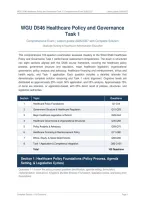
WGU D546 Healthcare Policy and Governance Task 1 | Comprehensive Exam 2026/2027 Latest Update 2026/2027
WGU D546 Healthcare Policy and Governance
Task 1
Comprehensive Exam | Latest Update 2026/2027 with Complete Solution
Graduate Nursing & Healthcare Administration Education
This comprehensive 100-question examination assesses mastery of the WGU D546 Healthcare
Policy and Governance Task 1 performance assessment competencies. The exam is structured
into eight sections aligned with the D546 course framework, covering the healthcare policy
process, government structure and regulation, major healthcare legislation, organizational
governance, policy analysis and advocacy, healthcare financing and reimbursement, ethics and
health equity, and Task 1 application. Each question includes a detailed rationale that
demonstrates complete solution reasoning and Task 1 rubric alignment. Cognitive levels are
distributed as approximately 25% recall, 50% application, and 25% analysis. Approximately 75%
of items are scenario- or application-based, with 25% direct recall of policies, structures, and
legislative authorities.
Section Topic Questions
1 Healthcare Policy Foundations Q1-Q14
2 Government Structure & Healthcare Regulation Q15-Q28
3 Major Healthcare Legislation & Reform Q29-Q44
4 Healthcare Governance & Organizational Structures Q45-Q58
5 Policy Analysis & Advocacy Q59-Q70
6 Healthcare Financing & Reimbursement Policy Q71-Q82
7 Ethics, Equity, & Social Determinants Q83-Q92
8 Task 1 Application & Competency Integration Q93-Q100
Total 100 Questions
Section 1: Healthcare Policy Foundations (Policy Process, Agenda
Setting, & Legislative Cycles)
Questions 1-14 cover the policy process (problem identification, agenda setting, formulation,
implementation, evaluation), Kingdon's Multiple Streams Framework, legislative cycles, and policy brief
foundations.
Complete Solution | 100 Questions Page 1
,WGU D546 Healthcare Policy and Governance Task 1 | Comprehensive Exam 2026/2027 Latest Update 2026/2027
Q1: A nurse in a community hospital notices a steady rise in 30-day readmission rates
among heart failure patients and decides to advocate for a transitional care policy. In the
classical policy process, what is the FIRST step the nurse must complete before any policy
solution can be considered?
A. Draft model legislation and recruit a bill sponsor in the state legislature.
B. Identify and clearly define the problem using credible data and evidence. [CORRECT]
C. Formulate specific policy alternatives and select evaluation criteria.
D. Implement a pilot transitional care program and measure outcomes.
Correct Answer: B
Rationale: Problem identification is the first stage of the policy process; before legislation, formulation, or
implementation can occur, the issue must be clearly defined with credible data. Drafting legislation and
formulation come after the problem is on the agenda, and implementation follows adoption. For WGU
D546 Task 1, the problem statement must be specific, measurable, and contextualized, which is
impossible without first completing problem identification.
Q2: Which policy theory best explains why some healthcare issues (e.g., opioid misuse)
suddenly gain legislative attention while equally serious issues remain ignored for years?
A. Kingdon's Multiple Streams Framework (problem, policy, and political streams
converging at a policy window). [CORRECT]
B. Maslow's Hierarchy of Needs applied to legislators' priorities.
C. Orem's Self-Care Deficit Nursing Theory applied to health systems.
D. Pender's Health Promotion Model applied to voter behavior.
Correct Answer: A
Rationale: Kingdon's Multiple Streams Framework explains agenda setting: a problem stream (e.g., a
crisis or indicator), a policy stream (developed solutions), and a political stream (public mood, elections)
converge at a brief 'policy window,' allowing entrepreneurs to push solutions. Maslow, Orem, and Pender
are nursing or behavioral theories with no explanatory power for legislative agenda setting. Task 1
stakeholders can act as policy entrepreneurs when windows open.
Q3: A healthcare bill has just been introduced in the U.S. Senate. According to the typical
federal legislative cycle, what is the next step?
A. Presidential signature or veto.
B. Conference committee to reconcile House and Senate versions.
C. Committee referral, hearings, and markup. [CORRECT]
D. A floor vote in both chambers.
Correct Answer: C
Rationale: After introduction, bills are referred to the committee of jurisdiction, which holds hearings,
marks up text, and decides whether to report the bill to the floor. Floor votes, conference committees,
and presidential action all occur later in the cycle. Understanding this sequence helps Task 1 analysts
identify where to target advocacy (e.g., committee testimony is often the highest-leverage intervention).
Complete Solution | 100 Questions Page 2
,WGU D546 Healthcare Policy and Governance Task 1 | Comprehensive Exam 2026/2027 Latest Update 2026/2027
Q4: A state task force convenes to address opioid use disorder. Members gather evidence,
review models from other states, draft alternative approaches, and weigh trade-offs before
recommending a specific policy package. Which stage of the policy process does this
represent?
A. Agenda setting.
B. Policy formulation. [CORRECT]
C. Implementation.
D. Evaluation.
Correct Answer: B
Rationale: Policy formulation involves developing, comparing, and refining alternative solutions once a
problem is already on the agenda. Agenda setting precedes formulation; implementation occurs after
adoption; evaluation assesses outcomes after implementation. In Task 1, the analysis section mirrors
formulation by weighing alternatives against explicit criteria.
Q5: After the Affordable Care Act was signed in March 2010, HHS issued regulations, states
built marketplaces, and providers reorganized care. These activities collectively represent
which stage of the policy process?
A. Policy formulation.
B. Policy implementation. [CORRECT]
C. Agenda setting.
D. Problem identification.
Correct Answer: B
Rationale: Implementation is the stage where adopted laws are translated into specific programs,
regulations, and operational actions. The ACA's passage was adoption; HHS rulemaking and
marketplace construction are implementation. Agenda setting and problem identification occurred years
earlier. Task 1 often requires students to assess how implementation realities shape a policy's actual
impact.
Q6: Five years after a state expanded Medicaid, researchers compare uninsured rates,
emergency department utilization, and access to primary care against pre-expansion
baselines. Which type of policy evaluation does this represent?
A. Process evaluation.
B. Outcome / impact evaluation. [CORRECT]
C. Formative evaluation.
D. Needs assessment.
Correct Answer: B
Rationale: Outcome (impact) evaluation measures whether a policy achieved its intended goals and
effects. Process evaluation examines whether implementation activities were carried out as planned;
formative evaluation occurs during development; needs assessment precedes policy formation. Task 1
recommendations should anticipate how outcomes will be evaluated.
Complete Solution | 100 Questions Page 3
, WGU D546 Healthcare Policy and Governance Task 1 | Comprehensive Exam 2026/2027 Latest Update 2026/2027
Q7: A sudden infectious disease outbreak captures national attention and shifts legislative
priorities within weeks. In Kingdon's framework, this is best understood as:
A. A change in the policy stream only.
B. A change in the political stream only.
C. A focusing event in the problem stream that opens a policy window. [CORRECT]
D. An example of incremental budgeting.
Correct Answer: C
Rationale: A focusing event (e.g., pandemic, natural disaster) elevates the problem stream, opening a
policy window that allows prepared entrepreneurs to push ready solutions. The policy stream contains
solutions; the political stream reflects electoral mood. This is punctuated change, not incrementalism.
Task 1 advocates must have evidence and stakeholder relationships ready before windows open.
Q8: A nurse advocates for state legislation establishing minimum nurse-to-patient ratios.
Which stakeholder group would MOST likely OPPOSE such legislation, and why is
identifying them critical for Task 1?
A. The American Nurses Association, because it generally opposes regulation of practice.
B. Hospital administrators and hospital associations, due to concerns about cost and
workforce flexibility. [CORRECT]
C. Patient advocacy organizations, because they oppose patient safety.
D. Nursing unions, because they oppose staffing standards.
Correct Answer: B
Rationale: Hospital administrators and associations typically oppose mandatory staffing ratios citing
cost, workforce shortages, and operational flexibility. ANA, patient advocacy groups, and nursing unions
generally support safe-staffing legislation. Identifying both supporters and opponents, with their interests
and influence, is a required element of Task 1 stakeholder analysis.
Q9: Medicare, financed by payroll taxes on current workers to provide hospital insurance to
elderly and disabled beneficiaries, is best classified as which type of public policy?
A. Distributive policy (broad benefit, no specific cost bearer).
B. Regulatory policy (restricting private behavior).
C. Redistributive policy (transferring resources from one group to another). [CORRECT]
D. Constituent policy (organizing government structure).
Correct Answer: C
Rationale: Redistributive policy transfers resources from one population (workers paying payroll taxes)
to another (elderly/disabled beneficiaries). Distributive policies provide broad benefits without a clear cost
bearer; regulatory policies restrict behavior; constituent policies organize government. Recognizing
policy type informs Task 1 analysis of who wins, who loses, and which political dynamics apply.
Complete Solution | 100 Questions Page 4
WGU D546 Healthcare Policy and Governance
Task 1
Comprehensive Exam | Latest Update 2026/2027 with Complete Solution
Graduate Nursing & Healthcare Administration Education
This comprehensive 100-question examination assesses mastery of the WGU D546 Healthcare
Policy and Governance Task 1 performance assessment competencies. The exam is structured
into eight sections aligned with the D546 course framework, covering the healthcare policy
process, government structure and regulation, major healthcare legislation, organizational
governance, policy analysis and advocacy, healthcare financing and reimbursement, ethics and
health equity, and Task 1 application. Each question includes a detailed rationale that
demonstrates complete solution reasoning and Task 1 rubric alignment. Cognitive levels are
distributed as approximately 25% recall, 50% application, and 25% analysis. Approximately 75%
of items are scenario- or application-based, with 25% direct recall of policies, structures, and
legislative authorities.
Section Topic Questions
1 Healthcare Policy Foundations Q1-Q14
2 Government Structure & Healthcare Regulation Q15-Q28
3 Major Healthcare Legislation & Reform Q29-Q44
4 Healthcare Governance & Organizational Structures Q45-Q58
5 Policy Analysis & Advocacy Q59-Q70
6 Healthcare Financing & Reimbursement Policy Q71-Q82
7 Ethics, Equity, & Social Determinants Q83-Q92
8 Task 1 Application & Competency Integration Q93-Q100
Total 100 Questions
Section 1: Healthcare Policy Foundations (Policy Process, Agenda
Setting, & Legislative Cycles)
Questions 1-14 cover the policy process (problem identification, agenda setting, formulation,
implementation, evaluation), Kingdon's Multiple Streams Framework, legislative cycles, and policy brief
foundations.
Complete Solution | 100 Questions Page 1
,WGU D546 Healthcare Policy and Governance Task 1 | Comprehensive Exam 2026/2027 Latest Update 2026/2027
Q1: A nurse in a community hospital notices a steady rise in 30-day readmission rates
among heart failure patients and decides to advocate for a transitional care policy. In the
classical policy process, what is the FIRST step the nurse must complete before any policy
solution can be considered?
A. Draft model legislation and recruit a bill sponsor in the state legislature.
B. Identify and clearly define the problem using credible data and evidence. [CORRECT]
C. Formulate specific policy alternatives and select evaluation criteria.
D. Implement a pilot transitional care program and measure outcomes.
Correct Answer: B
Rationale: Problem identification is the first stage of the policy process; before legislation, formulation, or
implementation can occur, the issue must be clearly defined with credible data. Drafting legislation and
formulation come after the problem is on the agenda, and implementation follows adoption. For WGU
D546 Task 1, the problem statement must be specific, measurable, and contextualized, which is
impossible without first completing problem identification.
Q2: Which policy theory best explains why some healthcare issues (e.g., opioid misuse)
suddenly gain legislative attention while equally serious issues remain ignored for years?
A. Kingdon's Multiple Streams Framework (problem, policy, and political streams
converging at a policy window). [CORRECT]
B. Maslow's Hierarchy of Needs applied to legislators' priorities.
C. Orem's Self-Care Deficit Nursing Theory applied to health systems.
D. Pender's Health Promotion Model applied to voter behavior.
Correct Answer: A
Rationale: Kingdon's Multiple Streams Framework explains agenda setting: a problem stream (e.g., a
crisis or indicator), a policy stream (developed solutions), and a political stream (public mood, elections)
converge at a brief 'policy window,' allowing entrepreneurs to push solutions. Maslow, Orem, and Pender
are nursing or behavioral theories with no explanatory power for legislative agenda setting. Task 1
stakeholders can act as policy entrepreneurs when windows open.
Q3: A healthcare bill has just been introduced in the U.S. Senate. According to the typical
federal legislative cycle, what is the next step?
A. Presidential signature or veto.
B. Conference committee to reconcile House and Senate versions.
C. Committee referral, hearings, and markup. [CORRECT]
D. A floor vote in both chambers.
Correct Answer: C
Rationale: After introduction, bills are referred to the committee of jurisdiction, which holds hearings,
marks up text, and decides whether to report the bill to the floor. Floor votes, conference committees,
and presidential action all occur later in the cycle. Understanding this sequence helps Task 1 analysts
identify where to target advocacy (e.g., committee testimony is often the highest-leverage intervention).
Complete Solution | 100 Questions Page 2
,WGU D546 Healthcare Policy and Governance Task 1 | Comprehensive Exam 2026/2027 Latest Update 2026/2027
Q4: A state task force convenes to address opioid use disorder. Members gather evidence,
review models from other states, draft alternative approaches, and weigh trade-offs before
recommending a specific policy package. Which stage of the policy process does this
represent?
A. Agenda setting.
B. Policy formulation. [CORRECT]
C. Implementation.
D. Evaluation.
Correct Answer: B
Rationale: Policy formulation involves developing, comparing, and refining alternative solutions once a
problem is already on the agenda. Agenda setting precedes formulation; implementation occurs after
adoption; evaluation assesses outcomes after implementation. In Task 1, the analysis section mirrors
formulation by weighing alternatives against explicit criteria.
Q5: After the Affordable Care Act was signed in March 2010, HHS issued regulations, states
built marketplaces, and providers reorganized care. These activities collectively represent
which stage of the policy process?
A. Policy formulation.
B. Policy implementation. [CORRECT]
C. Agenda setting.
D. Problem identification.
Correct Answer: B
Rationale: Implementation is the stage where adopted laws are translated into specific programs,
regulations, and operational actions. The ACA's passage was adoption; HHS rulemaking and
marketplace construction are implementation. Agenda setting and problem identification occurred years
earlier. Task 1 often requires students to assess how implementation realities shape a policy's actual
impact.
Q6: Five years after a state expanded Medicaid, researchers compare uninsured rates,
emergency department utilization, and access to primary care against pre-expansion
baselines. Which type of policy evaluation does this represent?
A. Process evaluation.
B. Outcome / impact evaluation. [CORRECT]
C. Formative evaluation.
D. Needs assessment.
Correct Answer: B
Rationale: Outcome (impact) evaluation measures whether a policy achieved its intended goals and
effects. Process evaluation examines whether implementation activities were carried out as planned;
formative evaluation occurs during development; needs assessment precedes policy formation. Task 1
recommendations should anticipate how outcomes will be evaluated.
Complete Solution | 100 Questions Page 3
, WGU D546 Healthcare Policy and Governance Task 1 | Comprehensive Exam 2026/2027 Latest Update 2026/2027
Q7: A sudden infectious disease outbreak captures national attention and shifts legislative
priorities within weeks. In Kingdon's framework, this is best understood as:
A. A change in the policy stream only.
B. A change in the political stream only.
C. A focusing event in the problem stream that opens a policy window. [CORRECT]
D. An example of incremental budgeting.
Correct Answer: C
Rationale: A focusing event (e.g., pandemic, natural disaster) elevates the problem stream, opening a
policy window that allows prepared entrepreneurs to push ready solutions. The policy stream contains
solutions; the political stream reflects electoral mood. This is punctuated change, not incrementalism.
Task 1 advocates must have evidence and stakeholder relationships ready before windows open.
Q8: A nurse advocates for state legislation establishing minimum nurse-to-patient ratios.
Which stakeholder group would MOST likely OPPOSE such legislation, and why is
identifying them critical for Task 1?
A. The American Nurses Association, because it generally opposes regulation of practice.
B. Hospital administrators and hospital associations, due to concerns about cost and
workforce flexibility. [CORRECT]
C. Patient advocacy organizations, because they oppose patient safety.
D. Nursing unions, because they oppose staffing standards.
Correct Answer: B
Rationale: Hospital administrators and associations typically oppose mandatory staffing ratios citing
cost, workforce shortages, and operational flexibility. ANA, patient advocacy groups, and nursing unions
generally support safe-staffing legislation. Identifying both supporters and opponents, with their interests
and influence, is a required element of Task 1 stakeholder analysis.
Q9: Medicare, financed by payroll taxes on current workers to provide hospital insurance to
elderly and disabled beneficiaries, is best classified as which type of public policy?
A. Distributive policy (broad benefit, no specific cost bearer).
B. Regulatory policy (restricting private behavior).
C. Redistributive policy (transferring resources from one group to another). [CORRECT]
D. Constituent policy (organizing government structure).
Correct Answer: C
Rationale: Redistributive policy transfers resources from one population (workers paying payroll taxes)
to another (elderly/disabled beneficiaries). Distributive policies provide broad benefits without a clear cost
bearer; regulatory policies restrict behavior; constituent policies organize government. Recognizing
policy type informs Task 1 analysis of who wins, who loses, and which political dynamics apply.
Complete Solution | 100 Questions Page 4


