
WGU D184 Standards-Based Assessment | 90 Q&A | 2026/2027 Update
WGU D184 Standards-Based Assessment
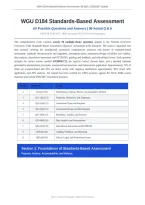
All Possible Questions and Answers | 90 Actual Q & A
UPDATE 2026/2027 | 100% Accurate | WGU D184 OA Preparation
This comprehensive exam contains exactly 90 multiple-choice questions aligned to the Western Governors
University D184 Standards-Based Assessment Objective Assessment (OA) blueprint. The exam is organized into
nine sections covering the foundational assessment competencies: purposes and history of standards-based
assessment, standards deconstruction and alignment, assessment types, assessment design, reliability and validity,
data analysis, data-driven instruction and RTI/MTSS, grading and feedback, and ethical/legal issues. Each question
includes the correct answer marked [CORRECT], the explicit Correct Answer letter, and a detailed rationale
grounded in measurement principles, assessment best practices, and instructional application. Approximately 75% of
items are scenario-based and 25% are direct recall, with cognitive distribution approximately 30% recall, 50%
application, and 20% analysis. All content has been verified for 100% accuracy against the WGU D184 course
materials and current 2026/2027 assessment practices.
Section Questions Focus
1 Q1-Q10 (10) Foundations: Purpose, History, Accountability, Reform
2 Q11-Q22 (12) Standards, Objectives, and Alignment
3 Q23-Q34 (12) Assessment Types and Purposes
4 Q35-Q46 (12) Assessment Design and Development
5 Q47-Q58 (12) Reliability, Validity, and Fairness
6 Q59-Q68 (10) Data Analysis and Interpretation
7 Q69-Q78 (10) Data-Driven Instruction and RTI/MTSS
8 Q79-Q84 (6) Grading, Feedback, and Reporting
9 Q85-Q90 (6) Ethical, Legal, and Professional Issues
Section 1: Foundations of Standards-Based Assessment
Purpose, History, Accountability, and Reform
Page 1 | D184 OA Preparation | 100% Verified Accurate
, WGU D184 Standards-Based Assessment | 90 Q&A | 2026/2027 Update
Q1: A third-grade teacher uses exit tickets at the end of each math lesson to determine which students need
additional support the next day. This practice primarily reflects which purpose of assessment?
A. Assessment OF learning, because the teacher is evaluating mastery of the standard.
B. Assessment FOR learning, because the results are used to adjust instruction. [CORRECT]
C. Assessment AS learning, because students self-assess their own understanding.
D. Assessment OF learning, because the data will be entered into the gradebook.
Correct Answer: B
Rationale: Assessment FOR learning (formative assessment) uses evidence of student learning to inform and
adjust instruction while learning is still occurring. The exit ticket provides immediate data the teacher uses the
next day to differentiate support, which is the defining feature of assessment FOR learning. Assessment OF
learning is summative and certifies mastery at the end of a cycle, not during it. Assessment AS learning
requires the student to actively monitor and reflect on their own progress, which is not described here. The data
is not graded, so the gradebook rationale is also incorrect.
Q2: Which legislative act most directly shifted federal accountability toward state-developed college- and
career-ready standards and required annual statewide assessments in grades 3-8 and once in high school?
A. Individuals with Disabilities Education Act (IDEA)
B. Every Student Succeeds Act (ESSA)
C. No Child Left Behind (NCLB) [CORRECT]
D. Title I of the Elementary and Secondary Education Act (ESEA) of 1965
Correct Answer: C
Rationale: No Child Left Behind (NCLB, 2001) was the legislation that mandated annual statewide
assessments in reading and mathematics for all students in grades 3-8 and once in high school, with strict
Adequate Yearly Progress (AYP) accountability tied to proficiency. IDEA governs special education services,
not general accountability testing. ESSA (2015) maintained the testing requirement but gave states more
flexibility in accountability design. The original ESEA of 1965 established Title I funding but did not mandate
the annual grade-span testing structure that defined NCLB-era accountability.
Q3: Under ESSA, states must include a non-academic indicator in their accountability systems. Which of the
following best represents an allowable non-academic indicator under ESSA?
A. School climate, student engagement, or advanced coursework completion. [CORRECT]
B. Teacher value-added scores used for compensation decisions.
C. Norm-referenced IQ scores for all enrolled students.
D. Final course grades from individual teachers without standardization.
Correct Answer: A
Rationale: ESSA explicitly requires at least one non-academic indicator of school quality or student success,
such as school climate, student engagement, chronic absenteeism, advanced coursework completion, or
post-secondary readiness. Teacher value-added scores are personnel evaluations, not a state-level
accountability indicator. Norm-referenced IQ testing of all students is neither required nor appropriate under
ESSA, and unstandardized teacher grades lack the comparability required for accountability. School climate
and engagement indicators are the canonical examples listed in ESSA's accountability framework.
Page 2 | D184 OA Preparation | 100% Verified Accurate
, WGU D184 Standards-Based Assessment | 90 Q&A | 2026/2027 Update
Q4: A high school English teacher asks students to keep a learning portfolio where they reflect on their writing
growth, set goals, and select pieces to revise. This approach best exemplifies:
A. Assessment OF learning, because the portfolio is a graded final product.
B. Assessment FOR learning, because the teacher uses it to plan next lessons.
C. Assessment AS learning, because students monitor and direct their own progress. [CORRECT]
D. Summative benchmark assessment, because it documents performance at intervals.
Correct Answer: C
Rationale: Assessment AS learning occurs when students actively monitor their own learning, set goals,
reflect on progress, and use feedback to direct their next steps. The student-led portfolio with self-reflection,
goal-setting, and revision choices directly matches this definition. Assessment OF learning would position the
teacher as the sole evaluator of a finished product, and assessment FOR learning would emphasize the teacher
using data to plan instruction. A benchmark assessment is an interim measure of progress at fixed intervals, not
a continuous self-monitoring tool.
Q5: Which statement best summarizes the historical shift from NCLB to ESSA regarding state accountability
systems?
A. ESSA eliminated all state-level testing requirements.
B. ESSA maintained the testing schedule but gave states flexibility in how accountability is designed and what
indicators are used. [CORRECT]
C. ESSA replaced state tests with national norm-referenced assessments.
D. ESSA transferred accountability from states to local school districts entirely.
Correct Answer: B
Rationale: ESSA preserved NCLB's testing framework (annual assessments in grades 3-8 and once in high
school) but significantly increased state flexibility in designing accountability systems, including the use of
multiple indicators, the addition of a non-academic indicator, and the elimination of federal prescriptive
interventions like AYP. ESSA did not eliminate testing, did not impose national norm-referenced tests, and did
not remove state-level accountability in favor of purely local control. The defining change was flexibility
within the testing framework, not its removal.
Q6: A district is selecting a new state-aligned assessment system. The assessment director argues that the system
must produce results teachers can use to adjust instruction within days of administration. Which type of assessment is
the director prioritizing?
A. Summative state assessment, because it provides accountability data.
B. Norm-referenced aptitude test, because it compares students nationally.
C. Interim/benchmark assessment with quick turnaround and instructional reports. [CORRECT]
D. Diagnostic placement test given only at the start of the school year.
Correct Answer: C
Rationale: Interim or benchmark assessments are designed to provide actionable instructional data at regular
intervals with rapid turnaround, allowing teachers to adjust instruction mid-cycle. The director's emphasis on
days-of turnaround and instructional use directly matches this purpose. A summative state assessment typically
produces results months later, often after the school year ends, making it unusable for mid-course adjustment.
A norm-referenced aptitude test measures general ability rather than standards-aligned learning, and a one-time
placement test cannot support ongoing instructional decisions across the year.
Page 3 | D184 OA Preparation | 100% Verified Accurate
, WGU D184 Standards-Based Assessment | 90 Q&A | 2026/2027 Update
Q7: The standards-based reform movement of the 1990s was built on three interrelated pillars. Which set correctly
identifies these pillars?
A. High standards, aligned assessments, and accountability for results. [CORRECT]
B. Teacher evaluation, merit pay, and school choice.
C. Reduced class size, longer school day, and expanded pre-K.
D. National curriculum, federal textbooks, and centralized teacher training.
Correct Answer: A
Rationale: The standards-based reform movement rests on three pillars: (1) rigorous content standards
defining what students should know and be able to do, (2) assessments aligned to those standards, and (3)
accountability systems that hold schools responsible for results. The other options describe unrelated policy
interventions (merit pay, class size reduction, or a centralized federal curriculum that the U.S. system explicitly
avoided). The three-pillar framework was articulated in reform documents of the 1990s and codified in NCLB
in 2001.
Q8: A parent asks why the school uses both a state summative assessment and classroom formative assessments. The
most accurate explanation is that:
A. State tests replace classroom assessments, so the parent should disregard teacher data.
B. The two assessments serve different purposes: state tests measure program accountability while classroom
formative assessments guide daily instruction. [CORRECT]
C. Both assessments are equivalent and used to assign student grades.
D. State tests are designed to evaluate teachers, while classroom assessments evaluate students.
Correct Answer: B
Rationale: State summative assessments and classroom formative assessments serve complementary but
distinct purposes. State tests provide program-level accountability and system monitoring across schools and
districts. Classroom formative assessments generate immediate, instructionally actionable data that teachers
use to differentiate and adjust instruction while learning is still occurring. They are not interchangeable, are not
both used to assign grades, and state tests are not designed as individual teacher evaluation tools under federal
law.
Q9: A teacher is preparing students for the state accountability assessment. Which of the following practices would
be considered ethically inappropriate under professional assessment standards?
A. Using released items from prior years to familiarize students with the test format.
B. Reviewing the blueprint to ensure instruction covers all tested standards.
C. Coaching students to memorize the specific correct answers to current secure test items. [CORRECT]
D. Teaching test-taking strategies that students can generalize to any assessment.
Correct Answer: C
Rationale: Coaching students to memorize the specific correct answers to current secure test items violates
test security and professional standards because it artificially inflates scores and invalidates the inferences
drawn from them. Using released items is explicitly permitted because they are non-secure. Aligning
instruction to the published blueprint is sound standards-based practice. Teaching generalizable test-taking
strategies supports valid assessment. Only memorizing secure answers compromises the integrity and validity
of the assessment results.
Page 4 | D184 OA Preparation | 100% Verified Accurate
WGU D184 Standards-Based Assessment
All Possible Questions and Answers | 90 Actual Q & A
UPDATE 2026/2027 | 100% Accurate | WGU D184 OA Preparation
This comprehensive exam contains exactly 90 multiple-choice questions aligned to the Western Governors
University D184 Standards-Based Assessment Objective Assessment (OA) blueprint. The exam is organized into
nine sections covering the foundational assessment competencies: purposes and history of standards-based
assessment, standards deconstruction and alignment, assessment types, assessment design, reliability and validity,
data analysis, data-driven instruction and RTI/MTSS, grading and feedback, and ethical/legal issues. Each question
includes the correct answer marked [CORRECT], the explicit Correct Answer letter, and a detailed rationale
grounded in measurement principles, assessment best practices, and instructional application. Approximately 75% of
items are scenario-based and 25% are direct recall, with cognitive distribution approximately 30% recall, 50%
application, and 20% analysis. All content has been verified for 100% accuracy against the WGU D184 course
materials and current 2026/2027 assessment practices.
Section Questions Focus
1 Q1-Q10 (10) Foundations: Purpose, History, Accountability, Reform
2 Q11-Q22 (12) Standards, Objectives, and Alignment
3 Q23-Q34 (12) Assessment Types and Purposes
4 Q35-Q46 (12) Assessment Design and Development
5 Q47-Q58 (12) Reliability, Validity, and Fairness
6 Q59-Q68 (10) Data Analysis and Interpretation
7 Q69-Q78 (10) Data-Driven Instruction and RTI/MTSS
8 Q79-Q84 (6) Grading, Feedback, and Reporting
9 Q85-Q90 (6) Ethical, Legal, and Professional Issues
Section 1: Foundations of Standards-Based Assessment
Purpose, History, Accountability, and Reform
Page 1 | D184 OA Preparation | 100% Verified Accurate
, WGU D184 Standards-Based Assessment | 90 Q&A | 2026/2027 Update
Q1: A third-grade teacher uses exit tickets at the end of each math lesson to determine which students need
additional support the next day. This practice primarily reflects which purpose of assessment?
A. Assessment OF learning, because the teacher is evaluating mastery of the standard.
B. Assessment FOR learning, because the results are used to adjust instruction. [CORRECT]
C. Assessment AS learning, because students self-assess their own understanding.
D. Assessment OF learning, because the data will be entered into the gradebook.
Correct Answer: B
Rationale: Assessment FOR learning (formative assessment) uses evidence of student learning to inform and
adjust instruction while learning is still occurring. The exit ticket provides immediate data the teacher uses the
next day to differentiate support, which is the defining feature of assessment FOR learning. Assessment OF
learning is summative and certifies mastery at the end of a cycle, not during it. Assessment AS learning
requires the student to actively monitor and reflect on their own progress, which is not described here. The data
is not graded, so the gradebook rationale is also incorrect.
Q2: Which legislative act most directly shifted federal accountability toward state-developed college- and
career-ready standards and required annual statewide assessments in grades 3-8 and once in high school?
A. Individuals with Disabilities Education Act (IDEA)
B. Every Student Succeeds Act (ESSA)
C. No Child Left Behind (NCLB) [CORRECT]
D. Title I of the Elementary and Secondary Education Act (ESEA) of 1965
Correct Answer: C
Rationale: No Child Left Behind (NCLB, 2001) was the legislation that mandated annual statewide
assessments in reading and mathematics for all students in grades 3-8 and once in high school, with strict
Adequate Yearly Progress (AYP) accountability tied to proficiency. IDEA governs special education services,
not general accountability testing. ESSA (2015) maintained the testing requirement but gave states more
flexibility in accountability design. The original ESEA of 1965 established Title I funding but did not mandate
the annual grade-span testing structure that defined NCLB-era accountability.
Q3: Under ESSA, states must include a non-academic indicator in their accountability systems. Which of the
following best represents an allowable non-academic indicator under ESSA?
A. School climate, student engagement, or advanced coursework completion. [CORRECT]
B. Teacher value-added scores used for compensation decisions.
C. Norm-referenced IQ scores for all enrolled students.
D. Final course grades from individual teachers without standardization.
Correct Answer: A
Rationale: ESSA explicitly requires at least one non-academic indicator of school quality or student success,
such as school climate, student engagement, chronic absenteeism, advanced coursework completion, or
post-secondary readiness. Teacher value-added scores are personnel evaluations, not a state-level
accountability indicator. Norm-referenced IQ testing of all students is neither required nor appropriate under
ESSA, and unstandardized teacher grades lack the comparability required for accountability. School climate
and engagement indicators are the canonical examples listed in ESSA's accountability framework.
Page 2 | D184 OA Preparation | 100% Verified Accurate
, WGU D184 Standards-Based Assessment | 90 Q&A | 2026/2027 Update
Q4: A high school English teacher asks students to keep a learning portfolio where they reflect on their writing
growth, set goals, and select pieces to revise. This approach best exemplifies:
A. Assessment OF learning, because the portfolio is a graded final product.
B. Assessment FOR learning, because the teacher uses it to plan next lessons.
C. Assessment AS learning, because students monitor and direct their own progress. [CORRECT]
D. Summative benchmark assessment, because it documents performance at intervals.
Correct Answer: C
Rationale: Assessment AS learning occurs when students actively monitor their own learning, set goals,
reflect on progress, and use feedback to direct their next steps. The student-led portfolio with self-reflection,
goal-setting, and revision choices directly matches this definition. Assessment OF learning would position the
teacher as the sole evaluator of a finished product, and assessment FOR learning would emphasize the teacher
using data to plan instruction. A benchmark assessment is an interim measure of progress at fixed intervals, not
a continuous self-monitoring tool.
Q5: Which statement best summarizes the historical shift from NCLB to ESSA regarding state accountability
systems?
A. ESSA eliminated all state-level testing requirements.
B. ESSA maintained the testing schedule but gave states flexibility in how accountability is designed and what
indicators are used. [CORRECT]
C. ESSA replaced state tests with national norm-referenced assessments.
D. ESSA transferred accountability from states to local school districts entirely.
Correct Answer: B
Rationale: ESSA preserved NCLB's testing framework (annual assessments in grades 3-8 and once in high
school) but significantly increased state flexibility in designing accountability systems, including the use of
multiple indicators, the addition of a non-academic indicator, and the elimination of federal prescriptive
interventions like AYP. ESSA did not eliminate testing, did not impose national norm-referenced tests, and did
not remove state-level accountability in favor of purely local control. The defining change was flexibility
within the testing framework, not its removal.
Q6: A district is selecting a new state-aligned assessment system. The assessment director argues that the system
must produce results teachers can use to adjust instruction within days of administration. Which type of assessment is
the director prioritizing?
A. Summative state assessment, because it provides accountability data.
B. Norm-referenced aptitude test, because it compares students nationally.
C. Interim/benchmark assessment with quick turnaround and instructional reports. [CORRECT]
D. Diagnostic placement test given only at the start of the school year.
Correct Answer: C
Rationale: Interim or benchmark assessments are designed to provide actionable instructional data at regular
intervals with rapid turnaround, allowing teachers to adjust instruction mid-cycle. The director's emphasis on
days-of turnaround and instructional use directly matches this purpose. A summative state assessment typically
produces results months later, often after the school year ends, making it unusable for mid-course adjustment.
A norm-referenced aptitude test measures general ability rather than standards-aligned learning, and a one-time
placement test cannot support ongoing instructional decisions across the year.
Page 3 | D184 OA Preparation | 100% Verified Accurate
, WGU D184 Standards-Based Assessment | 90 Q&A | 2026/2027 Update
Q7: The standards-based reform movement of the 1990s was built on three interrelated pillars. Which set correctly
identifies these pillars?
A. High standards, aligned assessments, and accountability for results. [CORRECT]
B. Teacher evaluation, merit pay, and school choice.
C. Reduced class size, longer school day, and expanded pre-K.
D. National curriculum, federal textbooks, and centralized teacher training.
Correct Answer: A
Rationale: The standards-based reform movement rests on three pillars: (1) rigorous content standards
defining what students should know and be able to do, (2) assessments aligned to those standards, and (3)
accountability systems that hold schools responsible for results. The other options describe unrelated policy
interventions (merit pay, class size reduction, or a centralized federal curriculum that the U.S. system explicitly
avoided). The three-pillar framework was articulated in reform documents of the 1990s and codified in NCLB
in 2001.
Q8: A parent asks why the school uses both a state summative assessment and classroom formative assessments. The
most accurate explanation is that:
A. State tests replace classroom assessments, so the parent should disregard teacher data.
B. The two assessments serve different purposes: state tests measure program accountability while classroom
formative assessments guide daily instruction. [CORRECT]
C. Both assessments are equivalent and used to assign student grades.
D. State tests are designed to evaluate teachers, while classroom assessments evaluate students.
Correct Answer: B
Rationale: State summative assessments and classroom formative assessments serve complementary but
distinct purposes. State tests provide program-level accountability and system monitoring across schools and
districts. Classroom formative assessments generate immediate, instructionally actionable data that teachers
use to differentiate and adjust instruction while learning is still occurring. They are not interchangeable, are not
both used to assign grades, and state tests are not designed as individual teacher evaluation tools under federal
law.
Q9: A teacher is preparing students for the state accountability assessment. Which of the following practices would
be considered ethically inappropriate under professional assessment standards?
A. Using released items from prior years to familiarize students with the test format.
B. Reviewing the blueprint to ensure instruction covers all tested standards.
C. Coaching students to memorize the specific correct answers to current secure test items. [CORRECT]
D. Teaching test-taking strategies that students can generalize to any assessment.
Correct Answer: C
Rationale: Coaching students to memorize the specific correct answers to current secure test items violates
test security and professional standards because it artificially inflates scores and invalidates the inferences
drawn from them. Using released items is explicitly permitted because they are non-secure. Aligning
instruction to the published blueprint is sound standards-based practice. Teaching generalizable test-taking
strategies supports valid assessment. Only memorizing secure answers compromises the integrity and validity
of the assessment results.
Page 4 | D184 OA Preparation | 100% Verified Accurate


