
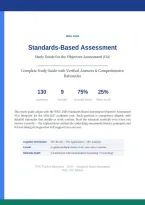
WGU D184
Standards-Based Assessment
Study Guide for the Objective Assessment (OA)
Complete Study Guide with Verified Answers & Comprehensive
Rationales
130 9 75% 25%
Questions Sections Scenario-based Direct recall
This study guide aligns with the WGU D184 Standards-Based Assessment Objective Assessment
(OA) blueprint for the 2026-2027 academic year. Each question is competency-aligned, with
detailed rationales that double as study content. Read the rationale carefully even when you
answer correctly — the explanations contain the underlying assessment-literacy principles and
OA test-taking strategies that will support your success.
Cognitive Distribution 30% Recall | 50% Application | 20% Analysis
Format 4-option multiple choice (A-D), one correct answer
Rationale Depth 3-4 sentences with measurement reasoning + OA strategy
WGU Teacher Education • D184 • Standards-Based Assessment
Edition
,WGU D184 — Standards-Based Assessment OA Study Guide 2026/2027
Section 1: Foundations of Standards-Based Assessment
Purpose, History, Accountability, and Educational Reform | Questions 1–15
Q1: Ms. Alvarez, a 4th grade teacher, designs an end-of-unit science test primarily to assign
report-card grades that summarize what students have learned after completing a
three-week unit on ecosystems. Which assessment purpose BEST describes her use of the
test?
A. Assessment AS learning, because students reflect on their own understanding of
ecosystems.
B. Assessment FOR learning, because the teacher will use the data to plan the next unit.
C. Assessment OF learning, because the test certifies achievement at the end of instruction.
[CORRECT]
D. Assessment AS learning, because peers will score each other's responses using a rubric.
Correct Answer: C
Rationale: Assessment OF learning is summative in nature and is used to certify or document
what a student knows at a point in time — exactly what Ms. Alvarez is doing when she uses an
end-of-unit test to assign report-card grades. Assessment FOR learning is formative and informs
instruction DURING teaching (B is wrong). Assessment AS learning involves students acting as
their own assessors through self-monitoring and reflection (A and D are wrong). OA test-taking
tip: when the stem signals 'end of unit,' 'report-card grades,' or 'certify achievement,' the answer is
almost always Assessment OF learning.
Q2: A district curriculum director explains to new teachers that the upcoming state math
assessment exists primarily to comply with federal accountability requirements under
ESSA. Which historical legislative milestone FIRST established the federal expectation that
all public schools annually test students in reading and math in grades 3-8 and once in high
school?
A. The Elementary and Secondary Education Act (ESEA) of 1965, which originally created
Title I funding.
B. The Individuals with Disabilities Education Act (IDEA) of 1975, which mandated
individualized education programs.
C. The No Child Left Behind Act (NCLB) of 2001, which required annual testing in grades 3-8
and once in high school. [CORRECT]
D. The Every Student Succeeds Act (ESSA) of 2015, which first introduced state-level
accountability systems.
Correct Answer: C
Rationale: NCLB (2001) is the legislation that FIRST mandated annual statewide testing in reading
and mathematics for all students in grades 3-8 and once during high school, plus science
assessments at three grade levels. ESEA (1965) created Title I funding but did not mandate annual
testing (A is wrong). IDEA (1975) focused on disabilities and IEPs (B is wrong). ESSA (2015)
maintained NCLB's testing requirements but gave states more flexibility in accountability design
— it did not introduce annual testing for the first time (D is wrong). OA study note: NCLB =
mandates; ESSA = flexibility.
Page 2
,WGU D184 — Standards-Based Assessment OA Study Guide 2026/2027
Q3: A teacher uses exit tickets daily, reviews them that evening, and adjusts the next day's
lesson based on what the tickets reveal. This daily cycle is the hallmark of which assessment
purpose, and which theorist is most associated with formalizing the formative/summative
distinction that frames this practice?
A. Assessment OF learning; Benjamin Bloom.
B. Assessment FOR learning; Michael Scriven. [CORRECT]
C. Assessment AS learning; Ralph Tyler.
D. Assessment FOR learning; Robert Linn.
Correct Answer: B
Rationale: Michael Scriven (1967) first introduced the formative/summative distinction, and the
daily exit-ticket cycle — adjust instruction based on evidence — is the textbook example of
assessment FOR learning (formative). Bloom is associated with the Taxonomy of Educational
Objectives, not the formative/summative distinction (A is wrong). Tyler is linked to
objective-based curriculum and evaluation (C is wrong). Linn is a measurement scholar but is not
the originator of the formative/summative terminology (D is wrong). OA tip: pair 'adjust
instruction in real time' with 'Scriven' and 'Assessment FOR learning.'
Q4: Under ESSA (2017 reauthorization forward), states must include at least one
non-academic indicator in their accountability systems. A state selects 'chronic
absenteeism' as one such indicator. Which ESSA accountability category does this best
represent?
A. Academic achievement indicator, because attendance correlates with test scores.
B. School quality or student success indicator. [CORRECT]
C. English-language proficiency indicator, because absent students miss language
instruction.
D. Long-term growth indicator, because attendance patterns develop over multiple years.
Correct Answer: B
Rationale: ESSA requires states to include a 'school quality or student success' (SQSS) indicator
that is non-academic in nature — chronic absenteeism, school climate, advanced coursework
access, or chronic discipline are common examples. Academic achievement indicators are
limited to proficiency on state assessments (A is wrong). English-language proficiency is its own
separate required indicator measuring progress toward English mastery (C is wrong). Growth is a
separate required indicator measured by longitudinal assessment data, not attendance (D is
wrong). OA study note: ESSA's 5 required indicators = academic achievement, academic growth,
English proficiency, graduation rate, AND at least one SQSS indicator.
Q5: A high school implements a 'data wall' where teachers collaboratively examine interim
assessment results every six weeks, identify students needing intervention, and assign them
to targeted small groups. This practice reflects the standards-based reform movement's
emphasis on which core principle?
A. Assessment data should be used to label and sort students for tracked programs.
B. All students can learn to high standards, and assessment data should drive instructional
responses that ensure that learning. [CORRECT]
C. State assessments should primarily serve as gatekeepers for grade promotion.
D. Accountability should focus on inputs (funding, staffing) rather than student outcomes.
Correct Answer: B
Page 3
, WGU D184 — Standards-Based Assessment OA Study Guide 2026/2027
Rationale: The standards-based reform movement rests on the belief that virtually all students
can reach high academic standards when given adequate time and support, and that assessment
data must inform instructional responses (intervention, reteaching, enrichment). The data-wall
practice embodies this principle. Sorting students into permanent tracks contradicts the equity
premise (A is wrong). Gatekeeping-grade-promotion tests reflect older accountability models, not
standards-based reform (C is wrong). The movement shifted accountability toward outcomes, not
inputs (D is wrong). OA tip: look for the response-to-data loop — that signals standards-based
reform.
Q6: A principal argues: 'Since NCLB required 100% proficiency by 2014 and that goal was not
met, federal accountability under ESSA is now purely voluntary.' Which response BEST
corrects the principal's misunderstanding?
A. 'ESSA eliminated state testing requirements entirely, so testing is now voluntary.'
B. 'ESSA kept mandatory annual testing and state accountability systems, but removed the
unrealistic 100% proficiency goal and gave states flexibility in setting long-term goals.'
[CORRECT]
C. 'ESSA transferred accountability to local districts, so states no longer need an
accountability plan.'
D. 'ESSA made accountability voluntary only for schools identified as low-performing.'
Correct Answer: B
Rationale: ESSA did NOT eliminate testing or accountability — it kept NCLB's annual testing
requirements and continued to require state accountability systems, but it removed the
unrealistic 100%-proficiency-by-2014 deadline and gave states flexibility to set their own
ambitious long-term goals and choose interventions for low-performing schools. A is wrong
because annual testing remains mandatory. C is wrong because accountability remains at the
state level via state plans submitted to the U.S. Department of Education. D is wrong because
accountability applies to all Title I schools, not just low-performing ones. OA memory hook:
NCLB = rigid federal; ESSA = state flexibility with federal guardrails.
Q7: Which historical figure is widely credited with proposing the original framework that
distinguished formative evaluation (used to improve a program while it is being developed)
from summative evaluation (used to judge its final worth)?
A. Lee Cronbach, in his work on internal consistency reliability.
B. Michael Scriven, in his 1967 chapter 'The Methodology of Evaluation.' [CORRECT]
C. Benjamin Bloom, in his 1956 Taxonomy of Educational Objectives.
D. Ralph Tyler, in his 1949 Basic Principles of Curriculum and Instruction.
Correct Answer: B
Rationale: Michael Scriven introduced the formative/summative distinction in 1967 in 'The
Methodology of Evaluation,' originally in the context of curriculum evaluation; Bloom and others
later extended it to student assessment. Cronbach is associated with coefficient alpha and
internal consistency reliability (A is wrong). Bloom's 1956 work is the Taxonomy, which classifies
cognitive levels (C is wrong). Tyler is the father of objective-based curriculum evaluation but did
not coin the formative/summative distinction (D is wrong). OA trivia: this question shows up
nearly every cycle — memorize Scriven 1967.
Page 4
Standards-Based Assessment
Study Guide for the Objective Assessment (OA)
Complete Study Guide with Verified Answers & Comprehensive
Rationales
130 9 75% 25%
Questions Sections Scenario-based Direct recall
This study guide aligns with the WGU D184 Standards-Based Assessment Objective Assessment
(OA) blueprint for the 2026-2027 academic year. Each question is competency-aligned, with
detailed rationales that double as study content. Read the rationale carefully even when you
answer correctly — the explanations contain the underlying assessment-literacy principles and
OA test-taking strategies that will support your success.
Cognitive Distribution 30% Recall | 50% Application | 20% Analysis
Format 4-option multiple choice (A-D), one correct answer
Rationale Depth 3-4 sentences with measurement reasoning + OA strategy
WGU Teacher Education • D184 • Standards-Based Assessment
Edition
,WGU D184 — Standards-Based Assessment OA Study Guide 2026/2027
Section 1: Foundations of Standards-Based Assessment
Purpose, History, Accountability, and Educational Reform | Questions 1–15
Q1: Ms. Alvarez, a 4th grade teacher, designs an end-of-unit science test primarily to assign
report-card grades that summarize what students have learned after completing a
three-week unit on ecosystems. Which assessment purpose BEST describes her use of the
test?
A. Assessment AS learning, because students reflect on their own understanding of
ecosystems.
B. Assessment FOR learning, because the teacher will use the data to plan the next unit.
C. Assessment OF learning, because the test certifies achievement at the end of instruction.
[CORRECT]
D. Assessment AS learning, because peers will score each other's responses using a rubric.
Correct Answer: C
Rationale: Assessment OF learning is summative in nature and is used to certify or document
what a student knows at a point in time — exactly what Ms. Alvarez is doing when she uses an
end-of-unit test to assign report-card grades. Assessment FOR learning is formative and informs
instruction DURING teaching (B is wrong). Assessment AS learning involves students acting as
their own assessors through self-monitoring and reflection (A and D are wrong). OA test-taking
tip: when the stem signals 'end of unit,' 'report-card grades,' or 'certify achievement,' the answer is
almost always Assessment OF learning.
Q2: A district curriculum director explains to new teachers that the upcoming state math
assessment exists primarily to comply with federal accountability requirements under
ESSA. Which historical legislative milestone FIRST established the federal expectation that
all public schools annually test students in reading and math in grades 3-8 and once in high
school?
A. The Elementary and Secondary Education Act (ESEA) of 1965, which originally created
Title I funding.
B. The Individuals with Disabilities Education Act (IDEA) of 1975, which mandated
individualized education programs.
C. The No Child Left Behind Act (NCLB) of 2001, which required annual testing in grades 3-8
and once in high school. [CORRECT]
D. The Every Student Succeeds Act (ESSA) of 2015, which first introduced state-level
accountability systems.
Correct Answer: C
Rationale: NCLB (2001) is the legislation that FIRST mandated annual statewide testing in reading
and mathematics for all students in grades 3-8 and once during high school, plus science
assessments at three grade levels. ESEA (1965) created Title I funding but did not mandate annual
testing (A is wrong). IDEA (1975) focused on disabilities and IEPs (B is wrong). ESSA (2015)
maintained NCLB's testing requirements but gave states more flexibility in accountability design
— it did not introduce annual testing for the first time (D is wrong). OA study note: NCLB =
mandates; ESSA = flexibility.
Page 2
,WGU D184 — Standards-Based Assessment OA Study Guide 2026/2027
Q3: A teacher uses exit tickets daily, reviews them that evening, and adjusts the next day's
lesson based on what the tickets reveal. This daily cycle is the hallmark of which assessment
purpose, and which theorist is most associated with formalizing the formative/summative
distinction that frames this practice?
A. Assessment OF learning; Benjamin Bloom.
B. Assessment FOR learning; Michael Scriven. [CORRECT]
C. Assessment AS learning; Ralph Tyler.
D. Assessment FOR learning; Robert Linn.
Correct Answer: B
Rationale: Michael Scriven (1967) first introduced the formative/summative distinction, and the
daily exit-ticket cycle — adjust instruction based on evidence — is the textbook example of
assessment FOR learning (formative). Bloom is associated with the Taxonomy of Educational
Objectives, not the formative/summative distinction (A is wrong). Tyler is linked to
objective-based curriculum and evaluation (C is wrong). Linn is a measurement scholar but is not
the originator of the formative/summative terminology (D is wrong). OA tip: pair 'adjust
instruction in real time' with 'Scriven' and 'Assessment FOR learning.'
Q4: Under ESSA (2017 reauthorization forward), states must include at least one
non-academic indicator in their accountability systems. A state selects 'chronic
absenteeism' as one such indicator. Which ESSA accountability category does this best
represent?
A. Academic achievement indicator, because attendance correlates with test scores.
B. School quality or student success indicator. [CORRECT]
C. English-language proficiency indicator, because absent students miss language
instruction.
D. Long-term growth indicator, because attendance patterns develop over multiple years.
Correct Answer: B
Rationale: ESSA requires states to include a 'school quality or student success' (SQSS) indicator
that is non-academic in nature — chronic absenteeism, school climate, advanced coursework
access, or chronic discipline are common examples. Academic achievement indicators are
limited to proficiency on state assessments (A is wrong). English-language proficiency is its own
separate required indicator measuring progress toward English mastery (C is wrong). Growth is a
separate required indicator measured by longitudinal assessment data, not attendance (D is
wrong). OA study note: ESSA's 5 required indicators = academic achievement, academic growth,
English proficiency, graduation rate, AND at least one SQSS indicator.
Q5: A high school implements a 'data wall' where teachers collaboratively examine interim
assessment results every six weeks, identify students needing intervention, and assign them
to targeted small groups. This practice reflects the standards-based reform movement's
emphasis on which core principle?
A. Assessment data should be used to label and sort students for tracked programs.
B. All students can learn to high standards, and assessment data should drive instructional
responses that ensure that learning. [CORRECT]
C. State assessments should primarily serve as gatekeepers for grade promotion.
D. Accountability should focus on inputs (funding, staffing) rather than student outcomes.
Correct Answer: B
Page 3
, WGU D184 — Standards-Based Assessment OA Study Guide 2026/2027
Rationale: The standards-based reform movement rests on the belief that virtually all students
can reach high academic standards when given adequate time and support, and that assessment
data must inform instructional responses (intervention, reteaching, enrichment). The data-wall
practice embodies this principle. Sorting students into permanent tracks contradicts the equity
premise (A is wrong). Gatekeeping-grade-promotion tests reflect older accountability models, not
standards-based reform (C is wrong). The movement shifted accountability toward outcomes, not
inputs (D is wrong). OA tip: look for the response-to-data loop — that signals standards-based
reform.
Q6: A principal argues: 'Since NCLB required 100% proficiency by 2014 and that goal was not
met, federal accountability under ESSA is now purely voluntary.' Which response BEST
corrects the principal's misunderstanding?
A. 'ESSA eliminated state testing requirements entirely, so testing is now voluntary.'
B. 'ESSA kept mandatory annual testing and state accountability systems, but removed the
unrealistic 100% proficiency goal and gave states flexibility in setting long-term goals.'
[CORRECT]
C. 'ESSA transferred accountability to local districts, so states no longer need an
accountability plan.'
D. 'ESSA made accountability voluntary only for schools identified as low-performing.'
Correct Answer: B
Rationale: ESSA did NOT eliminate testing or accountability — it kept NCLB's annual testing
requirements and continued to require state accountability systems, but it removed the
unrealistic 100%-proficiency-by-2014 deadline and gave states flexibility to set their own
ambitious long-term goals and choose interventions for low-performing schools. A is wrong
because annual testing remains mandatory. C is wrong because accountability remains at the
state level via state plans submitted to the U.S. Department of Education. D is wrong because
accountability applies to all Title I schools, not just low-performing ones. OA memory hook:
NCLB = rigid federal; ESSA = state flexibility with federal guardrails.
Q7: Which historical figure is widely credited with proposing the original framework that
distinguished formative evaluation (used to improve a program while it is being developed)
from summative evaluation (used to judge its final worth)?
A. Lee Cronbach, in his work on internal consistency reliability.
B. Michael Scriven, in his 1967 chapter 'The Methodology of Evaluation.' [CORRECT]
C. Benjamin Bloom, in his 1956 Taxonomy of Educational Objectives.
D. Ralph Tyler, in his 1949 Basic Principles of Curriculum and Instruction.
Correct Answer: B
Rationale: Michael Scriven introduced the formative/summative distinction in 1967 in 'The
Methodology of Evaluation,' originally in the context of curriculum evaluation; Bloom and others
later extended it to student assessment. Cronbach is associated with coefficient alpha and
internal consistency reliability (A is wrong). Bloom's 1956 work is the Taxonomy, which classifies
cognitive levels (C is wrong). Tyler is the father of objective-based curriculum evaluation but did
not coin the formative/summative distinction (D is wrong). OA trivia: this question shows up
nearly every cycle — memorize Scriven 1967.
Page 4


