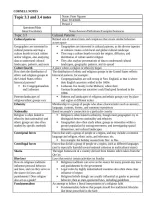
CORNELL NOTES
Topic 3.3 and 3.4 notes Name: Peter Nguyen
Date: 9/14/2026
Period: 2
Questions/Main
Ideas/Vocabulary Notes/Answers/Definitions/Examples/Sentences
Topic 3.3 Cultural Patterns
Cultural patterns Related sets of cultural traits and complexes that create similar behaviors
across space
Geographers are interested in Geographers are interested in cultural patterns, as the diverse tapestry
cultural patterns and map a of cultures creates a rich local and global cultural landscape
culture hearth to track culture They map a culture hearth to track the origins, diffusion, and
and/or religion, also analyzing distribution of culture and/or religion
data to understand cultural They also analyze presentations of data to understand cultural
landscapes, patterns, and more landscapes, geographic patterns, and its spread
Culture hearth A place where a religion or ethnicity began
How does the distribution of The distribution of ethnic and religious groups in the United States reflects
ethnic and religious groups in historical patterns, for example:
the United States reflect Congregationalists are still strong in New England, as that is where
historical patterns? their English ancestors settled in the 1600s
Ex: Congregationalists Lutherans live mostly in the Midwest, where their
and Lutherans German/Scandinavian ancestors could find good farmland in the
1800s
Patterns/landscapes of Patterns and landscapes of religious and ethnic groups vary by place
religious/ethnic groups vary and region at different scales
Ethnicity Membership in a group of people who share characteristics such as ancestry,
language, customs, history, and common experiences
Nationality Based on people’s connection to a particular country
Religion is often linked to Religion is often linked to ethnicity, though most geographers try to
ethnicity (not nationality) and distinguish between nationality and ethnicity
ethnic groups are also often Geographers also often study ethnic groups as minorities within a
studied by specific methods greater population by tracing movement, and investigating spatial
dimensions, and cultural landscapes
Centripetal forces Forces that unify a group of people or a region, and may include a common
language and religion, ethnic unity, and tolerance, etc.
For example: the holiday season from Nov. to Dec.
Centrifugal forces Forces that divide a group of people or a region, such as different languages
(and is especially harmful toward national cohesion in multicultural states)
Sharia The legal framework of a country derived from Islamic edicts taken from the
Qur’an
Blue laws Laws that restrict certain activities on Sunday
How do religious traditions Religious traditions can serve as the source for many present-day laws
influence personal behavior and punishments by the government
and laws, and can they serve as Legal codes by highly industrialized countries also often show clear
the source for laws and influence of region
punishments? Does religion Religious beliefs though. are usually influential as guides to personal
also act as a guide? behavior, then as state-sponsored laws, including guidelines
Fundamentalism An attempt to follow a literal interpretation of a religious faith
Fundamentalists believe that people should live traditional lifestyles
like those prescribed in the faith
Topic 3.3 and 3.4 notes Name: Peter Nguyen
Date: 9/14/2026
Period: 2
Questions/Main
Ideas/Vocabulary Notes/Answers/Definitions/Examples/Sentences
Topic 3.3 Cultural Patterns
Cultural patterns Related sets of cultural traits and complexes that create similar behaviors
across space
Geographers are interested in Geographers are interested in cultural patterns, as the diverse tapestry
cultural patterns and map a of cultures creates a rich local and global cultural landscape
culture hearth to track culture They map a culture hearth to track the origins, diffusion, and
and/or religion, also analyzing distribution of culture and/or religion
data to understand cultural They also analyze presentations of data to understand cultural
landscapes, patterns, and more landscapes, geographic patterns, and its spread
Culture hearth A place where a religion or ethnicity began
How does the distribution of The distribution of ethnic and religious groups in the United States reflects
ethnic and religious groups in historical patterns, for example:
the United States reflect Congregationalists are still strong in New England, as that is where
historical patterns? their English ancestors settled in the 1600s
Ex: Congregationalists Lutherans live mostly in the Midwest, where their
and Lutherans German/Scandinavian ancestors could find good farmland in the
1800s
Patterns/landscapes of Patterns and landscapes of religious and ethnic groups vary by place
religious/ethnic groups vary and region at different scales
Ethnicity Membership in a group of people who share characteristics such as ancestry,
language, customs, history, and common experiences
Nationality Based on people’s connection to a particular country
Religion is often linked to Religion is often linked to ethnicity, though most geographers try to
ethnicity (not nationality) and distinguish between nationality and ethnicity
ethnic groups are also often Geographers also often study ethnic groups as minorities within a
studied by specific methods greater population by tracing movement, and investigating spatial
dimensions, and cultural landscapes
Centripetal forces Forces that unify a group of people or a region, and may include a common
language and religion, ethnic unity, and tolerance, etc.
For example: the holiday season from Nov. to Dec.
Centrifugal forces Forces that divide a group of people or a region, such as different languages
(and is especially harmful toward national cohesion in multicultural states)
Sharia The legal framework of a country derived from Islamic edicts taken from the
Qur’an
Blue laws Laws that restrict certain activities on Sunday
How do religious traditions Religious traditions can serve as the source for many present-day laws
influence personal behavior and punishments by the government
and laws, and can they serve as Legal codes by highly industrialized countries also often show clear
the source for laws and influence of region
punishments? Does religion Religious beliefs though. are usually influential as guides to personal
also act as a guide? behavior, then as state-sponsored laws, including guidelines
Fundamentalism An attempt to follow a literal interpretation of a religious faith
Fundamentalists believe that people should live traditional lifestyles
like those prescribed in the faith