
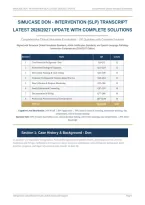
SIMUCASE DON - INTERVENTION (SLP) | LATEST 2026/2027 UPDATE Comprehensive Clinical Simulation Examination
SIMUCASE DON - INTERVENTION (SLP) TRANSCRIPT
LATEST 2026/2027 UPDATE WITH COMPLETE SOLUTIONS
Comprehensive Clinical Simulation Examination - 100 Questions with Complete Solutions
Aligned with Simucase Clinical Simulation Standards, ASHA Certification Standards, and Speech-Language Pathology
Intervention Competencies (2026/2027 Edition)
Section Topic Q# Count
1 Case History & Background - Don Q1-Q12 12
2 Assessment Findings & Diagnosis Q13-Q24 12
3 Intervention Planning & Goal Setting Q25-Q39 15
4 Treatment Techniques & Evidence-Based Practice Q40-Q54 15
5 Data Collection & Progress Monitoring Q55-Q66 12
6 Family Education & Counseling Q67-Q76 10
7 Documentation & Billing Q77-Q86 10
8 Professional Practice & Ethical Considerations Q87-Q100 14
TOTAL Q1-Q100 100
Cognitive Level Distribution: 20% Recall | 50% Application | 30% Analysis (clinical reasoning, intervention planning, data
interpretation, ethical decision-making)
Question Style: 80% Scenario-based (Don's case, clinical decision-making, intervention planning, data interpretation) | 20% Direct
knowledge
Section 1: Case History & Background - Don
12 questions covering patient demographics, medical/developmental/social/family history, presenting concerns, previous
evaluations and therapy, medications, hearing/vision status, oral-motor examination, cultural/linguistic background, family
priorities, prognosis, and impact of communication disorder on daily life.
100-Question Comprehensive Exam | ASHA & Simucase Aligned Page 1
,SIMUCASE DON - INTERVENTION (SLP) | LATEST 2026/2027 UPDATE Comprehensive Clinical Simulation Examination
Q1: Don is a 68-year-old male referred to outpatient speech-language pathology six weeks post-onset of a left
middle cerebral artery ischemic stroke. Reviewing his case history, which piece of information is MOST critical
for establishing an accurate intervention baseline and prognosis?
A. A documented history of childhood stuttering that resolved spontaneously in adolescence.
B. Pre-morbid occupational and educational history indicating high-level literacy and verbal functioning.
*[CORRECT]*
C. A family history of late-onset Alzheimer's dementia in two second-degree relatives.
D. A remote history of tonsillectomy at age seven without post-operative complications.
Correct Answer: B
Rationale:
Per Simucase case-history standards and ASHA assessment guidelines, pre-morbid functional baseline (education, occupation,
communication demands) is essential for setting realistic, client-centered intervention goals and for prognosticating recovery
trajectories. Childhood stuttering, Alzheimer's family history, and remote tonsillectomy are not directly relevant to acquired
aphasia intervention planning.
Q2: During Don's intake interview, his wife reports that Don worked as a high school history teacher for 32
years and was an active member of a community choir. How should this information PRIMARILY shape the
intervention plan?
A. It should not influence the plan, because standardized aphasia protocols are diagnosis-driven and uniform.
B. It identifies reading, expository discourse, and vocal expression as functional priorities aligned with Don's life
roles, consistent with the ICF participation framework. *[CORRECT]*
C. It requires the SLP to focus exclusively on singing-based therapy and abandon traditional language tasks.
D. It indicates that Don will require fewer sessions because educators recover language faster than non-educators.
Correct Answer: B
Rationale:
ASHA's Person-Centered Care and the ICF framework require intervention goals to be tied to the client's life roles and
participation patterns. Don's teaching and choir background identifies reading, expository discourse, and vocal expression as
meaningful targets. The other options reflect diagnosis-driven, non-evidence-based, or stereotypical reasoning that violates
person-centered planning standards.
Q3: Don's medical history includes hypertension, atrial fibrillation, type 2 diabetes, and dyslipidemia. He takes
metoprolol, apixaban, metformin, and atorvastatin. Which medication is MOST relevant to monitor for
potential impact on his cognitive-linguistic functioning during intervention?
A. Metformin, because it directly lowers blood glucose and may acutely impair naming ability.
B. Apixaban, because anticoagulation reduces stroke recurrence risk and supports continued neuroplastic
recovery potential. *[CORRECT]*
C. Atorvastatin, because statins are contraindicated in post-stroke aphasia.
D. Metoprolol, because beta-blockers are known to cause fluent aphasia in all geriatric patients.
Correct Answer: B
Rationale:
Apixaban (an anticoagulant) is critical because secondary stroke prevention preserves the neural substrate required for
neuroplastic recovery and continued therapy gains. The distractors misrepresent medication effects: statins are not
contraindicated post-stroke, metformin does not acutely impair naming, and beta-blockers do not cause fluent aphasia. ASHA's
scope of practice requires SLPs to monitor medications affecting cognition and recovery potential.
100-Question Comprehensive Exam | ASHA & Simucase Aligned Page 2
,SIMUCASE DON - INTERVENTION (SLP) | LATEST 2026/2027 UPDATE Comprehensive Clinical Simulation Examination
Q4: Don passed a pure-tone audiometric screening bilaterally at 25 dB HL at 500, 1000, 2000, and 4000 Hz.
However, he demonstrates inconsistent responses to verbal commands during therapy. What is the BEST clinical
interpretation guiding intervention?
A. Don is malingering and should be referred for psychological evaluation before continuing therapy.
B. Don may have an auditory processing deficit secondary to the left hemisphere lesion, requiring modified input
(slowed rate, repetition, written cues) rather than assuming peripheral hearing loss. *[CORRECT]*
C. Don's hearing screening is invalid and he must be referred for full audiological evaluation before any further SLP
intervention.
D. Don's inconsistent responses indicate cognitive decline unrelated to his stroke and warrant immediate neurology
referral.
Correct Answer: B
Rationale:
A passed pure-tone screen rules out peripheral hearing loss, but left-hemisphere strokes frequently produce central auditory
processing deficits that affect comprehension of verbal input. ASHA guidelines direct the SLP to modify input delivery (slower
rate, repetition, written supplementation) rather than attributing inconsistency to malingering or requiring full audiological
re-evaluation before continuing. Recognizing central versus peripheral deficits is essential for accurate intervention planning.
Q5: Don's vision screening indicates corrected 20/30 acuity bilaterally with reading glasses. He reports
occasional right visual field neglect when reading therapy materials. Which intervention accommodation is
MOST appropriate?
A. Discontinue all written therapy materials and rely exclusively on auditory-verbal tasks.
B. Present materials on Don's left visual field, use a vertical anchor line on the left margin, and train left-to-right
scanning strategy. *[CORRECT]*
C. Refer Don to an ophthalmologist for visual field expansion surgery before continuing therapy.
D. Increase font size to 36-point to compensate for the visual neglect.
Correct Answer: B
Rationale:
Right visual field neglect (more accurately, left field neglect, but the question stem describes a reading neglect pattern) following
right-hemisphere or large left-hemisphere lesions is best managed by anchoring materials on the intact side, using visual anchors,
and training systematic scanning. Increasing font size alone does not address neglect, and discontinuing written materials
removes a valuable modality. ASHA's cognitive-communication guidelines support environmental compensation as a first-line
intervention.
100-Question Comprehensive Exam | ASHA & Simucase Aligned Page 3
, SIMUCASE DON - INTERVENTION (SLP) | LATEST 2026/2027 UPDATE Comprehensive Clinical Simulation Examination
Q6: Don and his wife have been married for 42 years and have three adult children who live out of state. His wife
is his primary communication partner and caregiver. According to a family-systems approach to intervention,
what is the MOST appropriate first step in engaging the family?
A. Conduct a formal family therapy session led by a licensed marriage and family therapist before initiating SLP
intervention.
B. Administer a structured caregiver interview to identify the wife's communication priorities, burden level, and
learning needs, integrating findings into the intervention plan. *[CORRECT]*
C. Request that the wife observe all therapy sessions silently to avoid disrupting clinical rapport.
D. Exclude the wife from therapy planning to preserve Don's autonomy as an adult patient.
Correct Answer: B
Rationale:
ASHA's family-centered care standards and the Simucase family-engagement model require an early structured caregiver
interview to identify priorities, burden, and learning needs. This information directly shapes the intervention plan. Family therapy
referral is premature, silent observation excludes the caregiver from active collaboration, and excluding the wife contradicts the
person-in-environment model essential to aphasia intervention.
Q7: Don was referred to outpatient SLP by his physiatrist following discharge from inpatient rehabilitation. His
prior SLP history includes 14 inpatient sessions targeting basic verbal expression and auditory comprehension.
What is the BEST use of this prior therapy history in planning the current intervention?
A. Disregard the inpatient records because they are not from the current setting.
B. Review the inpatient discharge summary to identify mastered and emerging skills, current cueing hierarchies,
and any goals not yet achieved, then build forward rather than repeating baseline. *[CORRECT]*
C. Repeat the full inpatient evaluation battery to obtain fresh baseline data because scores may have changed.
D. Use only the inpatient goals without modification to ensure continuity of care.
Correct Answer: B
Rationale:
Continuity-of-care standards require reviewing prior records to identify mastered skills, current cueing hierarchies, and
unfinished goals so that intervention builds forward efficiently. Disregarding records wastes clinical time, repeating the full
battery is duplicative, and copying prior goals without modification ignores recovery gains. ASHA documentation guidelines
explicitly endorse integrating prior records into the current plan of care.
Q8: Don's oral-motor examination reveals mild right facial weakness, reduced lingual strength on the right side,
and intact velopharyngeal closure. No dysphagia is present. How should these findings influence intervention
planning?
A. Initiate oral-motor exercises including resistance tongue pressing and blowing exercises to strengthen articulatory
musculature.
B. Acknowledge the mild dysarthria contribution to intelligibility and incorporate motor-speech targeting within
functional speech tasks rather than isolated non-speech oral-motor exercises. *[CORRECT]*
C. Refer Don for a modified barium swallow study because all post-stroke patients require instrumental swallowing
evaluation.
D. Defer speech intervention until the facial weakness resolves spontaneously.
Correct Answer: B
Rationale:
Current evidence (Robbins et al., Mayo Clinic proceedings; ASHA's systematic reviews) indicates that non-speech oral-motor
exercises have limited transfer to speech production. Mild dysarthria is best addressed within functional speech tasks. Routine
MBS is not indicated without dysphagia signs, and deferring therapy delays neuroplastic recovery. ASHA's evidence-based
practice guidelines endorse speech-based motor-speech intervention over isolated exercises.
100-Question Comprehensive Exam | ASHA & Simucase Aligned Page 4


