
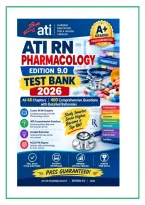
,ATI RN PHARMACOLOGY EDITION 9.0 TEST BANK 2026 | ALL 48 CHAPTERS | 400
COMPREHENSIVE QUESTIONS WITH DETAILED RATIONALES | NCLEX-RN ALIGNED | PASS
GUARANTEED - A+ GRADED
Core Domains
Pharmacological Principles and Safe Medication Administration
Medication Administration, Calculations, and Parenteral Therapy
Cardiovascular and Hematologic Medications
Endocrine and Metabolic Medications
Antimicrobial and Anti-Infective Medications
Central Nervous System Medications
Respiratory, Gastrointestinal, and Genitourinary Medications
Immune, Musculoskeletal, and Integumentary Medications
Special Populations, High-Alert Medications, and Clinical Judgment
Introduction
The ATI RN Pharmacology Edition 9.0 Test Bank is a comprehensive assessment tool designed to
evaluate the nursing student's mastery of pharmacological principles and safe medication
administration. This examination covers all 48 chapters of the ATI Review Module, encompassing
pharmacokinetics, pharmacodynamics, medication safety, and drug classifications across every
body system. Through scenario-based and application-focused questions, candidates
demonstrate critical thinking, clinical reasoning, and evidence-based decision-making. The test
bank emphasizes real-world application, high-alert medication safety, and NCLEX-RN alignment,
ensuring that future nurses possess the skills necessary to administer medications safely and
effectively across diverse patient populations.
SECTION 1 — PHARMACOLOGICAL PRINCIPLES AND SAFE MEDICATION ADMINISTRATION
(Q1–Q35)
1. A nurse is preparing to administer a medication. The provider's order reads: "Metformin
500 mg PO BID." The medication administration record (MAR) shows the patient is scheduled
for breakfast at 0800 and lunch at 1200. Which action by the nurse best demonstrates
application of pharmacokinetic principles?
,A. Administer the medication at 0800 and 2000 to maintain consistent 12-hour intervals
B. Administer the medication with meals at 0800 and 1200 to reduce gastrointestinal upset and
improve absorption tolerance
C. Administer the medication on an empty stomach at 0700 and 1700 to maximize absorption
D. Administer the medication once daily at 0900 to reduce the risk of hypoglycemia
B. Administer the medication with meals at 0800 and 1200 to reduce gastrointestinal upset
and improve absorption tolerance
RATIONALE: Metformin is best administered with meals to reduce GI side effects (nausea,
diarrhea) and improve tolerability. While metformin's absorption is reduced by food, the clinical
benefit of taking it with meals outweighs the slight reduction in bioavailability. "BID" means
twice daily, typically spaced approximately 12 hours apart but timed with meals for GI
tolerability. Administering on an empty stomach increases GI adverse effects. Once-daily dosing
does not meet the BID order. The nurse applies pharmacokinetic principles (food effect on
absorption and GI tolerability) to optimize therapy.
2. A patient receiving a medication with a half-life of 8 hours is prescribed the drug every 12
hours. After how many hours will approximately 75% of the medication be eliminated from
the body?
A. 8 hours
B. 16 hours
C. 24 hours
D. 32 hours
B. 16 hours
RATIONALE: Half-life is the time required for plasma medication concentration to decrease
by 50%. After one half-life (8 hours), 50% remains. After two half-lives (16 hours), 25% remains,
meaning 75% has been eliminated. After three half-lives (24 hours), 12.5% remains. After four
half-lives (32 hours), 6.25% remains. This is a fundamental pharmacokinetic principle used to
determine dosing intervals and predict drug accumulation.
3. A patient receives a medication that is an agonist at the beta-1 receptor. Which
pharmacodynamic effect is expected?
A. Decreased heart rate and contractility
B. Increased heart rate and contractility
, C. Bronchodilation
D. Vasodilation
B. Increased heart rate and contractility
RATIONALE: Beta-1 agonists (e.g., dobutamine, dopamine at low doses) stimulate beta-1
receptors in the heart, increasing heart rate (chronotropy) and contractility (inotropy). Beta-2
agonists cause bronchodilation. Alpha-1 agonists cause vasoconstriction, while alpha-1 blockers
cause vasodilation. Understanding receptor specificity is essential for predicting drug effects and
adverse reactions.
4. Which of the following represents the "Six Rights" of medication administration?
A. Right patient, right medication, right dose, right route, right time, right documentation
B. Right patient, right medication, right doctor, right pharmacy, right room, right chart
C. Right diagnosis, right medication, right dose, right nurse, right time, right family
D. Right patient, right syringe, right vial, right label, right pharmacy, right documentation
A. Right patient, right medication, right dose, right route, right time, right documentation
RATIONALE: The Six Rights of medication administration are: right patient (using two
identifiers), right medication, right dose, right route, right time, and right documentation. Some
institutions add additional rights such as right reason, right response, and right to refuse.
Options B, C, and D include incorrect elements (doctor, family, room, vial) that are not part of
the standard Six Rights. ATI emphasizes these rights as foundational safety checks.
5. Which pharmacokinetic process describes the movement of a medication from the
gastrointestinal tract into the bloodstream?
A. Distribution
B. Absorption
C. Metabolism
D. Excretion
B. Absorption
RATIONALE: Absorption is the movement of a medication from its administration site into
systemic circulation. Distribution involves the transport of medication to target tissues.
Metabolism (biotransformation) is the chemical alteration of the medication, primarily in the
COMPREHENSIVE QUESTIONS WITH DETAILED RATIONALES | NCLEX-RN ALIGNED | PASS
GUARANTEED - A+ GRADED
Core Domains
Pharmacological Principles and Safe Medication Administration
Medication Administration, Calculations, and Parenteral Therapy
Cardiovascular and Hematologic Medications
Endocrine and Metabolic Medications
Antimicrobial and Anti-Infective Medications
Central Nervous System Medications
Respiratory, Gastrointestinal, and Genitourinary Medications
Immune, Musculoskeletal, and Integumentary Medications
Special Populations, High-Alert Medications, and Clinical Judgment
Introduction
The ATI RN Pharmacology Edition 9.0 Test Bank is a comprehensive assessment tool designed to
evaluate the nursing student's mastery of pharmacological principles and safe medication
administration. This examination covers all 48 chapters of the ATI Review Module, encompassing
pharmacokinetics, pharmacodynamics, medication safety, and drug classifications across every
body system. Through scenario-based and application-focused questions, candidates
demonstrate critical thinking, clinical reasoning, and evidence-based decision-making. The test
bank emphasizes real-world application, high-alert medication safety, and NCLEX-RN alignment,
ensuring that future nurses possess the skills necessary to administer medications safely and
effectively across diverse patient populations.
SECTION 1 — PHARMACOLOGICAL PRINCIPLES AND SAFE MEDICATION ADMINISTRATION
(Q1–Q35)
1. A nurse is preparing to administer a medication. The provider's order reads: "Metformin
500 mg PO BID." The medication administration record (MAR) shows the patient is scheduled
for breakfast at 0800 and lunch at 1200. Which action by the nurse best demonstrates
application of pharmacokinetic principles?
,A. Administer the medication at 0800 and 2000 to maintain consistent 12-hour intervals
B. Administer the medication with meals at 0800 and 1200 to reduce gastrointestinal upset and
improve absorption tolerance
C. Administer the medication on an empty stomach at 0700 and 1700 to maximize absorption
D. Administer the medication once daily at 0900 to reduce the risk of hypoglycemia
B. Administer the medication with meals at 0800 and 1200 to reduce gastrointestinal upset
and improve absorption tolerance
RATIONALE: Metformin is best administered with meals to reduce GI side effects (nausea,
diarrhea) and improve tolerability. While metformin's absorption is reduced by food, the clinical
benefit of taking it with meals outweighs the slight reduction in bioavailability. "BID" means
twice daily, typically spaced approximately 12 hours apart but timed with meals for GI
tolerability. Administering on an empty stomach increases GI adverse effects. Once-daily dosing
does not meet the BID order. The nurse applies pharmacokinetic principles (food effect on
absorption and GI tolerability) to optimize therapy.
2. A patient receiving a medication with a half-life of 8 hours is prescribed the drug every 12
hours. After how many hours will approximately 75% of the medication be eliminated from
the body?
A. 8 hours
B. 16 hours
C. 24 hours
D. 32 hours
B. 16 hours
RATIONALE: Half-life is the time required for plasma medication concentration to decrease
by 50%. After one half-life (8 hours), 50% remains. After two half-lives (16 hours), 25% remains,
meaning 75% has been eliminated. After three half-lives (24 hours), 12.5% remains. After four
half-lives (32 hours), 6.25% remains. This is a fundamental pharmacokinetic principle used to
determine dosing intervals and predict drug accumulation.
3. A patient receives a medication that is an agonist at the beta-1 receptor. Which
pharmacodynamic effect is expected?
A. Decreased heart rate and contractility
B. Increased heart rate and contractility
, C. Bronchodilation
D. Vasodilation
B. Increased heart rate and contractility
RATIONALE: Beta-1 agonists (e.g., dobutamine, dopamine at low doses) stimulate beta-1
receptors in the heart, increasing heart rate (chronotropy) and contractility (inotropy). Beta-2
agonists cause bronchodilation. Alpha-1 agonists cause vasoconstriction, while alpha-1 blockers
cause vasodilation. Understanding receptor specificity is essential for predicting drug effects and
adverse reactions.
4. Which of the following represents the "Six Rights" of medication administration?
A. Right patient, right medication, right dose, right route, right time, right documentation
B. Right patient, right medication, right doctor, right pharmacy, right room, right chart
C. Right diagnosis, right medication, right dose, right nurse, right time, right family
D. Right patient, right syringe, right vial, right label, right pharmacy, right documentation
A. Right patient, right medication, right dose, right route, right time, right documentation
RATIONALE: The Six Rights of medication administration are: right patient (using two
identifiers), right medication, right dose, right route, right time, and right documentation. Some
institutions add additional rights such as right reason, right response, and right to refuse.
Options B, C, and D include incorrect elements (doctor, family, room, vial) that are not part of
the standard Six Rights. ATI emphasizes these rights as foundational safety checks.
5. Which pharmacokinetic process describes the movement of a medication from the
gastrointestinal tract into the bloodstream?
A. Distribution
B. Absorption
C. Metabolism
D. Excretion
B. Absorption
RATIONALE: Absorption is the movement of a medication from its administration site into
systemic circulation. Distribution involves the transport of medication to target tissues.
Metabolism (biotransformation) is the chemical alteration of the medication, primarily in the


