
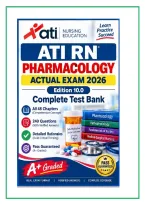
,ATI RN PHARMACOLOGY ACTUAL EXAM 2026 | Edition 10.0
Complete Test Bank | All 48 Chapters | 240 Questions with Verified
Answers | Pass Guaranteed - A+ Graded
Exam: ATI RN Pharmacology Proctored Assessment (Edition 10.0)
Format: 240 multiple-choice questions with detailed rationales
Cognitive Levels: 30% Recall | 50% Application | 20% Analysis
Question Style: 75% Scenario-Based | 25% Direct Recall / Calculation
Content: All 48 chapters of the ATI Pharmacology Review Module
Section 1: Pharmacology Foundations & Safe Medication
Administration (Questions 1–20)
Chapters 1–5 | Pharmacokinetics, Pharmacodynamics, Six Rights,
Medication Safety, Error Prevention
Q1: A nurse is preparing to administer medications to a client. The
provider has ordered a medication that has a low therapeutic index.
Which statement by the nurse best demonstrates understanding of
this concept?
A. "This medication has a wide safety margin between the therapeutic dose
and the toxic dose."
B. "I will need to monitor plasma drug levels closely because the difference
between a therapeutic and toxic dose is very small." [CORRECT]
C. "This medication does not require any specific monitoring because it is
naturally safe."
D. "I can administer this medication without worrying about the dosage."
Correct Answer: B
Explanation / Rationale:
A low therapeutic index means the difference between a therapeutic dose
and a toxic dose is very small. Option A is incorrect because a wide safety
margin describes a high therapeutic index. Option C is incorrect because
medications with a low therapeutic index require close monitoring, not less.
,Option D is incorrect because dosages must be carefully calculated and
monitored to avoid toxicity.
Q2: A nurse is preparing to administer a medication to a client who
has a history of renal failure. Which pharmacokinetic process should
the nurse expect to be most affected?
A. Absorption
B. Distribution
C. Metabolism
D. Excretion
Correct Answer: D
Rationale:
The kidneys are the primary organs responsible for the excretion of drugs
and their metabolites. Impaired renal function leads to decreased drug
clearance and a high risk for toxicity. Option A is incorrect because
absorption primarily occurs in the GI tract. Option B is incorrect because
distribution is affected by blood flow, protein binding, and lipid solubility.
Option C is incorrect because metabolism primarily occurs in the liver.
Q3: A nurse is teaching a client about the "First-pass effect." Which
route of administration is most affected by this process?
A. Intravenous
B. Sublingual
C. Oral
D. Transdermal
Correct Answer: C
Rationale:
Oral medications are absorbed in the GI tract and travel to the liver via the
portal vein. The liver may metabolize a large portion of the drug before it
ever reaches systemic circulation. Option A is incorrect because IV
, medications bypass the first-pass effect entirely. Option B is incorrect
because sublingual medications are absorbed directly into systemic
circulation. Option D is incorrect because transdermal medications also
bypass the first-pass effect.
Q4: A nurse is preparing to administer 0.5 g of a medication. The
available dose is 250 mg tablets. How many tablets should the nurse
administer?
A. 0.5 tablets
B. 1 tablet
C. 2 tablets
D. 4 tablets
Correct Answer: C
Rationale:
First, convert grams to milligrams: 0.5 g = 500 mg. Divide the ordered dose
(500 mg) by the available dose (250 mg) to get 2 tablets. Option A is
incorrect because 0.5 tablets would only provide 125 mg. Option B is
incorrect because 1 tablet provides only 250 mg. Option D is incorrect
because 4 tablets would provide 1000 mg, which exceeds the ordered
dose.
Q5: A nurse is reviewing a client's medication record and notes a
prescription for a "trough level." When should the nurse schedule the
blood draw?
A. 30 minutes after the dose is administered
B. Exactly mid-way between doses
C. 15 minutes before the next dose
D. 2 hours after the start of the infusion
Correct Answer: C
Complete Test Bank | All 48 Chapters | 240 Questions with Verified
Answers | Pass Guaranteed - A+ Graded
Exam: ATI RN Pharmacology Proctored Assessment (Edition 10.0)
Format: 240 multiple-choice questions with detailed rationales
Cognitive Levels: 30% Recall | 50% Application | 20% Analysis
Question Style: 75% Scenario-Based | 25% Direct Recall / Calculation
Content: All 48 chapters of the ATI Pharmacology Review Module
Section 1: Pharmacology Foundations & Safe Medication
Administration (Questions 1–20)
Chapters 1–5 | Pharmacokinetics, Pharmacodynamics, Six Rights,
Medication Safety, Error Prevention
Q1: A nurse is preparing to administer medications to a client. The
provider has ordered a medication that has a low therapeutic index.
Which statement by the nurse best demonstrates understanding of
this concept?
A. "This medication has a wide safety margin between the therapeutic dose
and the toxic dose."
B. "I will need to monitor plasma drug levels closely because the difference
between a therapeutic and toxic dose is very small." [CORRECT]
C. "This medication does not require any specific monitoring because it is
naturally safe."
D. "I can administer this medication without worrying about the dosage."
Correct Answer: B
Explanation / Rationale:
A low therapeutic index means the difference between a therapeutic dose
and a toxic dose is very small. Option A is incorrect because a wide safety
margin describes a high therapeutic index. Option C is incorrect because
medications with a low therapeutic index require close monitoring, not less.
,Option D is incorrect because dosages must be carefully calculated and
monitored to avoid toxicity.
Q2: A nurse is preparing to administer a medication to a client who
has a history of renal failure. Which pharmacokinetic process should
the nurse expect to be most affected?
A. Absorption
B. Distribution
C. Metabolism
D. Excretion
Correct Answer: D
Rationale:
The kidneys are the primary organs responsible for the excretion of drugs
and their metabolites. Impaired renal function leads to decreased drug
clearance and a high risk for toxicity. Option A is incorrect because
absorption primarily occurs in the GI tract. Option B is incorrect because
distribution is affected by blood flow, protein binding, and lipid solubility.
Option C is incorrect because metabolism primarily occurs in the liver.
Q3: A nurse is teaching a client about the "First-pass effect." Which
route of administration is most affected by this process?
A. Intravenous
B. Sublingual
C. Oral
D. Transdermal
Correct Answer: C
Rationale:
Oral medications are absorbed in the GI tract and travel to the liver via the
portal vein. The liver may metabolize a large portion of the drug before it
ever reaches systemic circulation. Option A is incorrect because IV
, medications bypass the first-pass effect entirely. Option B is incorrect
because sublingual medications are absorbed directly into systemic
circulation. Option D is incorrect because transdermal medications also
bypass the first-pass effect.
Q4: A nurse is preparing to administer 0.5 g of a medication. The
available dose is 250 mg tablets. How many tablets should the nurse
administer?
A. 0.5 tablets
B. 1 tablet
C. 2 tablets
D. 4 tablets
Correct Answer: C
Rationale:
First, convert grams to milligrams: 0.5 g = 500 mg. Divide the ordered dose
(500 mg) by the available dose (250 mg) to get 2 tablets. Option A is
incorrect because 0.5 tablets would only provide 125 mg. Option B is
incorrect because 1 tablet provides only 250 mg. Option D is incorrect
because 4 tablets would provide 1000 mg, which exceeds the ordered
dose.
Q5: A nurse is reviewing a client's medication record and notes a
prescription for a "trough level." When should the nurse schedule the
blood draw?
A. 30 minutes after the dose is administered
B. Exactly mid-way between doses
C. 15 minutes before the next dose
D. 2 hours after the start of the infusion
Correct Answer: C


