[STUDY GUIDE] • HIGH-YIELD PRACTICE & REVIEW EDITION
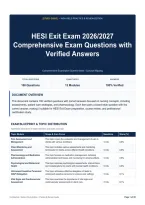
HESI Exit Exam 2026/2027
Comprehensive Exam Questions with
Verified Answers
Comprehensive Examination Question Bank • Concept Mapping
TOTAL QUESTIONS EXAM TOPICS ANSWERS
160 Questions 12 Modules 100% Verified
DOCUMENT OVERVIEW
This document contains 160 verified questions with correct answers focused on nursing concepts, including
assessments, patient care strategies, and pharmacology. Each item pairs a board-style question with the
correct answer, making it suitable for HESI Exit Exam preparation, course review, and professional
certification study.
EXAM BLUEPRINT & TOPIC DISTRIBUTION
Systematic breakdown of subject domains and exam coverage.
Topic Module Scope & Core Focus Questions Share (%)
Pain Assessment and This topic covers the evaluation and management of pain in
Management clients with various conditions. 14 Qs 8.8%
Client Monitoring and This topic includes various assessments and monitoring
Assessment techniques for clients across different health conditions. 14 Qs 8.8%
Pharmacology and Medication This topic focuses on medication management, including
Administration administration techniques and monitoring for adverse effects. 14 Qs 8.8%
Psychological and Behavioral This topic explores psychological assessments, interventions,
Health and considerations for clients with mental health conditions. 14 Qs 8.8%
Unlicensed Assistive Personnel This topic addresses effective delegation of tasks to
(UAP) Delegation unlicensed assistive personnel in various care settings. 13 Qs 8.1%
Vital Signs and Cardiovascular This topic examines the importance of vital signs and
Assessment cardiovascular assessments in client care. 13 Qs 8.1%
Confidential • Student Study Edition • Practice & Review Guide Page 1 of 59
,STUDENT STUDY & MASTERY EDITION PRACTICE & REVIEW GUIDE
Nutritional Considerations and This topic includes nutritional assessments and dietary
Dietary Management management strategies for various client populations. 13 Qs 8.1%
This topic focuses on the principles of infection control and
Infection Control and Prevention prevention in clinical settings. 13 Qs 8.1%
Emergency and Critical Care This topic involves the management and assessment of
Management clients in emergency and critical care situations. 13 Qs 8.1%
This topic addresses specific considerations and
Pediatric Care Considerations assessments required for pediatric clients. 13 Qs 8.1%
This topic covers strategies for managing chronic illnesses
Chronic Illness Management and promoting health in affected clients. 13 Qs 8.1%
Postoperative Care and This topic focuses on the assessment and management of
Recovery clients during the postoperative phase. 13 Qs 8.1%
Total Exam Coverage 12 Integrated Topic Modules 160 Qs 100.0%
TOPIC 1: PAIN ASSESSMENT AND MANAGEMENT
14 Questions • 8.8% of Exam • This topic covers the evaluation and management of pain in clients with various conditions.
QUESTION 1
A client presses the call bell and requests pain medication for a severe
headache. To assess the quality of the client's pain, which approach should the nurse
use?
A. Ask the client to describe the pain
B. Observe body language and movement
C. Identify effective pain relief measures
D. Provide a numeric pain scale
Answer: A. Ask the client to describe the pain.
Confidential • Student Study Edition • Practice & Review Guide Page 2 of 59
,STUDENT STUDY & MASTERY EDITION PRACTICE & REVIEW GUIDE
QUESTION 2
A young male client is admitted to rehabilitation following a right aboveknee
amputation (AKA) for a severe traumatic injury. He is in the commons room and
anxiously calls out to the nurse, stating that his "right foot is aching". The nurse offers
reassurance and support. Which additional intervention is most important for the nurse
to implement?
A. Encourage discussion of feelings about the loss of his limb
B. Administer a prescription for gabapentin, a neuroleptic agent
C. Tech the client how to wrap the stump with an elastic bandage
D. Offer to assist the client to a quieter location so he can relax
Answer: A. Encourage discussion of feelings about the loss of his limb.
QUESTION 3
A client with acute pancreatitis is admitted with severe, piercing abdominal pain and an
elevated serum amylase. Which additional information is the client most likely to report
to the nurse?
A. Abdominal pain decreases when lying supine
B. Pain lasts an hour and leaves the abdomen tender
C. Right upper quadrant pain refers to right scapula
D. Drinks alcohol until intoxicated at least twice weekly.
Answer: A. Abdominal pain decreases when lying supine.
QUESTION 4
The nurse is demonstrating correct transfer procedures to the unlicensed assistive
personnel (UAP) working on a rehabilitation unit.
The UAP asks the nurse how to safely move a physically disabled client from the
wheelchair to a bed. Which action should the nurse recommend?
A. apply a gait belt around the client's waist once a standing position has been assumed
B. Place the client's locked wheelchair on the client's strong side next to the bed
C. Pull the client into position by reaching from the opposite side of the bed
D. Hold the client at arm's length while transferring to better distribute the body weight
Answer: B. Place the client's locked wheelchair on the client's strong side next to the bed.
Confidential • Student Study Edition • Practice & Review Guide Page 3 of 59
, STUDENT STUDY & MASTERY EDITION PRACTICE & REVIEW GUIDE
QUESTION 5
A client with Type 1 diabetes mellitus and a large draining ulcer of the right foot is
admitted with a suspected Staphylococcus aureus infection.
Which interventions should the nurse implement? (Select all that apply)
A. Monitor the client's white blood cell count
B. Explain the purpose of a low bacteria diet
C. Send wound drainage for culture and sensitivity
D. Institute contact precautions for staff and visitors
E. Use standard precautions and wear a mask
Answer: A. Monitor the client's white blood cell count
C. Send wound drainage for culture and sensitivity
D. Institute contact precautions for staff and visitors.
QUESTION 6
When admitting a client with a diagnosis of transient ischemic attack
(TIA), which intervention is most important for the nurse to include in this client's plan
of care?
A. Assess bilateral breath sounds
B. Review client's daily medications
C. Initiate neurological monitoring every 2 hours
D. Palpate suprapubic region for urinary retention
Answer: C. Initiate neurological monitoring every 2 hours.
QUESTION 7
The nurse is feeding an older adult who was admitted with aspiration
pneumonia. The client is weak and begins coughing while attempting to drink through a
straw. Which intervention should the nurse implement?
A. Teach coughing and deep breathing exercises
B. Assess the client's oral cavity for ulcerations
C. Request thick nectar liquids for the client
D. Monitor the client when using a straw for liquids
Answer: A. Teach coughing and deep breathing exercises.
Confidential • Student Study Edition • Practice & Review Guide Page 4 of 59
HESI Exit Exam 2026/2027
Comprehensive Exam Questions with
Verified Answers
Comprehensive Examination Question Bank • Concept Mapping
TOTAL QUESTIONS EXAM TOPICS ANSWERS
160 Questions 12 Modules 100% Verified
DOCUMENT OVERVIEW
This document contains 160 verified questions with correct answers focused on nursing concepts, including
assessments, patient care strategies, and pharmacology. Each item pairs a board-style question with the
correct answer, making it suitable for HESI Exit Exam preparation, course review, and professional
certification study.
EXAM BLUEPRINT & TOPIC DISTRIBUTION
Systematic breakdown of subject domains and exam coverage.
Topic Module Scope & Core Focus Questions Share (%)
Pain Assessment and This topic covers the evaluation and management of pain in
Management clients with various conditions. 14 Qs 8.8%
Client Monitoring and This topic includes various assessments and monitoring
Assessment techniques for clients across different health conditions. 14 Qs 8.8%
Pharmacology and Medication This topic focuses on medication management, including
Administration administration techniques and monitoring for adverse effects. 14 Qs 8.8%
Psychological and Behavioral This topic explores psychological assessments, interventions,
Health and considerations for clients with mental health conditions. 14 Qs 8.8%
Unlicensed Assistive Personnel This topic addresses effective delegation of tasks to
(UAP) Delegation unlicensed assistive personnel in various care settings. 13 Qs 8.1%
Vital Signs and Cardiovascular This topic examines the importance of vital signs and
Assessment cardiovascular assessments in client care. 13 Qs 8.1%
Confidential • Student Study Edition • Practice & Review Guide Page 1 of 59
,STUDENT STUDY & MASTERY EDITION PRACTICE & REVIEW GUIDE
Nutritional Considerations and This topic includes nutritional assessments and dietary
Dietary Management management strategies for various client populations. 13 Qs 8.1%
This topic focuses on the principles of infection control and
Infection Control and Prevention prevention in clinical settings. 13 Qs 8.1%
Emergency and Critical Care This topic involves the management and assessment of
Management clients in emergency and critical care situations. 13 Qs 8.1%
This topic addresses specific considerations and
Pediatric Care Considerations assessments required for pediatric clients. 13 Qs 8.1%
This topic covers strategies for managing chronic illnesses
Chronic Illness Management and promoting health in affected clients. 13 Qs 8.1%
Postoperative Care and This topic focuses on the assessment and management of
Recovery clients during the postoperative phase. 13 Qs 8.1%
Total Exam Coverage 12 Integrated Topic Modules 160 Qs 100.0%
TOPIC 1: PAIN ASSESSMENT AND MANAGEMENT
14 Questions • 8.8% of Exam • This topic covers the evaluation and management of pain in clients with various conditions.
QUESTION 1
A client presses the call bell and requests pain medication for a severe
headache. To assess the quality of the client's pain, which approach should the nurse
use?
A. Ask the client to describe the pain
B. Observe body language and movement
C. Identify effective pain relief measures
D. Provide a numeric pain scale
Answer: A. Ask the client to describe the pain.
Confidential • Student Study Edition • Practice & Review Guide Page 2 of 59
,STUDENT STUDY & MASTERY EDITION PRACTICE & REVIEW GUIDE
QUESTION 2
A young male client is admitted to rehabilitation following a right aboveknee
amputation (AKA) for a severe traumatic injury. He is in the commons room and
anxiously calls out to the nurse, stating that his "right foot is aching". The nurse offers
reassurance and support. Which additional intervention is most important for the nurse
to implement?
A. Encourage discussion of feelings about the loss of his limb
B. Administer a prescription for gabapentin, a neuroleptic agent
C. Tech the client how to wrap the stump with an elastic bandage
D. Offer to assist the client to a quieter location so he can relax
Answer: A. Encourage discussion of feelings about the loss of his limb.
QUESTION 3
A client with acute pancreatitis is admitted with severe, piercing abdominal pain and an
elevated serum amylase. Which additional information is the client most likely to report
to the nurse?
A. Abdominal pain decreases when lying supine
B. Pain lasts an hour and leaves the abdomen tender
C. Right upper quadrant pain refers to right scapula
D. Drinks alcohol until intoxicated at least twice weekly.
Answer: A. Abdominal pain decreases when lying supine.
QUESTION 4
The nurse is demonstrating correct transfer procedures to the unlicensed assistive
personnel (UAP) working on a rehabilitation unit.
The UAP asks the nurse how to safely move a physically disabled client from the
wheelchair to a bed. Which action should the nurse recommend?
A. apply a gait belt around the client's waist once a standing position has been assumed
B. Place the client's locked wheelchair on the client's strong side next to the bed
C. Pull the client into position by reaching from the opposite side of the bed
D. Hold the client at arm's length while transferring to better distribute the body weight
Answer: B. Place the client's locked wheelchair on the client's strong side next to the bed.
Confidential • Student Study Edition • Practice & Review Guide Page 3 of 59
, STUDENT STUDY & MASTERY EDITION PRACTICE & REVIEW GUIDE
QUESTION 5
A client with Type 1 diabetes mellitus and a large draining ulcer of the right foot is
admitted with a suspected Staphylococcus aureus infection.
Which interventions should the nurse implement? (Select all that apply)
A. Monitor the client's white blood cell count
B. Explain the purpose of a low bacteria diet
C. Send wound drainage for culture and sensitivity
D. Institute contact precautions for staff and visitors
E. Use standard precautions and wear a mask
Answer: A. Monitor the client's white blood cell count
C. Send wound drainage for culture and sensitivity
D. Institute contact precautions for staff and visitors.
QUESTION 6
When admitting a client with a diagnosis of transient ischemic attack
(TIA), which intervention is most important for the nurse to include in this client's plan
of care?
A. Assess bilateral breath sounds
B. Review client's daily medications
C. Initiate neurological monitoring every 2 hours
D. Palpate suprapubic region for urinary retention
Answer: C. Initiate neurological monitoring every 2 hours.
QUESTION 7
The nurse is feeding an older adult who was admitted with aspiration
pneumonia. The client is weak and begins coughing while attempting to drink through a
straw. Which intervention should the nurse implement?
A. Teach coughing and deep breathing exercises
B. Assess the client's oral cavity for ulcerations
C. Request thick nectar liquids for the client
D. Monitor the client when using a straw for liquids
Answer: A. Teach coughing and deep breathing exercises.
Confidential • Student Study Edition • Practice & Review Guide Page 4 of 59