Florida Basic Recruit LEO: Chapter 3 Legal Test with all Correct &
100% Verified Answers |Latest Version |Already Graded A+
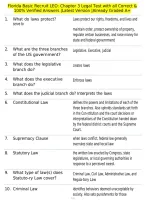
1. What do laws protect? Laws protect our rights, freedoms, and lives and
serve to
maintain order, protect ownership of property,
regulate certain businesses, and raise money for
state and federal government
2. What are the three branches Legislative, Executive, Judicial
of the US government?
3. What does the legislative creates laws
branch do?
4. What does the executive Enforces laws
branch do?
5. What does the judicial branch do? Interprets the laws
6. Constitutional Law defines the powers and limitations of each of the
three branches. Also upholds standards set forth
in the Con-stitution and the court decisions or
interpretations of the Constitution handed down
by the federal district courts and the Supreme
Court.
7. Supremacy Clause when laws conflict, federal law generally
overrules state and local law
8. Statutory Law the written law enacted by Congress, state
legislatures, or local governing authorities in
response to a perceived need.
9. What type of law(s) does Criminal Law, Civil Law, Administrative Law, and
Statuto-ry Law cover? Regula-tory Law
10. Criminal Law identifies behaviors deemed unacceptable by
society. Also sets punishments for those
,Florida Basic Recruit LEO: Chapter 3 Legal Test with all Correct &
100% Verified Answers |Latest Version |Already Graded A+
behaviors
, Florida Basic Recruit LEO: Chapter 3 Legal Test with all Correct &
100% Verified Answers |Latest Version |Already Graded A+
11. Ordinances laws enacted by a local governing unit, such as a
munic-ipal (city) or a county government.
12. Where do ordinances apply? Only within the jurisdiction of the governmental entity
that enacted them
13. What types of violations can Ordi-
Criminal or Civil nances be?
14. What can Ordinances not conflict State Laws, Federal Laws, or
Case Laws with?
15. Civil Law the legal action that a person takes to resolve a
non-crim-inal private dispute with another
person
16. A person filing a civil lawsuit must a court-recognized
cause of action have what?
17. Cause of Action a set of facts suflcient to justify a right to sue to
obtain money, property, or the enforcement of a
right against someone
18. Administrative Law the body of law that establishes the operation and
proce-
dures of government agencies. Also governs the
internal operations of these agencies and
ensures that they do not abuse their power.
19. What does Chapter 11B of governs the training and certification of law
the Florida Administrative enforcement oflcers
Code (F.A.C.) do?
20. Case Law the body of law formed by the decisions of
the court system
, Florida Basic Recruit LEO: Chapter 3 Legal Test with all Correct &
100% Verified Answers |Latest Version |Already Graded A+
21. Which branch of the Judicial Branch
government is Case Law
apart of?
22. Precedent a rule created by an appellate court
23. Once an appellate court a higher court changes the rule
creates a rule, you are
required to follow that rule
unless...
Hearing and reviewing appeals from cases that
24. What is an appellate court have al-ready been heard in a lower court.
re-sponsible for?
True
25. True or False: Each circuit
court ruling is binding for
that jurisdic-tion
Statutes; the case law interpreting those statutes
26. The rules under which you
oper-ate will constantly
change based upon
revisions in and
.
27. What are the sources available to - agency
bulletins stay current in statutory and case -
legislative updates
law? - oflcial websites; such as the Florida Department of
Law Enforcement (FDLE), the Florida Oflce of the
Attorney General (FOAG), and the Florida
Supreme Court
28. As a law enforcement officer, your to protect the constitutional rights of
everyone within the main objective is to protect what? US
100% Verified Answers |Latest Version |Already Graded A+
1. What do laws protect? Laws protect our rights, freedoms, and lives and
serve to
maintain order, protect ownership of property,
regulate certain businesses, and raise money for
state and federal government
2. What are the three branches Legislative, Executive, Judicial
of the US government?
3. What does the legislative creates laws
branch do?
4. What does the executive Enforces laws
branch do?
5. What does the judicial branch do? Interprets the laws
6. Constitutional Law defines the powers and limitations of each of the
three branches. Also upholds standards set forth
in the Con-stitution and the court decisions or
interpretations of the Constitution handed down
by the federal district courts and the Supreme
Court.
7. Supremacy Clause when laws conflict, federal law generally
overrules state and local law
8. Statutory Law the written law enacted by Congress, state
legislatures, or local governing authorities in
response to a perceived need.
9. What type of law(s) does Criminal Law, Civil Law, Administrative Law, and
Statuto-ry Law cover? Regula-tory Law
10. Criminal Law identifies behaviors deemed unacceptable by
society. Also sets punishments for those
,Florida Basic Recruit LEO: Chapter 3 Legal Test with all Correct &
100% Verified Answers |Latest Version |Already Graded A+
behaviors
, Florida Basic Recruit LEO: Chapter 3 Legal Test with all Correct &
100% Verified Answers |Latest Version |Already Graded A+
11. Ordinances laws enacted by a local governing unit, such as a
munic-ipal (city) or a county government.
12. Where do ordinances apply? Only within the jurisdiction of the governmental entity
that enacted them
13. What types of violations can Ordi-
Criminal or Civil nances be?
14. What can Ordinances not conflict State Laws, Federal Laws, or
Case Laws with?
15. Civil Law the legal action that a person takes to resolve a
non-crim-inal private dispute with another
person
16. A person filing a civil lawsuit must a court-recognized
cause of action have what?
17. Cause of Action a set of facts suflcient to justify a right to sue to
obtain money, property, or the enforcement of a
right against someone
18. Administrative Law the body of law that establishes the operation and
proce-
dures of government agencies. Also governs the
internal operations of these agencies and
ensures that they do not abuse their power.
19. What does Chapter 11B of governs the training and certification of law
the Florida Administrative enforcement oflcers
Code (F.A.C.) do?
20. Case Law the body of law formed by the decisions of
the court system
, Florida Basic Recruit LEO: Chapter 3 Legal Test with all Correct &
100% Verified Answers |Latest Version |Already Graded A+
21. Which branch of the Judicial Branch
government is Case Law
apart of?
22. Precedent a rule created by an appellate court
23. Once an appellate court a higher court changes the rule
creates a rule, you are
required to follow that rule
unless...
Hearing and reviewing appeals from cases that
24. What is an appellate court have al-ready been heard in a lower court.
re-sponsible for?
True
25. True or False: Each circuit
court ruling is binding for
that jurisdic-tion
Statutes; the case law interpreting those statutes
26. The rules under which you
oper-ate will constantly
change based upon
revisions in and
.
27. What are the sources available to - agency
bulletins stay current in statutory and case -
legislative updates
law? - oflcial websites; such as the Florida Department of
Law Enforcement (FDLE), the Florida Oflce of the
Attorney General (FOAG), and the Florida
Supreme Court
28. As a law enforcement officer, your to protect the constitutional rights of
everyone within the main objective is to protect what? US