
Unit and Dimension
Physical Quantity
Any quantity which can be measured using physical Instruments
Ex : Mass , Length , Time , Current, Temperature , voltage
S.No Physical Instruments
Quantities
1. Length Scale
2. Temperature Thermometer
3. Current Ammeter
4. Voltage Voltmeter
5. Time Watch/clock
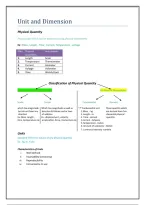
Classification of Physical Quantity
Based on Directional Properties On basis of Dependency
Scalar Vector Fundamental Derived
which has magnitude Which has magnitude as well as "7" Fundamental unit Those quantity which
but do not have any direction & follows vector laws 1. Mass - kg are derived from fun-
direction of addition 2. Length - m -damental physical
Ex: Mass ,length , Ex : displacement , velocity , 3. Time - second quantity
time ,temperature etc acceleration, force, momentum etc 4.current - Ampere
5.Temperature - Kelvin
6. Amount of substance - Moles
7. Luminous Intensity -candela
Units
standard reference values of any physical quantity
Ex : kg, m, A etc
Characteristics of Units
i. Well defined
ii. Invariability (constancy)
iii. Reproducibility
iv. Convenience in use
, Important prefix:
Kilometer → 10³ m
Hectometer → 10² m
Decameter → 10¹ m
meter → 1
decimeter→ 10⁻¹ m
centimeter → 10⁻² m
millimeter → 10⁻³ m
1 Km = 10³ m
1 Cm = 10⁻² m
1 mm = 10⁻³ m
Micrometer = 10⁻⁶ m
nanometer = 10⁻⁹ m
Picometer = 10⁻¹² m
femtometer = 10⁻¹⁵ m
1 Angstrom = 10⁻¹⁰ m
SYSTEM OF UNITS
Physical Quantity FPS CGS MKS
MASS Pounds Gram Kilogram
LENGTH Foot Centimeter meter
TIME second second second
Physical Quantity
Any quantity which can be measured using physical Instruments
Ex : Mass , Length , Time , Current, Temperature , voltage
S.No Physical Instruments
Quantities
1. Length Scale
2. Temperature Thermometer
3. Current Ammeter
4. Voltage Voltmeter
5. Time Watch/clock
Classification of Physical Quantity
Based on Directional Properties On basis of Dependency
Scalar Vector Fundamental Derived
which has magnitude Which has magnitude as well as "7" Fundamental unit Those quantity which
but do not have any direction & follows vector laws 1. Mass - kg are derived from fun-
direction of addition 2. Length - m -damental physical
Ex: Mass ,length , Ex : displacement , velocity , 3. Time - second quantity
time ,temperature etc acceleration, force, momentum etc 4.current - Ampere
5.Temperature - Kelvin
6. Amount of substance - Moles
7. Luminous Intensity -candela
Units
standard reference values of any physical quantity
Ex : kg, m, A etc
Characteristics of Units
i. Well defined
ii. Invariability (constancy)
iii. Reproducibility
iv. Convenience in use
, Important prefix:
Kilometer → 10³ m
Hectometer → 10² m
Decameter → 10¹ m
meter → 1
decimeter→ 10⁻¹ m
centimeter → 10⁻² m
millimeter → 10⁻³ m
1 Km = 10³ m
1 Cm = 10⁻² m
1 mm = 10⁻³ m
Micrometer = 10⁻⁶ m
nanometer = 10⁻⁹ m
Picometer = 10⁻¹² m
femtometer = 10⁻¹⁵ m
1 Angstrom = 10⁻¹⁰ m
SYSTEM OF UNITS
Physical Quantity FPS CGS MKS
MASS Pounds Gram Kilogram
LENGTH Foot Centimeter meter
TIME second second second


