
BSC2011 Exam 1 USF | University of South Florida | BSC
2011 | UPDATED Questions with 100% Verified Answers
Q1: descent with modification
A: principle that each living species has descended, with changes, from other species over
time
Q2: Homology
A: similarity resulting from common ancestry
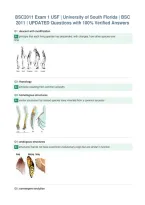
Q3: homologous structures
A: similar structures that related species have inherited from a common ancestor
Q4: analogous structures
A: structures that do not have a common evolutionary origin but are similar in function
Q5: convergent evolution
,A: Evolution toward similar characteristics in unrelated species
Q6: Fossil
A: The preserved remains or traces of an organism that lived in the past
Q7: vestigial structures
A: A structure that is present in an organism but no longer serves its original purpose
Q8: evolutionary tree
A: A branching diagram that reflects a hypothesis about evolutionary relationships among
groups of organisms.
Q9: Biogeography
A: study of the distribution of organisms around the world
, Q10: artificial selection
A: Selection by humans for breeding of useful traits from the natural variation among
different organisms
Q11: Adaptation
A: A characteristic that improves an individual's ability to survive and reproduce in a
particular environment.
Q12: Evolution
A: Change of one or more a kind of organism from one generation to the next; process by
which modern organisms have descended from ancient organisms. Occurs in populations
Q13: Population
A: A group of individuals that belong to the same species and live in the same area
Q14: natural selection
A: A process in which individuals that have certain inherited traits tend to survive and
reproduce at higher rates than other individuals because of those traits. Main process of
evolution. Must have variation in population,
Q15: Microevolution
A: Change in allele frequencies in a population over generations.
1. New genetic variation
Mutation
Gene duplication
2011 | UPDATED Questions with 100% Verified Answers
Q1: descent with modification
A: principle that each living species has descended, with changes, from other species over
time
Q2: Homology
A: similarity resulting from common ancestry
Q3: homologous structures
A: similar structures that related species have inherited from a common ancestor
Q4: analogous structures
A: structures that do not have a common evolutionary origin but are similar in function
Q5: convergent evolution
,A: Evolution toward similar characteristics in unrelated species
Q6: Fossil
A: The preserved remains or traces of an organism that lived in the past
Q7: vestigial structures
A: A structure that is present in an organism but no longer serves its original purpose
Q8: evolutionary tree
A: A branching diagram that reflects a hypothesis about evolutionary relationships among
groups of organisms.
Q9: Biogeography
A: study of the distribution of organisms around the world
, Q10: artificial selection
A: Selection by humans for breeding of useful traits from the natural variation among
different organisms
Q11: Adaptation
A: A characteristic that improves an individual's ability to survive and reproduce in a
particular environment.
Q12: Evolution
A: Change of one or more a kind of organism from one generation to the next; process by
which modern organisms have descended from ancient organisms. Occurs in populations
Q13: Population
A: A group of individuals that belong to the same species and live in the same area
Q14: natural selection
A: A process in which individuals that have certain inherited traits tend to survive and
reproduce at higher rates than other individuals because of those traits. Main process of
evolution. Must have variation in population,
Q15: Microevolution
A: Change in allele frequencies in a population over generations.
1. New genetic variation
Mutation
Gene duplication


