
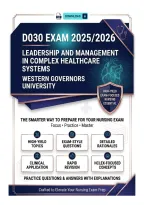
,D030 Leadership and Management in
Complex Healthcare Systems Exam
Prep — Comprehensive Review +
Practice MCQs — Western Governors
University 2025/2026
Q1. A nurse executive at a multi-hospital system is redesigning care delivery for patients with heart failure.
Which action best demonstrates a systems thinking approach?
A. Focusing exclusively on the cardiology unit's readmission rates
B. Examining how emergency department triage, inpatient staffing, discharge planning, and outpatient follow-
up interact to affect readmissions
C. Instructing individual nurses to work faster during discharge
D. Implementing a new electronic health record immediately without pilot testing
Correct Answer: B
Rationale: Systems thinking requires leaders to examine interconnections among staffing, workflows,
technology, policies, patient demand, and organizational structures rather than viewing problems in isolation .
Options A, C, and D reflect siloed or reactive thinking that ignores system interdependencies.
Q2. Which characteristic most clearly distinguishes transformational leadership from transactional leadership?
A. Reliance on rewards for meeting established performance targets
B. Emphasis on maintaining existing organizational procedures without change
C. Inspiration of employees around a shared vision and meaningful change
D. Use of formal authority to ensure compliance with policies
,Correct Answer: C
Rationale: Transformational leaders motivate by creating compelling vision, encouraging innovation,
developing followers, and connecting work to broader organizational values. Transactional leadership focuses
on exchanges, performance expectations, rewards, and corrective actions .
Q3. A PMHNP clinical director integrates behavioral health services into a primary care clinic using a
population-based registry to track depression outcomes. This model aligns with:
A. Fee-for-service psychiatry
B. Collaborative Care Model
C. Independent specialty silo practice
D. Concierge psychiatry
Correct Answer: B
Rationale: The Collaborative Care Model integrates behavioral health into primary care with measurement-
based outcomes tracking, a core competency for complex healthcare systems leadership .
Q4. A nurse leader observes that staff members are reluctant to report near-miss medication events. Which
intervention would best support a culture of safety?
A. Discipline employees who report repeated errors
B. Require employees to identify who caused each near miss
C. Encourage nonpunitive reporting and use reports to identify system weaknesses
D. Limit reporting to events that result in actual patient harm
, Correct Answer: C
Rationale: A strong safety culture encourages employees to report errors and near misses without fear of
inappropriate punishment. Near-miss data reveal process weaknesses before serious harm occurs. Leaders
should focus on learning and system improvement rather than blame .
Q5. A nurse manager is working with two departments that disagree about responsibility for delayed patient
transfers. Which approach is most appropriate initially?
A. Select the department with the highest staffing level as responsible
B. Avoid the conflict until one department changes its position
C. Facilitate a discussion focused on shared goals, facts, and underlying interests
D. Refer the disagreement immediately to the chief executive officer
Correct Answer: C
Rationale: Effective conflict management begins by understanding perspectives and interests of those involved.
Facilitating collaborative discussion can uncover process problems and identify shared objectives. Escalation
should not be the first response to a manageable conflict .
Q6. A healthcare system is adopting High Reliability Organization (HRO) principles. A PMHNP observes a near
miss where a patient was almost given a double dose of lithium. Which HRO principle is demonstrated when
the PMHNP encourages staff to report this near miss without fear of retribution?
A. Reluctance to simplify
B. Preoccupation with failure
Complex Healthcare Systems Exam
Prep — Comprehensive Review +
Practice MCQs — Western Governors
University 2025/2026
Q1. A nurse executive at a multi-hospital system is redesigning care delivery for patients with heart failure.
Which action best demonstrates a systems thinking approach?
A. Focusing exclusively on the cardiology unit's readmission rates
B. Examining how emergency department triage, inpatient staffing, discharge planning, and outpatient follow-
up interact to affect readmissions
C. Instructing individual nurses to work faster during discharge
D. Implementing a new electronic health record immediately without pilot testing
Correct Answer: B
Rationale: Systems thinking requires leaders to examine interconnections among staffing, workflows,
technology, policies, patient demand, and organizational structures rather than viewing problems in isolation .
Options A, C, and D reflect siloed or reactive thinking that ignores system interdependencies.
Q2. Which characteristic most clearly distinguishes transformational leadership from transactional leadership?
A. Reliance on rewards for meeting established performance targets
B. Emphasis on maintaining existing organizational procedures without change
C. Inspiration of employees around a shared vision and meaningful change
D. Use of formal authority to ensure compliance with policies
,Correct Answer: C
Rationale: Transformational leaders motivate by creating compelling vision, encouraging innovation,
developing followers, and connecting work to broader organizational values. Transactional leadership focuses
on exchanges, performance expectations, rewards, and corrective actions .
Q3. A PMHNP clinical director integrates behavioral health services into a primary care clinic using a
population-based registry to track depression outcomes. This model aligns with:
A. Fee-for-service psychiatry
B. Collaborative Care Model
C. Independent specialty silo practice
D. Concierge psychiatry
Correct Answer: B
Rationale: The Collaborative Care Model integrates behavioral health into primary care with measurement-
based outcomes tracking, a core competency for complex healthcare systems leadership .
Q4. A nurse leader observes that staff members are reluctant to report near-miss medication events. Which
intervention would best support a culture of safety?
A. Discipline employees who report repeated errors
B. Require employees to identify who caused each near miss
C. Encourage nonpunitive reporting and use reports to identify system weaknesses
D. Limit reporting to events that result in actual patient harm
, Correct Answer: C
Rationale: A strong safety culture encourages employees to report errors and near misses without fear of
inappropriate punishment. Near-miss data reveal process weaknesses before serious harm occurs. Leaders
should focus on learning and system improvement rather than blame .
Q5. A nurse manager is working with two departments that disagree about responsibility for delayed patient
transfers. Which approach is most appropriate initially?
A. Select the department with the highest staffing level as responsible
B. Avoid the conflict until one department changes its position
C. Facilitate a discussion focused on shared goals, facts, and underlying interests
D. Refer the disagreement immediately to the chief executive officer
Correct Answer: C
Rationale: Effective conflict management begins by understanding perspectives and interests of those involved.
Facilitating collaborative discussion can uncover process problems and identify shared objectives. Escalation
should not be the first response to a manageable conflict .
Q6. A healthcare system is adopting High Reliability Organization (HRO) principles. A PMHNP observes a near
miss where a patient was almost given a double dose of lithium. Which HRO principle is demonstrated when
the PMHNP encourages staff to report this near miss without fear of retribution?
A. Reluctance to simplify
B. Preoccupation with failure


