
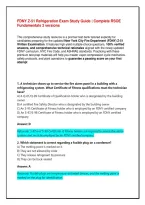
FDNY Z-51 Refrigeration Exam Study Guide | Complete RSOE
Fundamentals 3 versions
This comprehensive study resource is a premier test bank tailored explicitly for
candidates preparing for the updated New York City Fire Department (FDNY) Z-51
Written Examination. It features high-yield multiple-choice questions, 100% verified
answers, and comprehensive technical rationales aligned with the newly updated
FDNY curriculum, NYC Fire Code, and ASHRAE standards. Practicing with these
premium test-prep materials will help you master vapor-compression cycle mechanics,
safety protocols, and plant operations to guarantee a passing score on your first
attempt
1. A technician shows up to service the fire alarm panel in a building with a
refrigerating system. What Certificate of Fitness qualifications must the technician
have?
A) A Q-01/Q-99 Certificate of Qualification holder who is designated by the building
owner
B) A certified Fire Safety Director who is designated by the building owner
C) An S-95 Certificate of Fitness holder who is employed by an FDNY certified company
D) An S-97/S-98 Certificate of Fitness holder who is employed by an FDNY certified
company
Answer: D
Rationale: S-97 and S-98 Certificate of Fitness holders are required to service fire alarm
systems and must be employed by an FDNY certified company.
2. Which statement is correct regarding a fusible plug on a condenser?
A) The melting point is marked on it
B) They are not allowed by code
C) They release refrigerant by pressure
D) They can be back-seated
Answer: A
Rationale: Fusible plugs are temperature-activated devices, and the melting point is
marked on the plug for identification.
,3. A refrigeration compressor has failed to turn on. The engineer verifies that the
electrical circuit to the motor, including all switches and circuit breakers, is
complete. What is the next item that should likely be checked?
A) Temperature and pressure controls
B) Refrigerant charge
C) Cooling tower operation
D) Liquid-line solenoid valve
Answer: A
Rationale: After verifying the electrical circuit is complete, the next step is to check the
temperature and pressure controls, which may be preventing the compressor from
starting.
4. The total amount of heat to be removed from the refrigerant in a condenser
equals the heat picked up in the:
A) Evaporator plus the heat of compression
B) Evaporator
C) Evaporator plus the heat of included non-condensables
D) Evaporator less the heat given up in the muffler
Answer: A
Rationale: The condenser must reject both the heat absorbed in the evaporator and the
heat added during compression.
5. Efficiency of the refrigerant cycle is affected by the operation of the condenser.
A more efficient centrifugal compressor operation results from:
A) Raising the condensing pressure
B) Lowering the condensing pressure
C) Increasing the suction pressure
D) Decreasing the evaporator temperature
Answer: B
Rationale: Lower condensing pressure reduces the compression ratio, decreasing
compressor work and improving efficiency.
6. The heat removed from the refrigerant in a condenser is:
A) Latent heat only
B) Sensible heat only
,C) Sensible and latent heat
D) Superheat only
Answer: C
Rationale: The condenser removes both sensible heat (cooling the vapor) and latent heat
(condensing the vapor to liquid).
7. According to the NYC Fire Code, when withdrawing refrigerant for storage
during a major repair, the containers must:
A) Be labeled with the owner's name
B) Be approved by the US Department of Transportation
C) Be made of stainless steel
D) Have a capacity of at least 500 lbs
Answer: B
Rationale: DOT-approved containers are required for safe transport and storage of
refrigerant under NYC Fire Code.
8. Which of the following best describes how the cylinder unloader works?
A) Keeps the discharge valve closed during the compression stroke
B) Keeps the suction valve opened while the compressor is in the return stroke
C) Bypasses refrigerant from the discharge to the suction
D) Increases the clearance volume
Answer: B
Rationale: Unloaders keep suction valves open during the return stroke, preventing
compression in that cylinder to reduce capacity.
9. In most semi-hermetic compressors, the suction vapor is used to:
A) Lubricate the bearings
B) Cool the motor
C) Preheat the refrigerant
D) Drive the oil pump
Answer: B
Rationale: Suction vapor passes over the motor windings inside the hermetic shell, cooling
them before compression.
, 10. The amount of refrigerant that flows through the orifices of an economizer is
determined by the:
A) Compressor speed
B) Difference between the high side and low side pressure
C) Size of the expansion valve
D) Subcooling level
Answer: B
Rationale: Flow through economizer orifices is driven by the pressure differential between
the high and low sides.
11. A reciprocating compressor cylinder has a 10-inch bore and 14-inch stroke. The
volume of refrigerant, in cubic inches, will be closest to:
A) 700
B) 1,099
C) 1,400
D) 2,200
Answer: B
Rationale: Cylinder volume = πr² × stroke = 3.14 × (5²) × 14 ≈ 1,099 cubic inches.
12. Which ASHRAE refrigerant safety classification indicates no flammability and
lower toxicity?
A) A1
B) A2
C) B1
D) B2
Answer: A
Rationale: ASHRAE classifies refrigerants by toxicity (A = lower, B = higher) and
flammability (1 = no flame propagation, 2 = lower, 3 = higher). A1 is least hazardous.
13. What is the order of components on the liquid line of a reciprocating system
from the condenser?
A) Filter drier, king valve, solenoid valve, sight glass
B) King valve, filter drier, solenoid valve, sight glass
C) Sight glass, filter drier, king valve, solenoid valve
D) Solenoid valve, king valve, sight glass, filter drier
Answer: B
Fundamentals 3 versions
This comprehensive study resource is a premier test bank tailored explicitly for
candidates preparing for the updated New York City Fire Department (FDNY) Z-51
Written Examination. It features high-yield multiple-choice questions, 100% verified
answers, and comprehensive technical rationales aligned with the newly updated
FDNY curriculum, NYC Fire Code, and ASHRAE standards. Practicing with these
premium test-prep materials will help you master vapor-compression cycle mechanics,
safety protocols, and plant operations to guarantee a passing score on your first
attempt
1. A technician shows up to service the fire alarm panel in a building with a
refrigerating system. What Certificate of Fitness qualifications must the technician
have?
A) A Q-01/Q-99 Certificate of Qualification holder who is designated by the building
owner
B) A certified Fire Safety Director who is designated by the building owner
C) An S-95 Certificate of Fitness holder who is employed by an FDNY certified company
D) An S-97/S-98 Certificate of Fitness holder who is employed by an FDNY certified
company
Answer: D
Rationale: S-97 and S-98 Certificate of Fitness holders are required to service fire alarm
systems and must be employed by an FDNY certified company.
2. Which statement is correct regarding a fusible plug on a condenser?
A) The melting point is marked on it
B) They are not allowed by code
C) They release refrigerant by pressure
D) They can be back-seated
Answer: A
Rationale: Fusible plugs are temperature-activated devices, and the melting point is
marked on the plug for identification.
,3. A refrigeration compressor has failed to turn on. The engineer verifies that the
electrical circuit to the motor, including all switches and circuit breakers, is
complete. What is the next item that should likely be checked?
A) Temperature and pressure controls
B) Refrigerant charge
C) Cooling tower operation
D) Liquid-line solenoid valve
Answer: A
Rationale: After verifying the electrical circuit is complete, the next step is to check the
temperature and pressure controls, which may be preventing the compressor from
starting.
4. The total amount of heat to be removed from the refrigerant in a condenser
equals the heat picked up in the:
A) Evaporator plus the heat of compression
B) Evaporator
C) Evaporator plus the heat of included non-condensables
D) Evaporator less the heat given up in the muffler
Answer: A
Rationale: The condenser must reject both the heat absorbed in the evaporator and the
heat added during compression.
5. Efficiency of the refrigerant cycle is affected by the operation of the condenser.
A more efficient centrifugal compressor operation results from:
A) Raising the condensing pressure
B) Lowering the condensing pressure
C) Increasing the suction pressure
D) Decreasing the evaporator temperature
Answer: B
Rationale: Lower condensing pressure reduces the compression ratio, decreasing
compressor work and improving efficiency.
6. The heat removed from the refrigerant in a condenser is:
A) Latent heat only
B) Sensible heat only
,C) Sensible and latent heat
D) Superheat only
Answer: C
Rationale: The condenser removes both sensible heat (cooling the vapor) and latent heat
(condensing the vapor to liquid).
7. According to the NYC Fire Code, when withdrawing refrigerant for storage
during a major repair, the containers must:
A) Be labeled with the owner's name
B) Be approved by the US Department of Transportation
C) Be made of stainless steel
D) Have a capacity of at least 500 lbs
Answer: B
Rationale: DOT-approved containers are required for safe transport and storage of
refrigerant under NYC Fire Code.
8. Which of the following best describes how the cylinder unloader works?
A) Keeps the discharge valve closed during the compression stroke
B) Keeps the suction valve opened while the compressor is in the return stroke
C) Bypasses refrigerant from the discharge to the suction
D) Increases the clearance volume
Answer: B
Rationale: Unloaders keep suction valves open during the return stroke, preventing
compression in that cylinder to reduce capacity.
9. In most semi-hermetic compressors, the suction vapor is used to:
A) Lubricate the bearings
B) Cool the motor
C) Preheat the refrigerant
D) Drive the oil pump
Answer: B
Rationale: Suction vapor passes over the motor windings inside the hermetic shell, cooling
them before compression.
, 10. The amount of refrigerant that flows through the orifices of an economizer is
determined by the:
A) Compressor speed
B) Difference between the high side and low side pressure
C) Size of the expansion valve
D) Subcooling level
Answer: B
Rationale: Flow through economizer orifices is driven by the pressure differential between
the high and low sides.
11. A reciprocating compressor cylinder has a 10-inch bore and 14-inch stroke. The
volume of refrigerant, in cubic inches, will be closest to:
A) 700
B) 1,099
C) 1,400
D) 2,200
Answer: B
Rationale: Cylinder volume = πr² × stroke = 3.14 × (5²) × 14 ≈ 1,099 cubic inches.
12. Which ASHRAE refrigerant safety classification indicates no flammability and
lower toxicity?
A) A1
B) A2
C) B1
D) B2
Answer: A
Rationale: ASHRAE classifies refrigerants by toxicity (A = lower, B = higher) and
flammability (1 = no flame propagation, 2 = lower, 3 = higher). A1 is least hazardous.
13. What is the order of components on the liquid line of a reciprocating system
from the condenser?
A) Filter drier, king valve, solenoid valve, sight glass
B) King valve, filter drier, solenoid valve, sight glass
C) Sight glass, filter drier, king valve, solenoid valve
D) Solenoid valve, king valve, sight glass, filter drier
Answer: B


