
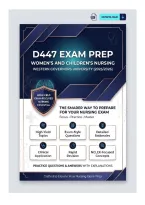
,D447 Women's and Children's Nursing Exam Prep
— Comprehensive Review + Practice MCQs —
Western Governors University 2025/2026
1. A client at 10 weeks' gestation presents for her first prenatal visit. Which assessment finding should the
nurse expect to be present at this gestational age?
A. Fetal heart tones auscultated with a fetoscope
B. Fetal movement felt by the mother (quickening)
C. Fundal height at the level of the umbilicus
D. Fetal heart tones detected via Doppler ultrasound
Correct Answer: D. Fetal heart tones detected via Doppler ultrasound
Rationale: At 10 weeks' gestation, fetal heart tones can be detected using Doppler ultrasound. Fetoscope
detection is typically possible at 18–20 weeks. Quickening is felt at 16–20 weeks. The fundus reaches the
umbilicus at approximately 20 weeks.
2. A client at 34 weeks' gestation reports severe itching without a rash, worse at night, particularly on the
palms and soles. Which condition should the nurse suspect?
A. Pruritic urticarial papules and plaques of pregnancy (PUPPP)
B. Intrahepatic cholestasis of pregnancy
C. Gestational pemphigoid
D. Scabies infestation
Correct Answer: B. Intrahepatic cholestasis of pregnancy
,Rationale: Intrahepatic cholestasis of pregnancy causes intense pruritus without rash, often involving the
palms and soles, and is worse at night due to elevated bile acids. PUPPP presents with urticarial papules and
plaques.
3. Using Naegele's Rule, a client's last menstrual period began on March 10, 2026. What is the estimated date
of delivery (EDD)?
A. December 3, 2026
B. December 17, 2026
C. December 10, 2026
D. December 24, 2026
Correct Answer: B. December 17, 2026
Rationale: Naegele's Rule: Subtract 3 months from the first day of the LMP and add 7 days, plus 1 year. March
10 – 3 months = December 10; December 10 + 7 days = December 17, 2026.
4. A client's obstetric history is documented as G5P3114. How should the nurse interpret this notation?
A. 5 pregnancies, 3 term births, 1 living child, 1 abortion, 4 preterm births
B. 5 pregnancies, 3 term births, 1 preterm birth, 1 abortion/miscarriage, 4 living children
C. 3 pregnancies, 5 term births, 1 abortion, 1 preterm birth, 4 living children
D. 5 pregnancies, 3 abortions, 1 preterm birth, 1 term birth, 4 living children
Correct Answer: B. 5 pregnancies, 3 term births, 1 preterm birth, 1 abortion/miscarriage, 4 living children
, Rationale: GTPAL notation: Gravida (total pregnancies), Term births, Preterm births, Abortions/miscarriages,
Living children. G5P3114 = 5 pregnancies, 3 term, 1 preterm, 1 abortion, 4 living.
5. A client at 32 weeks' gestation reports frequent urination. Which response by the nurse is most accurate?
A. "This is a sign of gestational diabetes and requires immediate testing."
B. "This is a sign of preterm labor and you should go to the hospital."
C. "This is normal due to the enlarging uterus pressing on your bladder."
D. "This indicates a urinary tract infection and you need antibiotics."
Correct Answer: C. "This is normal due to the enlarging uterus pressing on your bladder."
Rationale: Frequent urination is a normal physiological change in pregnancy, especially in the first and third
trimesters, due to pressure from the enlarging uterus on the bladder.
6. A client at 28 weeks' gestation is Rh-negative. Which intervention is indicated at this time?
A. Administer Rh immune globulin (RhoGAM) at 28 weeks
B. Administer Rh immune globulin after delivery only
C. Administer Rh immune globulin at 36 weeks
D. No intervention is indicated during pregnancy
Correct Answer: A. Administer Rh immune globulin (RhoGAM) at 28 weeks
Rationale: Rh-negative mothers should receive RhoGAM at 28 weeks' gestation and again within 72 hours of
delivery if the infant is Rh-positive. This prevents Rh isoimmunization.
— Comprehensive Review + Practice MCQs —
Western Governors University 2025/2026
1. A client at 10 weeks' gestation presents for her first prenatal visit. Which assessment finding should the
nurse expect to be present at this gestational age?
A. Fetal heart tones auscultated with a fetoscope
B. Fetal movement felt by the mother (quickening)
C. Fundal height at the level of the umbilicus
D. Fetal heart tones detected via Doppler ultrasound
Correct Answer: D. Fetal heart tones detected via Doppler ultrasound
Rationale: At 10 weeks' gestation, fetal heart tones can be detected using Doppler ultrasound. Fetoscope
detection is typically possible at 18–20 weeks. Quickening is felt at 16–20 weeks. The fundus reaches the
umbilicus at approximately 20 weeks.
2. A client at 34 weeks' gestation reports severe itching without a rash, worse at night, particularly on the
palms and soles. Which condition should the nurse suspect?
A. Pruritic urticarial papules and plaques of pregnancy (PUPPP)
B. Intrahepatic cholestasis of pregnancy
C. Gestational pemphigoid
D. Scabies infestation
Correct Answer: B. Intrahepatic cholestasis of pregnancy
,Rationale: Intrahepatic cholestasis of pregnancy causes intense pruritus without rash, often involving the
palms and soles, and is worse at night due to elevated bile acids. PUPPP presents with urticarial papules and
plaques.
3. Using Naegele's Rule, a client's last menstrual period began on March 10, 2026. What is the estimated date
of delivery (EDD)?
A. December 3, 2026
B. December 17, 2026
C. December 10, 2026
D. December 24, 2026
Correct Answer: B. December 17, 2026
Rationale: Naegele's Rule: Subtract 3 months from the first day of the LMP and add 7 days, plus 1 year. March
10 – 3 months = December 10; December 10 + 7 days = December 17, 2026.
4. A client's obstetric history is documented as G5P3114. How should the nurse interpret this notation?
A. 5 pregnancies, 3 term births, 1 living child, 1 abortion, 4 preterm births
B. 5 pregnancies, 3 term births, 1 preterm birth, 1 abortion/miscarriage, 4 living children
C. 3 pregnancies, 5 term births, 1 abortion, 1 preterm birth, 4 living children
D. 5 pregnancies, 3 abortions, 1 preterm birth, 1 term birth, 4 living children
Correct Answer: B. 5 pregnancies, 3 term births, 1 preterm birth, 1 abortion/miscarriage, 4 living children
, Rationale: GTPAL notation: Gravida (total pregnancies), Term births, Preterm births, Abortions/miscarriages,
Living children. G5P3114 = 5 pregnancies, 3 term, 1 preterm, 1 abortion, 4 living.
5. A client at 32 weeks' gestation reports frequent urination. Which response by the nurse is most accurate?
A. "This is a sign of gestational diabetes and requires immediate testing."
B. "This is a sign of preterm labor and you should go to the hospital."
C. "This is normal due to the enlarging uterus pressing on your bladder."
D. "This indicates a urinary tract infection and you need antibiotics."
Correct Answer: C. "This is normal due to the enlarging uterus pressing on your bladder."
Rationale: Frequent urination is a normal physiological change in pregnancy, especially in the first and third
trimesters, due to pressure from the enlarging uterus on the bladder.
6. A client at 28 weeks' gestation is Rh-negative. Which intervention is indicated at this time?
A. Administer Rh immune globulin (RhoGAM) at 28 weeks
B. Administer Rh immune globulin after delivery only
C. Administer Rh immune globulin at 36 weeks
D. No intervention is indicated during pregnancy
Correct Answer: A. Administer Rh immune globulin (RhoGAM) at 28 weeks
Rationale: Rh-negative mothers should receive RhoGAM at 28 weeks' gestation and again within 72 hours of
delivery if the infant is Rh-positive. This prevents Rh isoimmunization.


