
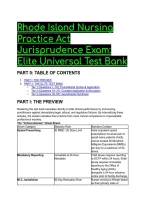
Rhode Island Nursing
Practice Act
Jurisprudence Exam:
Elite Universal Test Bank
PART 0: TABLE OF CONTENTS
1. PART I: THE PREVIEW
2. PART II: THE ELITE TEST BANK
○ Tier 1 (Questions 1–18): Foundational Syntax & Application
○ Tier 2 (Questions 19–37): Complex Application & Simulation
○ Tier 3 (Questions 38–55): Grandmaster Synthesis
PART I: THE PREVIEW
Mastering this test bank translates directly to elite clinical performance by immunizing
practitioners against devastating legal, ethical, and regulatory failures. By internalizing these
statutes, the student elevates their practice from mere clinical competence to impenetrable
professional mastery.
The "Critical Axioms" Cheat Sheet:
Axiom Category Statutory Rule Narrative Context
Opioid Prescribing 30 MME / 20 Dose Limit Initial outpatient opioid
prescriptions for acute pain in
opioid-naïve patients strictly
cannot exceed 30 Morphine
Milligram Equivalents (MMEs)
per day for a maximum of 20
doses.
Mandatory Reporting Immediate & 24-Hour Child abuse requires reporting
Mandates to DCYF within 24 hours. Elder
abuse requires immediate
reporting to the Office of
Healthy Aging (OHA),
alongside a 24-hour advance
notice prior to facility discharge.
NLC Jurisdiction 60-Day Relocation Rule Nurses moving to Rhode Island
as their primary state of
,Axiom Category Statutory Rule Narrative Context
residence must apply for a new
multistate license within 60
days of the move.
Scope Autonomy Global Signature Authority Rhode Island APRNs possess
global signature authority,
meaning their signature carries
the exact same legal weight as
a physician's signature on any
state medical form.
Delegation Predictability & Stability Registered Nurses may only
delegate tasks to Unlicensed
Assistive Personnel (UAP) if
the client's condition is stable
and the task requires no
independent nursing
assessment.
PART II: THE ELITE TEST BANK
Tier 1 (Questions 1–18): Foundational Syntax & Application
Q1: A registered nurse encounters an 8-year-old pediatric patient with unexplainable, patterned
bruising indicating severe physical trauma. The child's guardian provides a mechanism of injury
that contradicts the clinical presentation. Based on the principles of the Rhode Island Mandatory
Reporting Statutes, which action is the FIRST legal requirement? A) Document the findings
comprehensively and wait for the attending physician to report the incident to law enforcement.
B) Contact the hospital social worker and delegate the reporting responsibility entirely to the
social work department. C) Contact the Department of Children, Youth and Families (DCYF)
within 24 hours to file a formal report. D) Confront the guardian directly to verify the suspicion
before taking legal action that could disrupt the family dynamic.
● Answer: C (Contact the Department of Children, Youth and Families (DCYF) within 24
hours to file a formal report.)
● Distractor Analysis:
○ A is incorrect: The statutory mandate rests on the individual who forms the
reasonable suspicion; delaying action to wait for a physician constitutes a direct
failure to report.
○ B is incorrect: While institutional policy often involves social workers, the law
dictates that mandatory reporting is a non-delegable personal responsibility.
○ D is incorrect: Confronting a suspected abuser severely compromises the
subsequent state investigation and places the vulnerable child at immediate risk of
retaliatory harm.
The Mentor's Analysis: The law demands immediate action upon the formation of reasonable
suspicion to prevent further trauma. When facing suspected child abuse, the immediate priority
is protecting the vulnerable party by contacting DCYF within 24 hours. By utilizing direct
reporting mechanisms, you bypass the common trap of institutional diffusion of responsibility
that historically leaves children in danger. Professional Intuition: Mandated reporting is an
individual, non-delegable statutory duty; you cannot pass the legal burden to a
, colleague.
Q2: A licensed practical nurse (LPN) operating in Rhode Island wishes to renew their active
license. Based on the principles of the Rhode Island Board of Nursing Continuing Education
Regulations, what is the MINIMUM continuing education requirement the LPN must meet? A) 20
continuing education hours every calendar year. B) 15 continuing education hours in the
preceding two years. C) No continuing education is required for LPNs, as this mandate applies
strictly to RNs and APRNs. D) 10 continuing education hours in the preceding two years.
● Answer: D (10 continuing education hours in the preceding two years.)
● Distractor Analysis:
○ A is incorrect: This distractor overestimates both the total hour requirement and the
frequency of the renewal cycle, creating an unnecessarily burdensome metric.
○ B is incorrect: This represents an outdated or out-of-state metric; Rhode Island
regulators specifically mandate a different threshold.
○ C is incorrect: The educational mandate applies universally across all tiers of
nursing licensure, ensuring baseline competency for LPNs, RNs, and APRNs alike.
The Mentor's Analysis: Continuing education serves as the regulatory mechanism ensuring
baseline clinical competency and awareness of evolving evidence-based practices. When facing
license renewal, the immediate priority is verifying you hold the documented 10 contact hours.
By utilizing correct continuing education tracking, you bypass the common trap of inadvertent
license lapse and subsequent illegal practice. Professional Intuition: If you cannot produce
documentation for 10 CE hours every two years, you forfeit the legal right to touch a
patient.
Q3: A recently graduated nursing student applies for initial licensure in Rhode Island and
receives an application fee receipt, allowing temporary practice. Based on the principles of the
Rhode Island Nursing Practice Act, what is the MAXIMUM timeframe this individual can practice
as a graduate nurse before receiving NCLEX results? A) 60 days, renewable once if the testing
center experiences documented delays. B) 90 days, strictly non-renewable. C) 120 days,
non-renewable. D) 6 months, pending explicit authorization from the Board of Nursing.
● Answer: B (90 days, strictly non-renewable.)
● Distractor Analysis:
○ A is incorrect: The statutory privilege to practice prior to examination results cannot
be extended or renewed under any administrative circumstances.
○ C is incorrect: The 120-day timeframe exceeds the absolute statutory limit
established by the state legislature.
○ D is incorrect: The six-month rule applies exclusively to out-of-state nurses
temporarily accompanying a resident, not to local graduates pending examination.
The Mentor's Analysis: The state grants a highly restrictive window for graduates to transition
safely to fully licensed practitioners. When facing the pre-licensure period, the immediate priority
is passing the NCLEX within the rigid 90-day window. By utilizing strict timeline management,
you bypass the common trap of practicing without authorization, which instantly transforms the
graduate into an illegal practitioner. Professional Intuition: Day 91 without a license
permanently extinguishes the graduate privilege.
Q4: An Advanced Practice Registered Nurse (APRN) initiates a prescription for an opioid-naïve
adult patient experiencing acute pain following a minor distal radius fracture. Based on the
principles of Rhode Island Opioid Prescribing Regulations, which dosage parameter is the
MOST APPROPRIATE legal limit? A) 40 Morphine Milligram Equivalents (MME) per day for 10
doses. B) 25 Morphine Milligram Equivalents (MME) per day for 30 doses. C) A long-acting
opioid at 30 Morphine Milligram Equivalents (MME) per day. D) 20 Morphine Milligram
Practice Act
Jurisprudence Exam:
Elite Universal Test Bank
PART 0: TABLE OF CONTENTS
1. PART I: THE PREVIEW
2. PART II: THE ELITE TEST BANK
○ Tier 1 (Questions 1–18): Foundational Syntax & Application
○ Tier 2 (Questions 19–37): Complex Application & Simulation
○ Tier 3 (Questions 38–55): Grandmaster Synthesis
PART I: THE PREVIEW
Mastering this test bank translates directly to elite clinical performance by immunizing
practitioners against devastating legal, ethical, and regulatory failures. By internalizing these
statutes, the student elevates their practice from mere clinical competence to impenetrable
professional mastery.
The "Critical Axioms" Cheat Sheet:
Axiom Category Statutory Rule Narrative Context
Opioid Prescribing 30 MME / 20 Dose Limit Initial outpatient opioid
prescriptions for acute pain in
opioid-naïve patients strictly
cannot exceed 30 Morphine
Milligram Equivalents (MMEs)
per day for a maximum of 20
doses.
Mandatory Reporting Immediate & 24-Hour Child abuse requires reporting
Mandates to DCYF within 24 hours. Elder
abuse requires immediate
reporting to the Office of
Healthy Aging (OHA),
alongside a 24-hour advance
notice prior to facility discharge.
NLC Jurisdiction 60-Day Relocation Rule Nurses moving to Rhode Island
as their primary state of
,Axiom Category Statutory Rule Narrative Context
residence must apply for a new
multistate license within 60
days of the move.
Scope Autonomy Global Signature Authority Rhode Island APRNs possess
global signature authority,
meaning their signature carries
the exact same legal weight as
a physician's signature on any
state medical form.
Delegation Predictability & Stability Registered Nurses may only
delegate tasks to Unlicensed
Assistive Personnel (UAP) if
the client's condition is stable
and the task requires no
independent nursing
assessment.
PART II: THE ELITE TEST BANK
Tier 1 (Questions 1–18): Foundational Syntax & Application
Q1: A registered nurse encounters an 8-year-old pediatric patient with unexplainable, patterned
bruising indicating severe physical trauma. The child's guardian provides a mechanism of injury
that contradicts the clinical presentation. Based on the principles of the Rhode Island Mandatory
Reporting Statutes, which action is the FIRST legal requirement? A) Document the findings
comprehensively and wait for the attending physician to report the incident to law enforcement.
B) Contact the hospital social worker and delegate the reporting responsibility entirely to the
social work department. C) Contact the Department of Children, Youth and Families (DCYF)
within 24 hours to file a formal report. D) Confront the guardian directly to verify the suspicion
before taking legal action that could disrupt the family dynamic.
● Answer: C (Contact the Department of Children, Youth and Families (DCYF) within 24
hours to file a formal report.)
● Distractor Analysis:
○ A is incorrect: The statutory mandate rests on the individual who forms the
reasonable suspicion; delaying action to wait for a physician constitutes a direct
failure to report.
○ B is incorrect: While institutional policy often involves social workers, the law
dictates that mandatory reporting is a non-delegable personal responsibility.
○ D is incorrect: Confronting a suspected abuser severely compromises the
subsequent state investigation and places the vulnerable child at immediate risk of
retaliatory harm.
The Mentor's Analysis: The law demands immediate action upon the formation of reasonable
suspicion to prevent further trauma. When facing suspected child abuse, the immediate priority
is protecting the vulnerable party by contacting DCYF within 24 hours. By utilizing direct
reporting mechanisms, you bypass the common trap of institutional diffusion of responsibility
that historically leaves children in danger. Professional Intuition: Mandated reporting is an
individual, non-delegable statutory duty; you cannot pass the legal burden to a
, colleague.
Q2: A licensed practical nurse (LPN) operating in Rhode Island wishes to renew their active
license. Based on the principles of the Rhode Island Board of Nursing Continuing Education
Regulations, what is the MINIMUM continuing education requirement the LPN must meet? A) 20
continuing education hours every calendar year. B) 15 continuing education hours in the
preceding two years. C) No continuing education is required for LPNs, as this mandate applies
strictly to RNs and APRNs. D) 10 continuing education hours in the preceding two years.
● Answer: D (10 continuing education hours in the preceding two years.)
● Distractor Analysis:
○ A is incorrect: This distractor overestimates both the total hour requirement and the
frequency of the renewal cycle, creating an unnecessarily burdensome metric.
○ B is incorrect: This represents an outdated or out-of-state metric; Rhode Island
regulators specifically mandate a different threshold.
○ C is incorrect: The educational mandate applies universally across all tiers of
nursing licensure, ensuring baseline competency for LPNs, RNs, and APRNs alike.
The Mentor's Analysis: Continuing education serves as the regulatory mechanism ensuring
baseline clinical competency and awareness of evolving evidence-based practices. When facing
license renewal, the immediate priority is verifying you hold the documented 10 contact hours.
By utilizing correct continuing education tracking, you bypass the common trap of inadvertent
license lapse and subsequent illegal practice. Professional Intuition: If you cannot produce
documentation for 10 CE hours every two years, you forfeit the legal right to touch a
patient.
Q3: A recently graduated nursing student applies for initial licensure in Rhode Island and
receives an application fee receipt, allowing temporary practice. Based on the principles of the
Rhode Island Nursing Practice Act, what is the MAXIMUM timeframe this individual can practice
as a graduate nurse before receiving NCLEX results? A) 60 days, renewable once if the testing
center experiences documented delays. B) 90 days, strictly non-renewable. C) 120 days,
non-renewable. D) 6 months, pending explicit authorization from the Board of Nursing.
● Answer: B (90 days, strictly non-renewable.)
● Distractor Analysis:
○ A is incorrect: The statutory privilege to practice prior to examination results cannot
be extended or renewed under any administrative circumstances.
○ C is incorrect: The 120-day timeframe exceeds the absolute statutory limit
established by the state legislature.
○ D is incorrect: The six-month rule applies exclusively to out-of-state nurses
temporarily accompanying a resident, not to local graduates pending examination.
The Mentor's Analysis: The state grants a highly restrictive window for graduates to transition
safely to fully licensed practitioners. When facing the pre-licensure period, the immediate priority
is passing the NCLEX within the rigid 90-day window. By utilizing strict timeline management,
you bypass the common trap of practicing without authorization, which instantly transforms the
graduate into an illegal practitioner. Professional Intuition: Day 91 without a license
permanently extinguishes the graduate privilege.
Q4: An Advanced Practice Registered Nurse (APRN) initiates a prescription for an opioid-naïve
adult patient experiencing acute pain following a minor distal radius fracture. Based on the
principles of Rhode Island Opioid Prescribing Regulations, which dosage parameter is the
MOST APPROPRIATE legal limit? A) 40 Morphine Milligram Equivalents (MME) per day for 10
doses. B) 25 Morphine Milligram Equivalents (MME) per day for 30 doses. C) A long-acting
opioid at 30 Morphine Milligram Equivalents (MME) per day. D) 20 Morphine Milligram


