
,
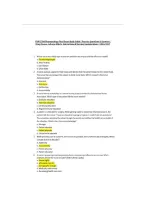
, PHM 2500 Pharmacology Final Exam | Practice
Questions & Answers | Drug Classes, Adverse
Effects, Interactions & Nursing Considerations |
2026/2027 update.-GALEN.
SECTION 1: PHARMACOKINETICS &
PHARMACODYNAMICS (Questions 1–10)
1. A nurse is caring for a patient who has been prescribed a
medication that is highly protein-bound. The patient also takes
another highly protein-bound medication. The nurse understands
that this combination may result in which effect?
A) Increased free drug concentration of both medications due to competition
for binding sites
B) Decreased free drug concentration of both medications due to saturation
C) Increased elimination of both medications from the body
D) Decreased therapeutic effect of both medications
Correct Answer: A
Rationale: When two highly protein-bound medications are administered
together, they compete for the same protein binding sites. This displacement
increases the free or unbound concentration of both drugs, potentially
leading to increased therapeutic effects and toxicity. The free fraction is
pharmacologically active, so increased free concentration enhances drug
effects .
Source: PHM 2500 Comprehensive Practice Exam
2. A nurse is monitoring a patient who is receiving a drug with a
narrow therapeutic index. Which laboratory value is most important
for the nurse to monitor to prevent toxicity?
, PHM 2500 Pharmacology Final Exam | Practice
Questions & Answers | Drug Classes, Adverse
Effects, Interactions & Nursing Considerations |
2026/2027 update.-GALEN.
SECTION 1: PHARMACOKINETICS &
PHARMACODYNAMICS (Questions 1–10)
1. A nurse is caring for a patient who has been prescribed a
medication that is highly protein-bound. The patient also takes
another highly protein-bound medication. The nurse understands
that this combination may result in which effect?
A) Increased free drug concentration of both medications due to competition
for binding sites
B) Decreased free drug concentration of both medications due to saturation
C) Increased elimination of both medications from the body
D) Decreased therapeutic effect of both medications
Correct Answer: A
Rationale: When two highly protein-bound medications are administered
together, they compete for the same protein binding sites. This displacement
increases the free or unbound concentration of both drugs, potentially
leading to increased therapeutic effects and toxicity. The free fraction is
pharmacologically active, so increased free concentration enhances drug
effects .
Source: PHM 2500 Comprehensive Practice Exam
2. A nurse is monitoring a patient who is receiving a drug with a
narrow therapeutic index. Which laboratory value is most important
for the nurse to monitor to prevent toxicity?


