
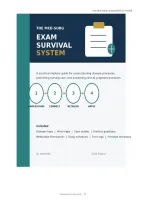
THE MED-SURG EXAM SURVIVAL SYSTEM
Educational study guide | 1
, THE MED-SURG EXAM SURVIVAL SYSTEM
THE MED-SURG EXAM SURVIVAL SYSTEM
How to Understand Disease Processes, Think Clinically, and Study for Higher Scores
WHAT YOU ARE HOLDING
This is a study system, not a pile of notes. It is designed to help you organize medical-surgical
nursing content, connect pathophysiology with assessment and pharmacology, practice clinical
judgment, and turn mistakes into targeted review.
How to use this guide
1. Read the chapter once for understanding, not memorization.
2. Complete the visual or worksheet activity at the end of the relevant section.
3. Close the guide and retrieve the main ideas from memory.
4. Use practice questions to test application.
5. Keep an error log and return to weak topics on a spaced schedule.
What is included
20 structured chapters built around disease maps, assessment, diagnostics, medications,
prioritization, and clinical judgment.
12 original diagrams and visual frameworks.
40 practice questions with explanations.
Printable study templates and dashboards.
7-day and 30-day study plans.
Case studies designed to train the full disease-to-decision chain.
The core promise
USE THE SYSTEM, NOT THE PANIC
You will not control how much content exists. You can control how you organize it, how often you
retrieve it, how deliberately you practice, and how precisely you repair mistakes.
CONTENTS
Chapter 01 | Stop Studying Med-Surg Like a Memorization Course
The mental shift that makes a huge volume of content manageable
Chapter 02 | Build the Disease Story Before You Build the Notes
A repeatable map for turning a condition into a connected mental model
Educational study guide | 2
, THE MED-SURG EXAM SURVIVAL SYSTEM
Chapter 03 | The Seven-Lens Disease Map
A complete study sheet that stays focused instead of becoming a mini textbook
Chapter 04 | Pathophysiology Without the Rabbit Hole
Understand enough physiology to predict the patient story
Chapter 05 | Assessment: Learn to See the Patient, Not the Chapter
Turn signs and symptoms into decisions
Chapter 06 | Diagnostics, Labs, and Numbers Without Memorization Overload
Use numbers to tell a clinical story
Chapter 07 | Pharmacology: Stop Studying Drugs in Isolation
Attach every important medication to a patient problem
Chapter 08 | From Lecture and Textbook to High-Yield Study Material
Process the material instead of copying it
Chapter 09 | Active Learning: Make Your Study Sessions Demand Something From You
Use retrieval, spacing, explanation, comparison, and application
Chapter 10 | Practice Questions: Turn Every Miss Into a Lesson
Practice is not a score-reporting exercise. It is a feedback system.
Chapter 11 | Clinical Judgment: Learn to Find the Priority
Move from disease recognition to patient-centered decisions
Chapter 12 | Compare Similar Conditions Instead of Mixing Them Up
Turn confusion into visible differences
Chapter 13 | Case Studies: Practice the Whole Chain
Train yourself to think from patient data to priority action
Chapter 14 | When You Keep Getting Questions Wrong
Turn repeated misses into a targeted repair plan
Chapter 15 | The Seven-Day Exam Sprint
A realistic final-week system that focuses on weaknesses
Chapter 16 | Printable Master Templates
Turn the method into a repeatable workbook
Chapter 17 | 40 Practice Questions for Med-Surg Study Mastery
Use these to train content understanding, prioritization, and study judgment
Chapter 18 | The 30-Day Med-Surg Mastery Plan
A longer runway for students who want consistency instead of rescue studying
Chapter 19 | The Complete Mastery Checklist
The final system in one place
Chapter 20 | Conclusion: From Memorizing Facts to Thinking Like a Nurse
A final reset before you study your next chapter
Educational study guide | 3
, THE MED-SURG EXAM SURVIVAL SYSTEM
VISUAL INDEX
Figure 1 - Med-Surg Mastery Ladder
Figure 2 - The Disease Story
Figure 3 - Seven-Lens Disease Map
Figure 4 - Medication Bridge
Figure 5 - Clinical Judgment Loop
Figure 6 - Question Attack Sequence
Figure 7 - Study Cycle
Figure 8 - Thinking-Heavy Study Block
Figure 9 - Illustrative Practice-Accuracy Trajectory
Figure 10 - Illustrative Final-Week Time Allocation
Figure 11 - Case Study Map
Figure 12 - Error Loop
Educational study guide | 4
Educational study guide | 1
, THE MED-SURG EXAM SURVIVAL SYSTEM
THE MED-SURG EXAM SURVIVAL SYSTEM
How to Understand Disease Processes, Think Clinically, and Study for Higher Scores
WHAT YOU ARE HOLDING
This is a study system, not a pile of notes. It is designed to help you organize medical-surgical
nursing content, connect pathophysiology with assessment and pharmacology, practice clinical
judgment, and turn mistakes into targeted review.
How to use this guide
1. Read the chapter once for understanding, not memorization.
2. Complete the visual or worksheet activity at the end of the relevant section.
3. Close the guide and retrieve the main ideas from memory.
4. Use practice questions to test application.
5. Keep an error log and return to weak topics on a spaced schedule.
What is included
20 structured chapters built around disease maps, assessment, diagnostics, medications,
prioritization, and clinical judgment.
12 original diagrams and visual frameworks.
40 practice questions with explanations.
Printable study templates and dashboards.
7-day and 30-day study plans.
Case studies designed to train the full disease-to-decision chain.
The core promise
USE THE SYSTEM, NOT THE PANIC
You will not control how much content exists. You can control how you organize it, how often you
retrieve it, how deliberately you practice, and how precisely you repair mistakes.
CONTENTS
Chapter 01 | Stop Studying Med-Surg Like a Memorization Course
The mental shift that makes a huge volume of content manageable
Chapter 02 | Build the Disease Story Before You Build the Notes
A repeatable map for turning a condition into a connected mental model
Educational study guide | 2
, THE MED-SURG EXAM SURVIVAL SYSTEM
Chapter 03 | The Seven-Lens Disease Map
A complete study sheet that stays focused instead of becoming a mini textbook
Chapter 04 | Pathophysiology Without the Rabbit Hole
Understand enough physiology to predict the patient story
Chapter 05 | Assessment: Learn to See the Patient, Not the Chapter
Turn signs and symptoms into decisions
Chapter 06 | Diagnostics, Labs, and Numbers Without Memorization Overload
Use numbers to tell a clinical story
Chapter 07 | Pharmacology: Stop Studying Drugs in Isolation
Attach every important medication to a patient problem
Chapter 08 | From Lecture and Textbook to High-Yield Study Material
Process the material instead of copying it
Chapter 09 | Active Learning: Make Your Study Sessions Demand Something From You
Use retrieval, spacing, explanation, comparison, and application
Chapter 10 | Practice Questions: Turn Every Miss Into a Lesson
Practice is not a score-reporting exercise. It is a feedback system.
Chapter 11 | Clinical Judgment: Learn to Find the Priority
Move from disease recognition to patient-centered decisions
Chapter 12 | Compare Similar Conditions Instead of Mixing Them Up
Turn confusion into visible differences
Chapter 13 | Case Studies: Practice the Whole Chain
Train yourself to think from patient data to priority action
Chapter 14 | When You Keep Getting Questions Wrong
Turn repeated misses into a targeted repair plan
Chapter 15 | The Seven-Day Exam Sprint
A realistic final-week system that focuses on weaknesses
Chapter 16 | Printable Master Templates
Turn the method into a repeatable workbook
Chapter 17 | 40 Practice Questions for Med-Surg Study Mastery
Use these to train content understanding, prioritization, and study judgment
Chapter 18 | The 30-Day Med-Surg Mastery Plan
A longer runway for students who want consistency instead of rescue studying
Chapter 19 | The Complete Mastery Checklist
The final system in one place
Chapter 20 | Conclusion: From Memorizing Facts to Thinking Like a Nurse
A final reset before you study your next chapter
Educational study guide | 3
, THE MED-SURG EXAM SURVIVAL SYSTEM
VISUAL INDEX
Figure 1 - Med-Surg Mastery Ladder
Figure 2 - The Disease Story
Figure 3 - Seven-Lens Disease Map
Figure 4 - Medication Bridge
Figure 5 - Clinical Judgment Loop
Figure 6 - Question Attack Sequence
Figure 7 - Study Cycle
Figure 8 - Thinking-Heavy Study Block
Figure 9 - Illustrative Practice-Accuracy Trajectory
Figure 10 - Illustrative Final-Week Time Allocation
Figure 11 - Case Study Map
Figure 12 - Error Loop
Educational study guide | 4


