
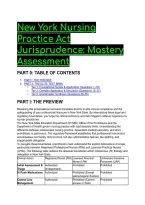
New York Nursing
Practice Act
Jurisprudence: Mastery
Assessment
PART 0: TABLE OF CONTENTS
1. PART I: THE PREVIEW
2. PART II: THE ELITE TEST BANK
○ Tier 1: Foundational Syntax & Application (Questions 1–18)
○ Tier 2: Complex Application & Simulation (Questions 19–37)
○ Tier 3: Grandmaster Synthesis (Questions 38–55)
PART I: THE PREVIEW
Mastering this jurisprudence test bank translates directly to elite clinical compliance and the
safeguarding of your professional licensure in New York State. By internalizing these legal and
regulatory boundaries, you forge the clinical autonomy and risk-mitigation reflexes required of a
top-tier practitioner.
The New York State Education Department (NYSED) Office of the Professions and the
Department of Health govern nursing practice with rigid statutory limits. Understanding the
difference between independent nursing practice, dependent medical execution, and strict
prohibitions is paramount. The regulatory framework establishes that professional misconduct
encompasses not merely clinical errors, but also administrative failures, fee-splitting, and
inappropriate delegation.
To navigate these boundaries, practitioners must understand the explicit delineations of scope,
particularly between Registered Professional Nurses (RNs) and Licensed Practical Nurses
(LPNs). The following table outlines the absolute boundaries within intravenous (IV) therapy and
delegation in New York State.
Clinical Action Registered Nurse (RN) Licensed Practical Unlicensed Assistive
Nurse (LPN) Personnel (UAP)
Initial Assessment & Authorized Prohibited Prohibited
Triage (Independent)
IV Push Medications Authorized Prohibited (Except Prohibited
saline/heparin flushes)
Central Line Authorized Prohibited (Cannot Prohibited
Management access or flush)
,Clinical Action Registered Nurse (RN) Licensed Practical Unlicensed Assistive
Nurse (LPN) Personnel (UAP)
Blood Product Authorized Prohibited (May only Prohibited
Administration monitor after initial 15
mins)
Execution of Standing Authorized for specific Prohibited Prohibited
Orders public health/ED
contexts
Further, New York State imposes stringent requirements on the retention of medical records and
the administration of professional discipline. Failure to maintain accurate records, or the
alteration of such records, is categorized as professional misconduct and carries severe
penalties, up to and including a $10,000 fine per charge and license revocation.
Record Type / Penalty Statutory Requirement / Consequence
Adult Patient Records Minimum 6 years from the last date of
treatment.
Minor Patient Records Minimum 6 years, and until 1 year after the
minor reaches age 21.
OPD Inquiry Response Licensees must respond to NYSED inquiries
within 30 days.
Misconduct Fine (Max) Up to $10,000 per specification of guilt.
● Critical Axioms Cheat Sheet:
○ The Delegation Divide: New York defines "delegation" strictly as assigning tasks
between licensed professionals (RN to LPN); assigning tasks to Unlicensed
Assistive Personnel (UAP) is "work allocation" and strictly forbids the transfer of
nursing judgment.
○ The 16-Hour Redline: Voluntarily working beyond 16 continuous hours in a
24-hour period is actionable unprofessional conduct representing a willful disregard
for patient safety.
○ LPN Intravenous Limitations: LPNs in New York are strictly prohibited from
administering IV push medications, managing central lines, or executing IV blood
administration, regardless of facility policy or emergency context.
○ NP Autonomy Threshold: Nurse Practitioners (NPs) require a written collaborative
agreement until they surpass 3,600 hours of clinical practice, after which they may
practice independently.
○ Corporate Practice of Medicine (CPOM): Fee-splitting or paying commissions
based on medical procedures (e.g., MedSpa injectables) to RNs or LPNs is
professional misconduct under 8 NYCRR 29.1(b).
PART II: THE ELITE TEST BANK
Tier 1: Foundational Syntax & Application
Q1: Under New York State Education Law Article 139, a Registered Professional Nurse (RN) is
assigning vital sign collection to an Unlicensed Assistive Personnel (UAP). Based on the
principles of New York Jurisprudence, which regulatory definition BEST describes this action?
A) Professional Delegation B) Work Allocation C) Dependent Practice Transfer D) Scope
Expansion
, ● Answer: B (Work Allocation)
● Distractor Analysis:
○ A is incorrect: In New York, delegation is strictly defined as assigning activities
within a licensed professional's scope to another licensee (e.g., RN to LPN).
○ C is incorrect: There is no legal framework termed "dependent practice transfer" in
New York law.
○ D is incorrect: UAPs do not possess a defined clinical scope of practice to expand;
they perform non-professional health care tasks.
The Mentor's Analysis: New York uniquely separates the transfer of tasks into two distinct legal
categories based on licensure. Assigning tasks to unlicensed personnel is merely work
allocation, whereas delegation involves transferring authority between licensed professionals.
Professional Intuition: Never allocate tasks requiring nursing judgment, assessment, or
evaluation to unlicensed personnel.
Q2: An LPN is directed by an RN during a Code Blue to administer 1 mg of epinephrine via IV
push. Based on the principles of the New York State Board for Nursing, which action is the
ONLY lawful response? A) Administer the medication due to the emergency exemption in the
Nurse Practice Act. B) Refuse the directive because LPNs are prohibited from administering IV
push medications. C) Administer the medication only if the attending physician verbally
countersigns the RN's order. D) Refuse the directive unless the LPN possesses a specialized IV
certification approved by NYSED.
● Answer: B (Refuse the directive because LPNs are prohibited from administering IV push
medications.)
● Distractor Analysis:
○ A is incorrect: Emergency situations do not expand statutory scope of practice;
LPNs cannot push IV medications other than heparin/saline flushes.
○ C is incorrect: Physician verbal orders do not override the strict statutory
prohibitions placed on the LPN license in New York. * D is incorrect: Additional IV
certification in New York does not grant LPNs the legal authority to administer IV
push therapeutic medications.
The Mentor's Analysis: The LPN scope of practice in New York rigidly excludes IV push
therapeutic medications, IV blood administration, and central line access, regardless of
advanced training or emergency status. Professional Intuition: Scope of practice acts as a
hard deck; facility policy or emergency context can never authorize you to pierce it.
Q3: To maintain active registration, a New York RN must complete state-mandated training on
Infection Control. Based on the rules of the NYSED Office of the Professions, what is the
REQUIRED frequency for this specific coursework? A) Every 2 years B) Every 3 years C) Every
4 years D) Every 6 years
● Answer: C (Every 4 years)
● Distractor Analysis:
○ A is incorrect: A two-year cycle applies to certain other jurisdictions, not New York's
infection control mandate.
○ B is incorrect: While the RN license registration must be renewed every three years,
the infection control training specifically operates on a different cycle.
○ D is incorrect: Six years is the minimum retention period for medical records, not
the training cycle.
The Mentor's Analysis: Regulatory compliance requires tracking multiple, asynchronous
timelines. Triennial registration allows practice, but quadrennial infection control training
maintains eligibility. Professional Intuition: Your registration renews every three years;
Practice Act
Jurisprudence: Mastery
Assessment
PART 0: TABLE OF CONTENTS
1. PART I: THE PREVIEW
2. PART II: THE ELITE TEST BANK
○ Tier 1: Foundational Syntax & Application (Questions 1–18)
○ Tier 2: Complex Application & Simulation (Questions 19–37)
○ Tier 3: Grandmaster Synthesis (Questions 38–55)
PART I: THE PREVIEW
Mastering this jurisprudence test bank translates directly to elite clinical compliance and the
safeguarding of your professional licensure in New York State. By internalizing these legal and
regulatory boundaries, you forge the clinical autonomy and risk-mitigation reflexes required of a
top-tier practitioner.
The New York State Education Department (NYSED) Office of the Professions and the
Department of Health govern nursing practice with rigid statutory limits. Understanding the
difference between independent nursing practice, dependent medical execution, and strict
prohibitions is paramount. The regulatory framework establishes that professional misconduct
encompasses not merely clinical errors, but also administrative failures, fee-splitting, and
inappropriate delegation.
To navigate these boundaries, practitioners must understand the explicit delineations of scope,
particularly between Registered Professional Nurses (RNs) and Licensed Practical Nurses
(LPNs). The following table outlines the absolute boundaries within intravenous (IV) therapy and
delegation in New York State.
Clinical Action Registered Nurse (RN) Licensed Practical Unlicensed Assistive
Nurse (LPN) Personnel (UAP)
Initial Assessment & Authorized Prohibited Prohibited
Triage (Independent)
IV Push Medications Authorized Prohibited (Except Prohibited
saline/heparin flushes)
Central Line Authorized Prohibited (Cannot Prohibited
Management access or flush)
,Clinical Action Registered Nurse (RN) Licensed Practical Unlicensed Assistive
Nurse (LPN) Personnel (UAP)
Blood Product Authorized Prohibited (May only Prohibited
Administration monitor after initial 15
mins)
Execution of Standing Authorized for specific Prohibited Prohibited
Orders public health/ED
contexts
Further, New York State imposes stringent requirements on the retention of medical records and
the administration of professional discipline. Failure to maintain accurate records, or the
alteration of such records, is categorized as professional misconduct and carries severe
penalties, up to and including a $10,000 fine per charge and license revocation.
Record Type / Penalty Statutory Requirement / Consequence
Adult Patient Records Minimum 6 years from the last date of
treatment.
Minor Patient Records Minimum 6 years, and until 1 year after the
minor reaches age 21.
OPD Inquiry Response Licensees must respond to NYSED inquiries
within 30 days.
Misconduct Fine (Max) Up to $10,000 per specification of guilt.
● Critical Axioms Cheat Sheet:
○ The Delegation Divide: New York defines "delegation" strictly as assigning tasks
between licensed professionals (RN to LPN); assigning tasks to Unlicensed
Assistive Personnel (UAP) is "work allocation" and strictly forbids the transfer of
nursing judgment.
○ The 16-Hour Redline: Voluntarily working beyond 16 continuous hours in a
24-hour period is actionable unprofessional conduct representing a willful disregard
for patient safety.
○ LPN Intravenous Limitations: LPNs in New York are strictly prohibited from
administering IV push medications, managing central lines, or executing IV blood
administration, regardless of facility policy or emergency context.
○ NP Autonomy Threshold: Nurse Practitioners (NPs) require a written collaborative
agreement until they surpass 3,600 hours of clinical practice, after which they may
practice independently.
○ Corporate Practice of Medicine (CPOM): Fee-splitting or paying commissions
based on medical procedures (e.g., MedSpa injectables) to RNs or LPNs is
professional misconduct under 8 NYCRR 29.1(b).
PART II: THE ELITE TEST BANK
Tier 1: Foundational Syntax & Application
Q1: Under New York State Education Law Article 139, a Registered Professional Nurse (RN) is
assigning vital sign collection to an Unlicensed Assistive Personnel (UAP). Based on the
principles of New York Jurisprudence, which regulatory definition BEST describes this action?
A) Professional Delegation B) Work Allocation C) Dependent Practice Transfer D) Scope
Expansion
, ● Answer: B (Work Allocation)
● Distractor Analysis:
○ A is incorrect: In New York, delegation is strictly defined as assigning activities
within a licensed professional's scope to another licensee (e.g., RN to LPN).
○ C is incorrect: There is no legal framework termed "dependent practice transfer" in
New York law.
○ D is incorrect: UAPs do not possess a defined clinical scope of practice to expand;
they perform non-professional health care tasks.
The Mentor's Analysis: New York uniquely separates the transfer of tasks into two distinct legal
categories based on licensure. Assigning tasks to unlicensed personnel is merely work
allocation, whereas delegation involves transferring authority between licensed professionals.
Professional Intuition: Never allocate tasks requiring nursing judgment, assessment, or
evaluation to unlicensed personnel.
Q2: An LPN is directed by an RN during a Code Blue to administer 1 mg of epinephrine via IV
push. Based on the principles of the New York State Board for Nursing, which action is the
ONLY lawful response? A) Administer the medication due to the emergency exemption in the
Nurse Practice Act. B) Refuse the directive because LPNs are prohibited from administering IV
push medications. C) Administer the medication only if the attending physician verbally
countersigns the RN's order. D) Refuse the directive unless the LPN possesses a specialized IV
certification approved by NYSED.
● Answer: B (Refuse the directive because LPNs are prohibited from administering IV push
medications.)
● Distractor Analysis:
○ A is incorrect: Emergency situations do not expand statutory scope of practice;
LPNs cannot push IV medications other than heparin/saline flushes.
○ C is incorrect: Physician verbal orders do not override the strict statutory
prohibitions placed on the LPN license in New York. * D is incorrect: Additional IV
certification in New York does not grant LPNs the legal authority to administer IV
push therapeutic medications.
The Mentor's Analysis: The LPN scope of practice in New York rigidly excludes IV push
therapeutic medications, IV blood administration, and central line access, regardless of
advanced training or emergency status. Professional Intuition: Scope of practice acts as a
hard deck; facility policy or emergency context can never authorize you to pierce it.
Q3: To maintain active registration, a New York RN must complete state-mandated training on
Infection Control. Based on the rules of the NYSED Office of the Professions, what is the
REQUIRED frequency for this specific coursework? A) Every 2 years B) Every 3 years C) Every
4 years D) Every 6 years
● Answer: C (Every 4 years)
● Distractor Analysis:
○ A is incorrect: A two-year cycle applies to certain other jurisdictions, not New York's
infection control mandate.
○ B is incorrect: While the RN license registration must be renewed every three years,
the infection control training specifically operates on a different cycle.
○ D is incorrect: Six years is the minimum retention period for medical records, not
the training cycle.
The Mentor's Analysis: Regulatory compliance requires tracking multiple, asynchronous
timelines. Triennial registration allows practice, but quadrennial infection control training
maintains eligibility. Professional Intuition: Your registration renews every three years;


