
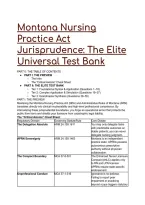
Montana Nursing
Practice Act
Jurisprudence: The Elite
Universal Test Bank
PART 0: THE TABLE OF CONTENTS
● PART I: THE PREVIEW
○ The Intro
○ The "Critical Axioms" Cheat Sheet
● PART II: THE ELITE TEST BANK
○ Tier 1: Foundational Syntax & Application (Questions 1–18)
○ Tier 2: Complex Application & Simulation (Questions 19–37)
○ Tier 3: Grandmaster Synthesis (Questions 38–55)
PART I: THE PREVIEW
Mastering the Montana Nursing Practice Act (NPA) and Administrative Rules of Montana (ARM)
translates directly into clinical invulnerability and high-level professional competence. By
internalizing these jurisprudential boundaries, you forge an operational armor that protects the
public from harm and shields your licensure from catastrophic legal liability.
The "Critical Axioms" Cheat Sheet:
Regulatory Domain Governing Statute/Rule Core Dictate
The Delegation Absolute ARM 24.159.1611 You may only delegate tasks
with predictable outcomes on
stable patients; you can never
delegate nursing judgment.
APRN Sovereignty ARM 24.159.1463 Montana is an independent
practice state; APRNs possess
autonomous prescriptive
authority without physician
collaboration.
The Compact Boundary MCA 37-8-501 The Enhanced Nurse Licensure
Compact (eNLC) applies only
to RN and LPN licenses.
APRNs require state-specific
endorsement.
Unprofessional Conduct MCA 37-1-316 Ignorance is no defense.
Failing to report peer
impairment or practicing
beyond scope triggers statutory
,Regulatory Domain Governing Statute/Rule Core Dictate
discipline.
License Termination ARM 24.101.402 A license expired beyond two
years is legally terminated and
cannot be reactivated; the
nurse must reapply.
PART II: THE ELITE TEST BANK
Tier 1: Foundational Syntax & Application
Q1: A registered nurse is preparing to assign morning care tasks to an unlicensed assistive
personnel (UAP) for a patient admitted with acute respiratory distress. Based on the principles
of ARM 24.159.1611 Criteria for Delegation, which action is the MOST APPROPRIATE? A)
Delegate the administration of an IV push diuretic to stabilize the patient's respiratory status. B)
Delegate the initial physical assessment of the patient's lung sounds to the UAP. C) Withhold
delegation of any tasks until the nurse personally assesses the patient's condition. D) Delegate
the creation of the nursing care plan to the UAP while the nurse gathers medications.
● Answer: C (Withhold delegation of any tasks until the nurse personally assesses the
patient's condition.)
● Distractor Analysis:
○ A is incorrect: IV medication administration is explicitly outside the scope of a UAP
and constitutes a severe violation of delegation rules.
○ B is incorrect: Assessment requires clinical reasoning and nursing judgment, which
cannot be legally delegated to unlicensed personnel.
○ D is incorrect: Care planning is an autonomous RN function and cannot be
delegated.
The Mentor's Analysis: Delegation relies on the baseline stability of the patient. When facing a
newly admitted or acute patient, the immediate priority is conducting an independent RN
assessment. By utilizing direct assessment protocols, you bypass the common trap of
delegating tasks on an unstable patient. Professional Intuition: Never delegate tasks involving
a patient whose clinical baseline is unknown or acutely fluctuating.
Q2: An Advanced Practice Registered Nurse (APRN) from an eNLC state wishes to provide
telehealth services to a resident in Montana. Based on the principles of the Montana Nurse
Practice Act, which conclusion is CORRECT regarding their licensure? A) The APRN may
practice under their home state's multistate RN compact privilege without additional licensing. B)
The APRN must secure a temporary physician sponsor in Montana before initiating telehealth.
C) The APRN must obtain an active Montana APRN license to provide advanced practice
services to a Montana resident. D) The APRN can utilize their home state APRN license for up
to 30 days before applying to Montana.
● Answer: C (The APRN must obtain an active Montana APRN license to provide advanced
practice services to a Montana resident.)
● Distractor Analysis:
○ A is incorrect: The eNLC covers RN and LPN practice, not advanced practice. An
RN compact license does not authorize APRN functions.
○ B is incorrect: Montana is an independent practice state; APRNs do not require a
physician sponsor or collaborative practice agreement.
○ D is incorrect: There is no 30-day grace period for out-of-state APRN practice
, without a Montana license.
The Mentor's Analysis: Jurisdiction is tied to the physical location of the patient. When facing
cross-border telehealth scenarios, the immediate priority is securing a state-specific APRN
credential. By utilizing Montana's APRN licensure pathway, you bypass the common trap of
assuming the RN compact covers advanced practice. Professional Intuition: The Nurse
Licensure Compact ends where Advanced Practice begins.
Q3: A Licensed Practical Nurse (LPN) is directed by a physician to administer an IV push of an
analgesic to a postoperative adult patient. Based on the principles of ARM 24.159.1010
Standards Related to Intravenous Therapy, which action is MOST APPROPRIATE? A) Refuse
the order, as LPNs are strictly prohibited from administering any medications via IV push. B)
Require a registered nurse to physically push the medication while the LPN documents the
intervention. C) Administer the IV push analgesic, provided the LPN has successfully completed
an approved IV therapy training course. D) Request an unlicensed assistive personnel to
administer the medication under the LPN's direct line of sight.
● Answer: C (Administer the IV push analgesic, provided the LPN has successfully
completed an approved IV therapy training course.)
● Distractor Analysis:
○ A is incorrect: Under Montana ARM 24.159.1010, LPNs with proper IV training are
explicitly allowed to administer specific IV push medications, including analgesics,
to adult clients.
○ B is incorrect: It is unnecessary to pass the task to an RN if the LPN is adequately
trained, as it falls within the LPN scope of practice.
○ D is incorrect: UAPs cannot administer IV push medications under any
circumstances.
The Mentor's Analysis: The LPN scope of practice in Montana includes specific, limited IV push
capabilities for adults. When facing an order for an IV analgesic, the immediate priority is
verifying the LPN's educational competency on file. By utilizing established training standards,
you bypass the common trap of artificially limiting the LPN's legal scope. Professional Intuition:
Montana LPNs can push standard analgesics and antiemetics to adults, provided their
competency is documented.
Q4: A registered nurse is convicted of a misdemeanor relating to violence. Based on the
principles of ARM 24.101.402 and 24.159.403, what is the IMMEDIATE consequence when
renewing or applying for a license? A) The application is automatically denied permanently. B)
The application is flagged as nonroutine and requires formal review and approval by the Board
of Nursing. C) The conviction is ignored because it is not a felony. D) The nurse must retake the
NCLEX-RN examination before the application is processed.
● Answer: B (The application is flagged as nonroutine and requires formal review and
approval by the Board of Nursing.)
● Distractor Analysis:
○ A is incorrect: A misdemeanor conviction does not trigger an automatic permanent
denial; it triggers a review.
○ C is incorrect: Misdemeanors related to sex, drugs, or violence explicitly classify an
application as nonroutine in Montana.
○ D is incorrect: NCLEX re-examination is used for lapsed clinical competency, not as
a primary punitive measure for criminal convictions.
The Mentor's Analysis: Criminal histories relating to violence directly impact public safety and
board trust. When facing a relevant conviction disclosure, the immediate priority is routing the
file for Board scrutiny. By utilizing the nonroutine application protocol, you bypass the common
Practice Act
Jurisprudence: The Elite
Universal Test Bank
PART 0: THE TABLE OF CONTENTS
● PART I: THE PREVIEW
○ The Intro
○ The "Critical Axioms" Cheat Sheet
● PART II: THE ELITE TEST BANK
○ Tier 1: Foundational Syntax & Application (Questions 1–18)
○ Tier 2: Complex Application & Simulation (Questions 19–37)
○ Tier 3: Grandmaster Synthesis (Questions 38–55)
PART I: THE PREVIEW
Mastering the Montana Nursing Practice Act (NPA) and Administrative Rules of Montana (ARM)
translates directly into clinical invulnerability and high-level professional competence. By
internalizing these jurisprudential boundaries, you forge an operational armor that protects the
public from harm and shields your licensure from catastrophic legal liability.
The "Critical Axioms" Cheat Sheet:
Regulatory Domain Governing Statute/Rule Core Dictate
The Delegation Absolute ARM 24.159.1611 You may only delegate tasks
with predictable outcomes on
stable patients; you can never
delegate nursing judgment.
APRN Sovereignty ARM 24.159.1463 Montana is an independent
practice state; APRNs possess
autonomous prescriptive
authority without physician
collaboration.
The Compact Boundary MCA 37-8-501 The Enhanced Nurse Licensure
Compact (eNLC) applies only
to RN and LPN licenses.
APRNs require state-specific
endorsement.
Unprofessional Conduct MCA 37-1-316 Ignorance is no defense.
Failing to report peer
impairment or practicing
beyond scope triggers statutory
,Regulatory Domain Governing Statute/Rule Core Dictate
discipline.
License Termination ARM 24.101.402 A license expired beyond two
years is legally terminated and
cannot be reactivated; the
nurse must reapply.
PART II: THE ELITE TEST BANK
Tier 1: Foundational Syntax & Application
Q1: A registered nurse is preparing to assign morning care tasks to an unlicensed assistive
personnel (UAP) for a patient admitted with acute respiratory distress. Based on the principles
of ARM 24.159.1611 Criteria for Delegation, which action is the MOST APPROPRIATE? A)
Delegate the administration of an IV push diuretic to stabilize the patient's respiratory status. B)
Delegate the initial physical assessment of the patient's lung sounds to the UAP. C) Withhold
delegation of any tasks until the nurse personally assesses the patient's condition. D) Delegate
the creation of the nursing care plan to the UAP while the nurse gathers medications.
● Answer: C (Withhold delegation of any tasks until the nurse personally assesses the
patient's condition.)
● Distractor Analysis:
○ A is incorrect: IV medication administration is explicitly outside the scope of a UAP
and constitutes a severe violation of delegation rules.
○ B is incorrect: Assessment requires clinical reasoning and nursing judgment, which
cannot be legally delegated to unlicensed personnel.
○ D is incorrect: Care planning is an autonomous RN function and cannot be
delegated.
The Mentor's Analysis: Delegation relies on the baseline stability of the patient. When facing a
newly admitted or acute patient, the immediate priority is conducting an independent RN
assessment. By utilizing direct assessment protocols, you bypass the common trap of
delegating tasks on an unstable patient. Professional Intuition: Never delegate tasks involving
a patient whose clinical baseline is unknown or acutely fluctuating.
Q2: An Advanced Practice Registered Nurse (APRN) from an eNLC state wishes to provide
telehealth services to a resident in Montana. Based on the principles of the Montana Nurse
Practice Act, which conclusion is CORRECT regarding their licensure? A) The APRN may
practice under their home state's multistate RN compact privilege without additional licensing. B)
The APRN must secure a temporary physician sponsor in Montana before initiating telehealth.
C) The APRN must obtain an active Montana APRN license to provide advanced practice
services to a Montana resident. D) The APRN can utilize their home state APRN license for up
to 30 days before applying to Montana.
● Answer: C (The APRN must obtain an active Montana APRN license to provide advanced
practice services to a Montana resident.)
● Distractor Analysis:
○ A is incorrect: The eNLC covers RN and LPN practice, not advanced practice. An
RN compact license does not authorize APRN functions.
○ B is incorrect: Montana is an independent practice state; APRNs do not require a
physician sponsor or collaborative practice agreement.
○ D is incorrect: There is no 30-day grace period for out-of-state APRN practice
, without a Montana license.
The Mentor's Analysis: Jurisdiction is tied to the physical location of the patient. When facing
cross-border telehealth scenarios, the immediate priority is securing a state-specific APRN
credential. By utilizing Montana's APRN licensure pathway, you bypass the common trap of
assuming the RN compact covers advanced practice. Professional Intuition: The Nurse
Licensure Compact ends where Advanced Practice begins.
Q3: A Licensed Practical Nurse (LPN) is directed by a physician to administer an IV push of an
analgesic to a postoperative adult patient. Based on the principles of ARM 24.159.1010
Standards Related to Intravenous Therapy, which action is MOST APPROPRIATE? A) Refuse
the order, as LPNs are strictly prohibited from administering any medications via IV push. B)
Require a registered nurse to physically push the medication while the LPN documents the
intervention. C) Administer the IV push analgesic, provided the LPN has successfully completed
an approved IV therapy training course. D) Request an unlicensed assistive personnel to
administer the medication under the LPN's direct line of sight.
● Answer: C (Administer the IV push analgesic, provided the LPN has successfully
completed an approved IV therapy training course.)
● Distractor Analysis:
○ A is incorrect: Under Montana ARM 24.159.1010, LPNs with proper IV training are
explicitly allowed to administer specific IV push medications, including analgesics,
to adult clients.
○ B is incorrect: It is unnecessary to pass the task to an RN if the LPN is adequately
trained, as it falls within the LPN scope of practice.
○ D is incorrect: UAPs cannot administer IV push medications under any
circumstances.
The Mentor's Analysis: The LPN scope of practice in Montana includes specific, limited IV push
capabilities for adults. When facing an order for an IV analgesic, the immediate priority is
verifying the LPN's educational competency on file. By utilizing established training standards,
you bypass the common trap of artificially limiting the LPN's legal scope. Professional Intuition:
Montana LPNs can push standard analgesics and antiemetics to adults, provided their
competency is documented.
Q4: A registered nurse is convicted of a misdemeanor relating to violence. Based on the
principles of ARM 24.101.402 and 24.159.403, what is the IMMEDIATE consequence when
renewing or applying for a license? A) The application is automatically denied permanently. B)
The application is flagged as nonroutine and requires formal review and approval by the Board
of Nursing. C) The conviction is ignored because it is not a felony. D) The nurse must retake the
NCLEX-RN examination before the application is processed.
● Answer: B (The application is flagged as nonroutine and requires formal review and
approval by the Board of Nursing.)
● Distractor Analysis:
○ A is incorrect: A misdemeanor conviction does not trigger an automatic permanent
denial; it triggers a review.
○ C is incorrect: Misdemeanors related to sex, drugs, or violence explicitly classify an
application as nonroutine in Montana.
○ D is incorrect: NCLEX re-examination is used for lapsed clinical competency, not as
a primary punitive measure for criminal convictions.
The Mentor's Analysis: Criminal histories relating to violence directly impact public safety and
board trust. When facing a relevant conviction disclosure, the immediate priority is routing the
file for Board scrutiny. By utilizing the nonroutine application protocol, you bypass the common


