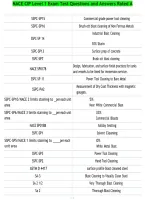
NACE CIP Level 1 Exam Test Questions and Answers Rated A
SSPC-SP15 Commercial grade power tool cleaning
SSPC-SP16 Brush-ott blast cleaning of Non Ferrous Metals
Industrial Blast Cleaning
SSPC-SP 14
10% Stain
SSPC-SP13 Surface prep of concrete
SSPC-SP7 Brush ott blast cleaning
Design, fabrication, and surface finish practices for tanks
NACE SP0178
and vessels to be lined for immersion service.
SSPC-SP 11 Power Tool Cleaning to Bare Metal
Measurement of Dry Coat Thickness with magnetic
SSPC-PA2
gauges.
SSPC-SP10/NACE 2 limits staining to per each unit 5%
area Near White Commercial Blast
SSPC-SP6/NACE 3 limits staining to per each unit 33%
area Commercial Blasts
NACE SP0188 holiday testing
SSPC-SP1 Solvent Cleaning
SSPC-SP5/NACE 1 limits staining to per each 0%
unit area White Metal Blast
SSPC-SP3 Power Tool Cleaning
SSPC-SP2 Hand Tool Cleaning
ASTM D 4417 surface profile blast cleaned steel
SA-3 Blast Cleaning to Visually Clean Steel
SA 2 1/2 Very Thorough Blast Cleaning
Sa 2 Thorough Blast Cleaning
, SA 1 Light Blast Cleaning
St 3 Very Thorough Hand and Power Tool Cleaning
St 2 Thorough Hand and Power Tool Cleaning
2 Non-convertible coating types 1. Evaporation cure 2. Coalescence cure
SSPC-VIS1 Defines surface covered with and rust as what
Grade B
grade?
SSPC-SP2
ISO St 3
True
ISO St 2
All deal with hand tool Cleaning. True or false?
A plastic resin that, when mixed with water and pigment,
forms an inorganic and quick-drying paint medium.
Acrylic
-Excellent UV and weather resistance
-Used to achieve low or near zero VOC systems
Polyaspartic -pot lives from 5 minutes to several hours
-Film builds up to (15 mils) DFT in a single pass
Typically used where low PH environments and Higher
Phenolic
Temperature are factors
-Resins normally thermoplastic resin types
latex (Emulsions) -Coalescence curing
(Non-convertible)
-Applied by Brick layers not coating applicators.
Furans
-Not a common coating type
-Two parts, resin and hardener must be mixed.
epoxy
-Can be solvent-based, water-based, or solvent-free
-Oxidative curing
Alkyds
-Rettered to as "Oil Based Paints"
Polyurethane
, Two major types:
-Alphatic
-Aromatic
(Main Hazard is isocyanate component) cancer causing
-Used in services with abrasion, chemicals, extreme UV
Polysiloxane
and high temperature
-Evaporative curing
-Contains large amounts of VOC
Chlorinated Rubber
-Excellent resistance to water, sunlight and many chemi-
cals
Vinyls Banned from use in most countries sure to High VOC
Exclusively to polyurethane
Isocyanates
(Cancer causing)
Contains the
Anode,
Corrosion Cell Cathode,
Metallic Pathway(Return Path),
Electrolytes
the deterioration of a metal due to a chemical reaction in
corrosion
the environment
Anode the electrode at which oxidation occurs
Cathode the electrode at which reduction occurs
Electrolyte A medium that conducts ionic current.
Commonly used for steel structure Epoxy
wet and dry thermometers that measures relative humid-
Sling psychrometer
ity (requires a chart)
SSPC-SP15 Commercial grade power tool cleaning
SSPC-SP16 Brush-ott blast cleaning of Non Ferrous Metals
Industrial Blast Cleaning
SSPC-SP 14
10% Stain
SSPC-SP13 Surface prep of concrete
SSPC-SP7 Brush ott blast cleaning
Design, fabrication, and surface finish practices for tanks
NACE SP0178
and vessels to be lined for immersion service.
SSPC-SP 11 Power Tool Cleaning to Bare Metal
Measurement of Dry Coat Thickness with magnetic
SSPC-PA2
gauges.
SSPC-SP10/NACE 2 limits staining to per each unit 5%
area Near White Commercial Blast
SSPC-SP6/NACE 3 limits staining to per each unit 33%
area Commercial Blasts
NACE SP0188 holiday testing
SSPC-SP1 Solvent Cleaning
SSPC-SP5/NACE 1 limits staining to per each 0%
unit area White Metal Blast
SSPC-SP3 Power Tool Cleaning
SSPC-SP2 Hand Tool Cleaning
ASTM D 4417 surface profile blast cleaned steel
SA-3 Blast Cleaning to Visually Clean Steel
SA 2 1/2 Very Thorough Blast Cleaning
Sa 2 Thorough Blast Cleaning
, SA 1 Light Blast Cleaning
St 3 Very Thorough Hand and Power Tool Cleaning
St 2 Thorough Hand and Power Tool Cleaning
2 Non-convertible coating types 1. Evaporation cure 2. Coalescence cure
SSPC-VIS1 Defines surface covered with and rust as what
Grade B
grade?
SSPC-SP2
ISO St 3
True
ISO St 2
All deal with hand tool Cleaning. True or false?
A plastic resin that, when mixed with water and pigment,
forms an inorganic and quick-drying paint medium.
Acrylic
-Excellent UV and weather resistance
-Used to achieve low or near zero VOC systems
Polyaspartic -pot lives from 5 minutes to several hours
-Film builds up to (15 mils) DFT in a single pass
Typically used where low PH environments and Higher
Phenolic
Temperature are factors
-Resins normally thermoplastic resin types
latex (Emulsions) -Coalescence curing
(Non-convertible)
-Applied by Brick layers not coating applicators.
Furans
-Not a common coating type
-Two parts, resin and hardener must be mixed.
epoxy
-Can be solvent-based, water-based, or solvent-free
-Oxidative curing
Alkyds
-Rettered to as "Oil Based Paints"
Polyurethane
, Two major types:
-Alphatic
-Aromatic
(Main Hazard is isocyanate component) cancer causing
-Used in services with abrasion, chemicals, extreme UV
Polysiloxane
and high temperature
-Evaporative curing
-Contains large amounts of VOC
Chlorinated Rubber
-Excellent resistance to water, sunlight and many chemi-
cals
Vinyls Banned from use in most countries sure to High VOC
Exclusively to polyurethane
Isocyanates
(Cancer causing)
Contains the
Anode,
Corrosion Cell Cathode,
Metallic Pathway(Return Path),
Electrolytes
the deterioration of a metal due to a chemical reaction in
corrosion
the environment
Anode the electrode at which oxidation occurs
Cathode the electrode at which reduction occurs
Electrolyte A medium that conducts ionic current.
Commonly used for steel structure Epoxy
wet and dry thermometers that measures relative humid-
Sling psychrometer
ity (requires a chart)