
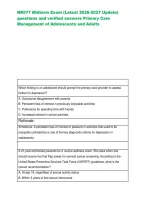
NR577 Midterm Exam (Latest 2026-2027 Update)
questions and verified answers Primary Care
Management of Adolescents and Adults
Which finding in an adolescent should prompt the primary care provider to assess
further for depression?
A. Occasional disagreement with parents
B. Persistent loss of interest in previously enjoyable activities
C. Preference for spending time with friends
D. Increased interest in school activities
Rationale:
Anhedonia: A persistent loss of interest or pleasure in activities that used to be
enjoyable (anhedonia) is one of the key diagnostic criteria for depression in
adolescents.
A 21-year-old female presents for a routine wellness exam. She asks when she
should receive her first Pap smear for cervical cancer screening. According to the
United States Preventive Services Task Force (USPSTF) guidelines, what is the
correct recommendation?
A. At age 18, regardless of sexual activity status
B. Within 3 years of first sexual intercourse
, NR577 Midterm Exam (Latest 2026-2027 Update)
questions and verified answers Primary Care
Management of Adolescents and Adults
C. At age 21, regardless of sexual activity status
D. At age 25, paired with primary HPV testing
Rationale
Screening Baseline: Both USPSTF and ACOG guidelines recommend initiating
cervical cancer screening with cervical cytology (Pap smear) alone starting at age 21,
regardless of the age of sexual debut.
Incorrect options: Screening prior to 21 (options A and B) leads to unnecessary
treatments for transient HPV infections. Primary HPV screening alone typically starts
at age 25 (option D).
Question 5
A 15-year-old male presents for a sports physical. During the physical exam, the
nurse practitioner notes a soft, non-cardiac systolic murmur at the left upper sternal
, NR577 Midterm Exam (Latest 2026-2027 Update)
questions and verified answers Primary Care
Management of Adolescents and Adults
border that decreases in intensity when the patient stands up. What is the most
appropriate next step?
A. Document the finding as an innocent physiological murmur and clear him for
sports.
B. Order an immediate 12-lead ECG and refer to pediatric cardiology.
C. Restrict the patient from all high-intensity competitive athletics.
D. Order a transthoracic echocardiogram to rule out hypertrophic cardiomyopathy
(HCM).
Rationale
Innocent Murmurs: Physiological/innocent murmurs are common in adolescents. They
are usually systolic, soft (Grade I-II), change with position (decrease or disappear with
standing), and lack radiation.
Incorrect options: Pathological murmurs, such as HCM, typically increase in intensity
with standing or Valsalva maneuvers, which would warrant an ECG, echo, or
cardiology referral (options B, C, and D).
, NR577 Midterm Exam (Latest 2026-2027 Update)
questions and verified answers Primary Care
Management of Adolescents and Adults
Question 6
An 18-year-old college freshman presents to the clinic requesting the Meningococcal
B vaccine before moving into the resident dormitories. Which statement correctly
guides the practitioner's clinical decision regarding meningococcal vaccination?
A. The Meningococcal B vaccine is a routine requirement for all adolescents at age
11-12.
B. Meningococcal B (MenB) provides separate serogroup coverage from the routine
quadrivalent Meningococcal conjugate vaccine (MenACWY).
C. A booster dose of MenACWY is sufficient and covers serogroups A, B, C, Y, and
W-135.
D. MenB vaccine series should only be given to individuals with anatomic or
functional asplenia.
Rationale
Serogroup Differences: The standard MenACWY vaccine protects against serogroups
A, C, Y, and W-135 but does not cover serogroup B. MenB is a separate series
questions and verified answers Primary Care
Management of Adolescents and Adults
Which finding in an adolescent should prompt the primary care provider to assess
further for depression?
A. Occasional disagreement with parents
B. Persistent loss of interest in previously enjoyable activities
C. Preference for spending time with friends
D. Increased interest in school activities
Rationale:
Anhedonia: A persistent loss of interest or pleasure in activities that used to be
enjoyable (anhedonia) is one of the key diagnostic criteria for depression in
adolescents.
A 21-year-old female presents for a routine wellness exam. She asks when she
should receive her first Pap smear for cervical cancer screening. According to the
United States Preventive Services Task Force (USPSTF) guidelines, what is the
correct recommendation?
A. At age 18, regardless of sexual activity status
B. Within 3 years of first sexual intercourse
, NR577 Midterm Exam (Latest 2026-2027 Update)
questions and verified answers Primary Care
Management of Adolescents and Adults
C. At age 21, regardless of sexual activity status
D. At age 25, paired with primary HPV testing
Rationale
Screening Baseline: Both USPSTF and ACOG guidelines recommend initiating
cervical cancer screening with cervical cytology (Pap smear) alone starting at age 21,
regardless of the age of sexual debut.
Incorrect options: Screening prior to 21 (options A and B) leads to unnecessary
treatments for transient HPV infections. Primary HPV screening alone typically starts
at age 25 (option D).
Question 5
A 15-year-old male presents for a sports physical. During the physical exam, the
nurse practitioner notes a soft, non-cardiac systolic murmur at the left upper sternal
, NR577 Midterm Exam (Latest 2026-2027 Update)
questions and verified answers Primary Care
Management of Adolescents and Adults
border that decreases in intensity when the patient stands up. What is the most
appropriate next step?
A. Document the finding as an innocent physiological murmur and clear him for
sports.
B. Order an immediate 12-lead ECG and refer to pediatric cardiology.
C. Restrict the patient from all high-intensity competitive athletics.
D. Order a transthoracic echocardiogram to rule out hypertrophic cardiomyopathy
(HCM).
Rationale
Innocent Murmurs: Physiological/innocent murmurs are common in adolescents. They
are usually systolic, soft (Grade I-II), change with position (decrease or disappear with
standing), and lack radiation.
Incorrect options: Pathological murmurs, such as HCM, typically increase in intensity
with standing or Valsalva maneuvers, which would warrant an ECG, echo, or
cardiology referral (options B, C, and D).
, NR577 Midterm Exam (Latest 2026-2027 Update)
questions and verified answers Primary Care
Management of Adolescents and Adults
Question 6
An 18-year-old college freshman presents to the clinic requesting the Meningococcal
B vaccine before moving into the resident dormitories. Which statement correctly
guides the practitioner's clinical decision regarding meningococcal vaccination?
A. The Meningococcal B vaccine is a routine requirement for all adolescents at age
11-12.
B. Meningococcal B (MenB) provides separate serogroup coverage from the routine
quadrivalent Meningococcal conjugate vaccine (MenACWY).
C. A booster dose of MenACWY is sufficient and covers serogroups A, B, C, Y, and
W-135.
D. MenB vaccine series should only be given to individuals with anatomic or
functional asplenia.
Rationale
Serogroup Differences: The standard MenACWY vaccine protects against serogroups
A, C, Y, and W-135 but does not cover serogroup B. MenB is a separate series


