
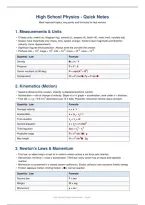
High School Physics - Quick Notes
Most important topics, key points and formulas for fast revision
1. Measurements & Units
• SI base units: metre (m), kilogram (kg), second (s), ampere (A), kelvin (K), mole (mol), candela (cd).
• Scalars have magnitude only (mass, time, speed, energy). Vectors have magnitude and direction
(velocity, force, displacement).
• Significant figures show precision. Always write the unit with the answer.
• Prefixes: kilo = 103, mega = 106, milli = 10-3, micro = 10-6, nano = 10-9.
Quantity / Law Formula
Density ■=m/V
Pressure P=F/A
Vector resultant (at 90 deg) R = sqrt(A2 + B2)
Components Fx = F cos ■, Fy = F sin ■
2. Kinematics (Motion)
• Speed is distance/time (scalar). Velocity is displacement/time (vector).
• Acceleration = rate of change of velocity. Slope of a v-t graph = acceleration; area under it = distance.
• Free fall: a = g = 9.8 m/s2 downward (use 10 if told). Projectile: horizontal velocity stays constant.
Quantity / Law Formula
Average velocity v=s/t
Acceleration a = (vf - vi) / t
First equation vf = vi + at
Second equation s = vit + (1/2)at2
Third equation 2as = vf2 - vi2
Projectile range R = v2 sin 2■ / g
Max height H = v2 sin2■ / 2g
3. Newton's Laws & Momentum
• First law: an object stays at rest or in uniform motion unless a net force acts (inertia).
• Second law: net force = mass x acceleration. Third law: every action has an equal and opposite
reaction.
• Momentum is conserved in a closed system (collisions). Elastic collisions also conserve kinetic energy.
• Friction opposes motion; limiting friction = ■ x normal reaction.
Quantity / Law Formula
Second law F = ma
Weight W = mg
Momentum p = mv
High School Physics Quick Notes | Page 1
, Impulse F t = m vf - m vi
Conservation of momentum m1u1 + m2u2 = m1v1 + m2v2
Friction f=■R
4. Work, Energy & Power
• Work is done only when force causes displacement in its direction. Unit: joule (J).
• Energy cannot be created or destroyed, only changed from one form to another.
• Power is the rate of doing work. Unit: watt (W). 1 hp = 746 W.
• Efficiency = (useful output / total input) x 100%.
Quantity / Law Formula
Work W = F s cos ■
Kinetic energy KE = (1/2)mv2
Potential energy PE = mgh
Power P=W/t=Fv
Efficiency Eff = (output / input) x 100
5. Circular Motion & Gravitation
• In uniform circular motion speed is constant but velocity changes, so there is acceleration toward the
centre.
• Centripetal force acts toward the centre. Satellites stay in orbit because gravity provides this force.
• Gravitational force is always attractive. g falls with height above Earth.
Quantity / Law Formula
Angular velocity ■ = ■ / t = 2■f
Linear speed v = r■
Centripetal acceleration a = v2 / r
Centripetal force F = mv2 / r
Universal gravitation F = G m1m2 / r2
G value 6.67 x 10⁻¹¹ N m2/kg2
High School Physics Quick Notes | Page 2
Most important topics, key points and formulas for fast revision
1. Measurements & Units
• SI base units: metre (m), kilogram (kg), second (s), ampere (A), kelvin (K), mole (mol), candela (cd).
• Scalars have magnitude only (mass, time, speed, energy). Vectors have magnitude and direction
(velocity, force, displacement).
• Significant figures show precision. Always write the unit with the answer.
• Prefixes: kilo = 103, mega = 106, milli = 10-3, micro = 10-6, nano = 10-9.
Quantity / Law Formula
Density ■=m/V
Pressure P=F/A
Vector resultant (at 90 deg) R = sqrt(A2 + B2)
Components Fx = F cos ■, Fy = F sin ■
2. Kinematics (Motion)
• Speed is distance/time (scalar). Velocity is displacement/time (vector).
• Acceleration = rate of change of velocity. Slope of a v-t graph = acceleration; area under it = distance.
• Free fall: a = g = 9.8 m/s2 downward (use 10 if told). Projectile: horizontal velocity stays constant.
Quantity / Law Formula
Average velocity v=s/t
Acceleration a = (vf - vi) / t
First equation vf = vi + at
Second equation s = vit + (1/2)at2
Third equation 2as = vf2 - vi2
Projectile range R = v2 sin 2■ / g
Max height H = v2 sin2■ / 2g
3. Newton's Laws & Momentum
• First law: an object stays at rest or in uniform motion unless a net force acts (inertia).
• Second law: net force = mass x acceleration. Third law: every action has an equal and opposite
reaction.
• Momentum is conserved in a closed system (collisions). Elastic collisions also conserve kinetic energy.
• Friction opposes motion; limiting friction = ■ x normal reaction.
Quantity / Law Formula
Second law F = ma
Weight W = mg
Momentum p = mv
High School Physics Quick Notes | Page 1
, Impulse F t = m vf - m vi
Conservation of momentum m1u1 + m2u2 = m1v1 + m2v2
Friction f=■R
4. Work, Energy & Power
• Work is done only when force causes displacement in its direction. Unit: joule (J).
• Energy cannot be created or destroyed, only changed from one form to another.
• Power is the rate of doing work. Unit: watt (W). 1 hp = 746 W.
• Efficiency = (useful output / total input) x 100%.
Quantity / Law Formula
Work W = F s cos ■
Kinetic energy KE = (1/2)mv2
Potential energy PE = mgh
Power P=W/t=Fv
Efficiency Eff = (output / input) x 100
5. Circular Motion & Gravitation
• In uniform circular motion speed is constant but velocity changes, so there is acceleration toward the
centre.
• Centripetal force acts toward the centre. Satellites stay in orbit because gravity provides this force.
• Gravitational force is always attractive. g falls with height above Earth.
Quantity / Law Formula
Angular velocity ■ = ■ / t = 2■f
Linear speed v = r■
Centripetal acceleration a = v2 / r
Centripetal force F = mv2 / r
Universal gravitation F = G m1m2 / r2
G value 6.67 x 10⁻¹¹ N m2/kg2
High School Physics Quick Notes | Page 2


