
ATI/HESI Proctored Mastery Maternal-Newborn & Pediatrics
Maternal-Newborn & Pediatrics Final
Exam Master Summary
High-Yield Pathophysiology & Clinical Priority Actions
Fetal Monitoring, Labor Complications, APGAR & Pediatric Math
How to Use This Guide: This document is specifically engineered to defeat the ATI, HESI,
and NCLEX Maternal-Newborn proctored exams. Do not read textbooks; memorize the clinical
alerts and standard frameworks (like VEAL CHOP and APGAR) presented here.
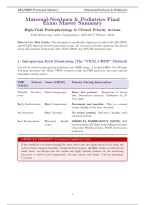
1. Intrapartum Fetal Monitoring (The ”VEAL CHOP” Method)
You will be tested on interpreting fetal heart rate (FHR) strips. A normal FHR is 110-160 bpm.
You must memorize the VEAL CHOP acronym to link the FHR pattern to the cause and the
immediate nursing action.
FHR Pattern Cause (CHOP) Priority Nursing Intervention
(VEAL)
Variable Decelera- Cord Compression Move the patient. Reposition to lateral
tions side. Discontinue oxytocin. Administer O2 (8-
10 L/min).
Early Decelerations Head Compression Document and monitor. This is a normal,
benign finding as the fetus descends.
Accelerations Okay (Normal) No action needed. Indicates a healthy, well-
oxygenated fetus.
Late Decelerations Placental Insuffi- MEDICAL EMERGENCY (LION): Left
ciency lateral position, IV fluids bolus, Oxygen via non-
rebreather, Notify provider. STOP oxytocin im-
mediately.
CRITICAL PRIORITY: Prolapsed Umbilical Cord
If the umbilical cord drops through the open cervix into the vagina ahead of the baby, the
cord becomes trapped, instantly cutting off fetal oxygen. Action: Using a sterile gloved
hand, insert two fingers into the vagina and apply upward pressure on the presenting
fetal part to relieve cord compression. Do not remove your hand. Call for immediate
C-section.
1
Maternal-Newborn & Pediatrics Final
Exam Master Summary
High-Yield Pathophysiology & Clinical Priority Actions
Fetal Monitoring, Labor Complications, APGAR & Pediatric Math
How to Use This Guide: This document is specifically engineered to defeat the ATI, HESI,
and NCLEX Maternal-Newborn proctored exams. Do not read textbooks; memorize the clinical
alerts and standard frameworks (like VEAL CHOP and APGAR) presented here.
1. Intrapartum Fetal Monitoring (The ”VEAL CHOP” Method)
You will be tested on interpreting fetal heart rate (FHR) strips. A normal FHR is 110-160 bpm.
You must memorize the VEAL CHOP acronym to link the FHR pattern to the cause and the
immediate nursing action.
FHR Pattern Cause (CHOP) Priority Nursing Intervention
(VEAL)
Variable Decelera- Cord Compression Move the patient. Reposition to lateral
tions side. Discontinue oxytocin. Administer O2 (8-
10 L/min).
Early Decelerations Head Compression Document and monitor. This is a normal,
benign finding as the fetus descends.
Accelerations Okay (Normal) No action needed. Indicates a healthy, well-
oxygenated fetus.
Late Decelerations Placental Insuffi- MEDICAL EMERGENCY (LION): Left
ciency lateral position, IV fluids bolus, Oxygen via non-
rebreather, Notify provider. STOP oxytocin im-
mediately.
CRITICAL PRIORITY: Prolapsed Umbilical Cord
If the umbilical cord drops through the open cervix into the vagina ahead of the baby, the
cord becomes trapped, instantly cutting off fetal oxygen. Action: Using a sterile gloved
hand, insert two fingers into the vagina and apply upward pressure on the presenting
fetal part to relieve cord compression. Do not remove your hand. Call for immediate
C-section.
1


