
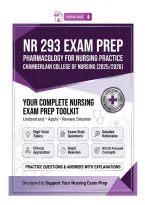
,NR 293 Pharmacology for Nursing
Practice Exam Prep — Comprehensive
Review + Practice MCQs —
Chamberlain College of Nursing
2025/2026
1. A nurse is reviewing pharmacology concepts with a student. The student asks, “What is the difference
between pharmacokinetics and pharmacodynamics?” Which response by the nurse is most accurate?
A. “Pharmacokinetics is what the drug does to the body, while pharmacodynamics is what the body does to
the drug.”
B. “Pharmacokinetics is what the body does to the drug, while pharmacodynamics is what the drug does to the
body.”
C. “Both terms describe the same process but at different stages of drug therapy.”
D. “Pharmacokinetics refers to drug toxicity, while pharmacodynamics refers to therapeutic effects.”
Correct Answer: B. “Pharmacokinetics is what the body does to the drug, while pharmacodynamics is what the
drug does to the body.”
Rationale: Pharmacokinetics encompasses absorption, distribution, metabolism, and excretion (ADME)—what
the body does to the drug. Pharmacodynamics is the study of the biochemical and physiological effects of
drugs and their mechanisms of action—what the drug does to the body. This foundational distinction is
emphasized early in NR-293.
2. A nurse is preparing to administer an oral medication that undergoes extensive first-pass metabolism. The
nurse understands that this means:
,A. The drug will have a faster onset of action than intravenous administration.
B. The drug is metabolized by the liver before reaching systemic circulation, reducing bioavailability.
C. The drug is excreted unchanged in the urine without hepatic processing.
D. The drug bypasses the gastrointestinal tract entirely.
Correct Answer: B. The drug is metabolized by the liver before reaching systemic circulation, reducing
bioavailability.
Rationale: The first-pass effect refers to the metabolism of an oral drug by the liver before it reaches systemic
circulation, reducing the fraction of active drug available (bioavailability). Drugs administered sublingually,
buccally, or parenterally bypass this effect. Understanding first-pass metabolism guides route selection and
dose calculation.
3. A client is prescribed a medication with a narrow therapeutic index. Which nursing action is the priority?
A. Administer the medication with food to enhance absorption.
B. Monitor serum drug levels closely to prevent toxicity.
C. Administer the medication at the same time every day.
D. Assess the client for allergic reactions before each dose.
Correct Answer: B. Monitor serum drug levels closely to prevent toxicity.
, Rationale: Drugs with a narrow therapeutic index have a small margin between therapeutic and toxic doses.
Serum drug level monitoring is essential to ensure the dose is both effective and safe, preventing toxicity while
maintaining therapeutic efficacy. Examples include digoxin, warfarin, phenytoin, and vancomycin.
4. A nurse is reviewing the concept of bioavailability. Which statement by the nurse is correct?
A. “Bioavailability is the time it takes for a drug to reach its peak effect.”
B. “Bioavailability is the amount of active drug that reaches systemic circulation.”
C. “Bioavailability is the duration of time a drug remains in the body.”
D. “Bioavailability is the rate at which the kidneys excrete a drug.”
Correct Answer: B. “Bioavailability is the amount of active drug that reaches systemic circulation.”
Rationale: Bioavailability is the extent of drug absorption for a given drug and route—the amount of active
drug that reaches systemic circulation. It is influenced by first-pass metabolism, drug formulation, and route of
administration. Intravenous administration has 100% bioavailability.
5. A client asks the nurse, “What is the difference between the generic name and the trade name of a drug?”
Which response is correct?
A. “The generic name is assigned by the manufacturer, and the trade name is the official name.”
Practice Exam Prep — Comprehensive
Review + Practice MCQs —
Chamberlain College of Nursing
2025/2026
1. A nurse is reviewing pharmacology concepts with a student. The student asks, “What is the difference
between pharmacokinetics and pharmacodynamics?” Which response by the nurse is most accurate?
A. “Pharmacokinetics is what the drug does to the body, while pharmacodynamics is what the body does to
the drug.”
B. “Pharmacokinetics is what the body does to the drug, while pharmacodynamics is what the drug does to the
body.”
C. “Both terms describe the same process but at different stages of drug therapy.”
D. “Pharmacokinetics refers to drug toxicity, while pharmacodynamics refers to therapeutic effects.”
Correct Answer: B. “Pharmacokinetics is what the body does to the drug, while pharmacodynamics is what the
drug does to the body.”
Rationale: Pharmacokinetics encompasses absorption, distribution, metabolism, and excretion (ADME)—what
the body does to the drug. Pharmacodynamics is the study of the biochemical and physiological effects of
drugs and their mechanisms of action—what the drug does to the body. This foundational distinction is
emphasized early in NR-293.
2. A nurse is preparing to administer an oral medication that undergoes extensive first-pass metabolism. The
nurse understands that this means:
,A. The drug will have a faster onset of action than intravenous administration.
B. The drug is metabolized by the liver before reaching systemic circulation, reducing bioavailability.
C. The drug is excreted unchanged in the urine without hepatic processing.
D. The drug bypasses the gastrointestinal tract entirely.
Correct Answer: B. The drug is metabolized by the liver before reaching systemic circulation, reducing
bioavailability.
Rationale: The first-pass effect refers to the metabolism of an oral drug by the liver before it reaches systemic
circulation, reducing the fraction of active drug available (bioavailability). Drugs administered sublingually,
buccally, or parenterally bypass this effect. Understanding first-pass metabolism guides route selection and
dose calculation.
3. A client is prescribed a medication with a narrow therapeutic index. Which nursing action is the priority?
A. Administer the medication with food to enhance absorption.
B. Monitor serum drug levels closely to prevent toxicity.
C. Administer the medication at the same time every day.
D. Assess the client for allergic reactions before each dose.
Correct Answer: B. Monitor serum drug levels closely to prevent toxicity.
, Rationale: Drugs with a narrow therapeutic index have a small margin between therapeutic and toxic doses.
Serum drug level monitoring is essential to ensure the dose is both effective and safe, preventing toxicity while
maintaining therapeutic efficacy. Examples include digoxin, warfarin, phenytoin, and vancomycin.
4. A nurse is reviewing the concept of bioavailability. Which statement by the nurse is correct?
A. “Bioavailability is the time it takes for a drug to reach its peak effect.”
B. “Bioavailability is the amount of active drug that reaches systemic circulation.”
C. “Bioavailability is the duration of time a drug remains in the body.”
D. “Bioavailability is the rate at which the kidneys excrete a drug.”
Correct Answer: B. “Bioavailability is the amount of active drug that reaches systemic circulation.”
Rationale: Bioavailability is the extent of drug absorption for a given drug and route—the amount of active
drug that reaches systemic circulation. It is influenced by first-pass metabolism, drug formulation, and route of
administration. Intravenous administration has 100% bioavailability.
5. A client asks the nurse, “What is the difference between the generic name and the trade name of a drug?”
Which response is correct?
A. “The generic name is assigned by the manufacturer, and the trade name is the official name.”


