
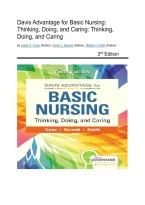
Davis Advantage for Basic Nursing:
Thinking, Doing, and Caring: Thinking,
Doing, and Caring
by Leslie S. Treas (Author), Karen L. Barnett (Author), Mable H. Smith (Author)
3rd Edition
,TABLE OF CONTENTS
I. How Nurses Think
1. Evolution of Nursing Thought & Action
2. Clinical Judgment
3. The Steps of the Nursing Process
4. Evidence-Based Practice: Theory & Research
II. Factors Affecting Health
5. Life Span: Infancy Through Middle Adulthood
6. Life Span: Older Adults
7. Experiencing Health & Illness
8. Stress & Adaptation
9. Psychosocial Health & Illness
10. Family Health
11. Caring in Multicultural Healthcare Environments
12. Spirituality
13. Experiencing Loss
III. Essential Nursing Interventions
14. Promoting Health
15. Communication & Therapeutic Relationships
16. Patient Education
17. Documenting & Reporting
18. Measuring Vital Signs
19. Physical Assessment
20. Promoting Asepsis & Preventing Infection
21. Safety
22. Facilitating Hygiene
23. Administering Medication
IV. Supporting Physiological Function
24. Nutrition
25. Urinary Elimination
26. Bowel Elimination
27. Sensation, Perception, & Response
28. Pain
29. Physical Activity & Immobility
30. Sexual Health
31. Sleep & Rest
32. Skin Integrity & Wound Healing
33. Oxygenation
34. Circulation & Perfusion
35. Hydration & Homeostasis
36. Caring for the Surgical Patient
V. The Context for Nurses' Work
37. Community & Home Health Nursing
,38. Nursing Informatics
39. Legal Accountability
40. Leading and Managing (Online Only in the eBook on Davis Advantage)
41. Ethics and Values (Online Only in the eBook on Davis Advantage)
, TEST BANK
Basic Nursing: Thinking, Doing, and Caring, 3rd Edition (Treas, 2022)
Chapters 1–41 Multiple Choice Questions
PART I: HOW NURSES THINK
CHAPTER 1: Evolution of Nursing Thought & Action
1. Which historical figure is most credited with establishing the foundations of modern nursing
through environmental theory and statistical analysis?
A. Clara Barton
B. Dorothea Dix
C. Florence Nightingale
D. Mary Mahoney
Answer: C
Rationale: Florence Nightingale is widely regarded as the founder of modern nursing. She used
environmental theory (fresh air, clean water, sanitation) and pioneered the use of statistics to
demonstrate that improved sanitary conditions reduced mortality during the Crimean War. Clara Barton
founded the American Red Cross. Dorothea Dix advocated for the mentally ill and served as
Superintendent of Army Nurses during the Civil War. Mary Mahoney was the first African American
professionally trained nurse.
2. The nurse is explaining the evolution of nursing to a group of students. Which statement best
describes how nursing has evolved over time?
A. Nursing has remained primarily a vocational skill focused on task completion.
B. Nursing has transitioned from an intuitive, apprenticeship model to an evidence-based, professional
discipline.
C. Nursing has always relied on physician-directed protocols for all patient care decisions.
D. Nursing education has changed little since the early 1900s.
Answer: B
Rationale: Nursing has evolved from an intuitive, apprenticeship-based model of care to a professional
discipline grounded in theory, research, and evidence-based practice. Nursing is no longer purely
vocational; it encompasses critical thinking, clinical judgment, and autonomous decision-making.
Nursing education has undergone tremendous change, moving from hospital-based diploma programs
to university-based programs at the baccalaureate, master's, and doctoral levels.
Thinking, Doing, and Caring: Thinking,
Doing, and Caring
by Leslie S. Treas (Author), Karen L. Barnett (Author), Mable H. Smith (Author)
3rd Edition
,TABLE OF CONTENTS
I. How Nurses Think
1. Evolution of Nursing Thought & Action
2. Clinical Judgment
3. The Steps of the Nursing Process
4. Evidence-Based Practice: Theory & Research
II. Factors Affecting Health
5. Life Span: Infancy Through Middle Adulthood
6. Life Span: Older Adults
7. Experiencing Health & Illness
8. Stress & Adaptation
9. Psychosocial Health & Illness
10. Family Health
11. Caring in Multicultural Healthcare Environments
12. Spirituality
13. Experiencing Loss
III. Essential Nursing Interventions
14. Promoting Health
15. Communication & Therapeutic Relationships
16. Patient Education
17. Documenting & Reporting
18. Measuring Vital Signs
19. Physical Assessment
20. Promoting Asepsis & Preventing Infection
21. Safety
22. Facilitating Hygiene
23. Administering Medication
IV. Supporting Physiological Function
24. Nutrition
25. Urinary Elimination
26. Bowel Elimination
27. Sensation, Perception, & Response
28. Pain
29. Physical Activity & Immobility
30. Sexual Health
31. Sleep & Rest
32. Skin Integrity & Wound Healing
33. Oxygenation
34. Circulation & Perfusion
35. Hydration & Homeostasis
36. Caring for the Surgical Patient
V. The Context for Nurses' Work
37. Community & Home Health Nursing
,38. Nursing Informatics
39. Legal Accountability
40. Leading and Managing (Online Only in the eBook on Davis Advantage)
41. Ethics and Values (Online Only in the eBook on Davis Advantage)
, TEST BANK
Basic Nursing: Thinking, Doing, and Caring, 3rd Edition (Treas, 2022)
Chapters 1–41 Multiple Choice Questions
PART I: HOW NURSES THINK
CHAPTER 1: Evolution of Nursing Thought & Action
1. Which historical figure is most credited with establishing the foundations of modern nursing
through environmental theory and statistical analysis?
A. Clara Barton
B. Dorothea Dix
C. Florence Nightingale
D. Mary Mahoney
Answer: C
Rationale: Florence Nightingale is widely regarded as the founder of modern nursing. She used
environmental theory (fresh air, clean water, sanitation) and pioneered the use of statistics to
demonstrate that improved sanitary conditions reduced mortality during the Crimean War. Clara Barton
founded the American Red Cross. Dorothea Dix advocated for the mentally ill and served as
Superintendent of Army Nurses during the Civil War. Mary Mahoney was the first African American
professionally trained nurse.
2. The nurse is explaining the evolution of nursing to a group of students. Which statement best
describes how nursing has evolved over time?
A. Nursing has remained primarily a vocational skill focused on task completion.
B. Nursing has transitioned from an intuitive, apprenticeship model to an evidence-based, professional
discipline.
C. Nursing has always relied on physician-directed protocols for all patient care decisions.
D. Nursing education has changed little since the early 1900s.
Answer: B
Rationale: Nursing has evolved from an intuitive, apprenticeship-based model of care to a professional
discipline grounded in theory, research, and evidence-based practice. Nursing is no longer purely
vocational; it encompasses critical thinking, clinical judgment, and autonomous decision-making.
Nursing education has undergone tremendous change, moving from hospital-based diploma programs
to university-based programs at the baccalaureate, master's, and doctoral levels.


