
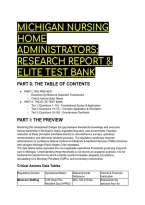
MICHIGAN NURSING
HOME
ADMINISTRATORS:
RESEARCH REPORT &
ELITE TEST BANK
PART 0: THE TABLE OF CONTENTS
● PART I: THE PREVIEW
○ Executive Synthesis & Axiomatic Frameworks
○ Critical Axioms Data Tables
● PART II: THE ELITE TEST BANK
○ Tier 1 (Questions 1–18) - Foundational Syntax & Application
○ Tier 2 (Questions 19–37) - Complex Application & Simulation
○ Tier 3 (Questions 38–55) - Grandmaster Synthesis
PART I: THE PREVIEW
Mastering this assessment bridges the gap between theoretical knowledge and executive
clinical leadership in Michigan's highly regulated long-term care environment. Flawless
execution of these principles translates directly to zero-deficiency surveys, optimized
reimbursement, and elite-level resident advocacy. The regulatory landscape requires
administrators to synthesize federal Centers for Medicare & Medicaid Services (CMS) directives
with stringent Michigan Public Health Code mandates.
The data tables below represent the non-negotiable operational thresholds governing long-term
care in Michigan. Understanding these thresholds is not merely an academic exercise; it is the
fundamental mechanism by which a facility avoids Immediate Jeopardy (IJ) citations,
devastating Civil Monetary Penalties (CMPs), and involuntary receivership.
Critical Axioms Data Tables
Regulatory Domain Operational Metric Statutory/Code Clinical & Financial
Reference Implication
Minimum Staffing 2.25 Hours Per MCL 333.21720a Represents the
Resident Day (HPRD) absolute floor for
,Regulatory Domain Operational Metric Statutory/Code Clinical & Financial
Reference Implication
employed nursing
personnel. Failure to
meet this triggers
immediate state
citations and potential
negligence liability.
Administrative Full-time licensed NHA MCL 333.21720 Applies exclusively to
Staffing required facilities with 50 or
more beds. Facilities
under 50 beds may
utilize part-time
administrators.
Involuntary Discharge 30-Day Written Notice MCL 333.21773 Mandatory for
nonpayment, welfare,
or closure. Waived only
for documented
immediate physical
emergencies.
Medicaid Eligibility $9,950 Countable MDHHS Title XIX Michigan’s threshold for
Asset Limit a single applicant is
uniquely generous
compared to the federal
$2,000 SSI standard,
impacting admission
screening.
Life Safety Code 22,500 sq. ft. Smoke NFPA 101 (2012) Dictates fire barrier
(LSC) Compartment construction.
Determines the
maximum area a fire
can spread before
encountering a rated
horizontal containment
wall.
Corridor Width 8 Feet (96 Inches) NFPA 101 (2012) Required in clinical
Minimum areas for simultaneous
bed evacuation.
Wheeled equipment
may project if 60 inches
of clear width remains.
Continuing Education 36 Hours (2 in Pain R 339.14021 Required biennially for
Management) NHA license renewal.
Hours cannot be
carried over between
renewal cycles.
The interaction between these variables dictates administrative survival. For instance, a facility
, attempting to maximize Medicaid reimbursement must not only understand the $9,950 asset
limit but must also navigate the 98% occupancy requirement to secure funding for temporary
hospital bed holds. Similarly, the imposition of CMPs relies heavily on whether noncompliance is
classified as an ongoing systemic failure (warranting Per Day fines) or a successfully corrected
Past Noncompliance (warranting a Per Instance fine).
PART II: THE ELITE TEST BANK
Tier 1 - Foundational Syntax & Application
Q1: A Michigan nursing facility with 120 certified beds is auditing its daily staffing logs to ensure
compliance with state mandates. Based on the principles of the Michigan Public Health Code,
which calculation represents the MINIMUM required hours of direct nursing care per patient per
day? A) 2.00 hours, provided solely by registered nurses B) 2.45 hours, exclusive of
administrative nursing time C) 2.25 hours by employed nursing care personnel D) 3.00 hours,
adjusted upward for higher acuity residents
● Answer: C (2.25 hours by employed nursing care personnel)
● Distractor Analysis:
○ A is incorrect: The mandate includes all employed nursing care personnel, not just
registered nurses.
○ B is incorrect: 2.45 hours represents a federal CMS phase-in target for nurse aides,
not the foundational Michigan state statutory minimum.
○ D is incorrect: 3.00 hours is an outdated literature recommendation, not the state
legal baseline.
The Mentor's Analysis: Michigan law sets a hard statutory floor for staffing to ensure basic
resident safety. When facing daily staffing audits, the immediate priority is maintaining this
absolute minimum threshold. By utilizing employed nursing care personnel to calculate the 2.25
HPRD floor, you bypass the common trap of state-level noncompliance. Professional Intuition:
Never let your daily PPD calculation drop below 2.25; it is a strict liability statutory metric
in Michigan.
Q2: A corporation recently acquired a 45-bed nursing home in Michigan. The governing body
wishes to operate the facility using a part-time administrator. Based on LARA licensure
requirements, which conclusion is the MOST APPROPRIATE? A) The facility may use a
part-time administrator because it has fewer than 50 beds. B) The facility must hire a full-time
administrator regardless of bed size under federal law. C) The facility can use a part-time
administrator only if approved by the county medical director. D) The facility is prohibited from
operating without a full-time licensed administrator on-site 40 hours a week.
● Answer: A (The facility may use a part-time administrator because it has fewer than 50
beds.)
● Distractor Analysis:
○ B is incorrect: State law specifically delineates the 50-bed threshold for a full-time
NHA; smaller facilities have legal flexibility.
○ C is incorrect: The county medical director has no jurisdiction over NHA licensure
mandates.
○ D is incorrect: The Michigan Public Health Code explicitly requires a full-time NHA
only for facilities having 50 beds or more.
The Mentor's Analysis: Administrative overhead is tightly regulated based on operational scale.
HOME
ADMINISTRATORS:
RESEARCH REPORT &
ELITE TEST BANK
PART 0: THE TABLE OF CONTENTS
● PART I: THE PREVIEW
○ Executive Synthesis & Axiomatic Frameworks
○ Critical Axioms Data Tables
● PART II: THE ELITE TEST BANK
○ Tier 1 (Questions 1–18) - Foundational Syntax & Application
○ Tier 2 (Questions 19–37) - Complex Application & Simulation
○ Tier 3 (Questions 38–55) - Grandmaster Synthesis
PART I: THE PREVIEW
Mastering this assessment bridges the gap between theoretical knowledge and executive
clinical leadership in Michigan's highly regulated long-term care environment. Flawless
execution of these principles translates directly to zero-deficiency surveys, optimized
reimbursement, and elite-level resident advocacy. The regulatory landscape requires
administrators to synthesize federal Centers for Medicare & Medicaid Services (CMS) directives
with stringent Michigan Public Health Code mandates.
The data tables below represent the non-negotiable operational thresholds governing long-term
care in Michigan. Understanding these thresholds is not merely an academic exercise; it is the
fundamental mechanism by which a facility avoids Immediate Jeopardy (IJ) citations,
devastating Civil Monetary Penalties (CMPs), and involuntary receivership.
Critical Axioms Data Tables
Regulatory Domain Operational Metric Statutory/Code Clinical & Financial
Reference Implication
Minimum Staffing 2.25 Hours Per MCL 333.21720a Represents the
Resident Day (HPRD) absolute floor for
,Regulatory Domain Operational Metric Statutory/Code Clinical & Financial
Reference Implication
employed nursing
personnel. Failure to
meet this triggers
immediate state
citations and potential
negligence liability.
Administrative Full-time licensed NHA MCL 333.21720 Applies exclusively to
Staffing required facilities with 50 or
more beds. Facilities
under 50 beds may
utilize part-time
administrators.
Involuntary Discharge 30-Day Written Notice MCL 333.21773 Mandatory for
nonpayment, welfare,
or closure. Waived only
for documented
immediate physical
emergencies.
Medicaid Eligibility $9,950 Countable MDHHS Title XIX Michigan’s threshold for
Asset Limit a single applicant is
uniquely generous
compared to the federal
$2,000 SSI standard,
impacting admission
screening.
Life Safety Code 22,500 sq. ft. Smoke NFPA 101 (2012) Dictates fire barrier
(LSC) Compartment construction.
Determines the
maximum area a fire
can spread before
encountering a rated
horizontal containment
wall.
Corridor Width 8 Feet (96 Inches) NFPA 101 (2012) Required in clinical
Minimum areas for simultaneous
bed evacuation.
Wheeled equipment
may project if 60 inches
of clear width remains.
Continuing Education 36 Hours (2 in Pain R 339.14021 Required biennially for
Management) NHA license renewal.
Hours cannot be
carried over between
renewal cycles.
The interaction between these variables dictates administrative survival. For instance, a facility
, attempting to maximize Medicaid reimbursement must not only understand the $9,950 asset
limit but must also navigate the 98% occupancy requirement to secure funding for temporary
hospital bed holds. Similarly, the imposition of CMPs relies heavily on whether noncompliance is
classified as an ongoing systemic failure (warranting Per Day fines) or a successfully corrected
Past Noncompliance (warranting a Per Instance fine).
PART II: THE ELITE TEST BANK
Tier 1 - Foundational Syntax & Application
Q1: A Michigan nursing facility with 120 certified beds is auditing its daily staffing logs to ensure
compliance with state mandates. Based on the principles of the Michigan Public Health Code,
which calculation represents the MINIMUM required hours of direct nursing care per patient per
day? A) 2.00 hours, provided solely by registered nurses B) 2.45 hours, exclusive of
administrative nursing time C) 2.25 hours by employed nursing care personnel D) 3.00 hours,
adjusted upward for higher acuity residents
● Answer: C (2.25 hours by employed nursing care personnel)
● Distractor Analysis:
○ A is incorrect: The mandate includes all employed nursing care personnel, not just
registered nurses.
○ B is incorrect: 2.45 hours represents a federal CMS phase-in target for nurse aides,
not the foundational Michigan state statutory minimum.
○ D is incorrect: 3.00 hours is an outdated literature recommendation, not the state
legal baseline.
The Mentor's Analysis: Michigan law sets a hard statutory floor for staffing to ensure basic
resident safety. When facing daily staffing audits, the immediate priority is maintaining this
absolute minimum threshold. By utilizing employed nursing care personnel to calculate the 2.25
HPRD floor, you bypass the common trap of state-level noncompliance. Professional Intuition:
Never let your daily PPD calculation drop below 2.25; it is a strict liability statutory metric
in Michigan.
Q2: A corporation recently acquired a 45-bed nursing home in Michigan. The governing body
wishes to operate the facility using a part-time administrator. Based on LARA licensure
requirements, which conclusion is the MOST APPROPRIATE? A) The facility may use a
part-time administrator because it has fewer than 50 beds. B) The facility must hire a full-time
administrator regardless of bed size under federal law. C) The facility can use a part-time
administrator only if approved by the county medical director. D) The facility is prohibited from
operating without a full-time licensed administrator on-site 40 hours a week.
● Answer: A (The facility may use a part-time administrator because it has fewer than 50
beds.)
● Distractor Analysis:
○ B is incorrect: State law specifically delineates the 50-bed threshold for a full-time
NHA; smaller facilities have legal flexibility.
○ C is incorrect: The county medical director has no jurisdiction over NHA licensure
mandates.
○ D is incorrect: The Michigan Public Health Code explicitly requires a full-time NHA
only for facilities having 50 beds or more.
The Mentor's Analysis: Administrative overhead is tightly regulated based on operational scale.


