
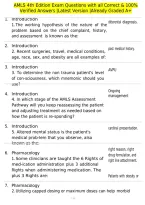
AMLS 4th Edition Exam Questions with all Correct & 100%
Verified Answers |Latest Version |Already Graded A+
1. Introduction
ditterential diagnosis.
1. The working hypothesis of the nature of the
problem based on the chief complaint, history,
and assessment is known as the:
2. Introduction
past medical history.
2. Recent surgeries, travel, medical conditions,
age, race, sex, and obesity are all examples of:
3. Introduction
AVPU
3. To determine the non trauma patient's level
of con-sciousness, which mnemonic should you
use?
Ongoing
4. Introduction management
4. In which stage of the AMLS Assessment
Pathway will you keep reassessing the patient
and adjusting treatment as needed based on
how the patient is re-sponding?
5. Introduction cardinal presentation.
5. Altered mental status is the patient's
medical prob-lem that you observe, also
known as the:
right reason, right
6. Pharmacology drug formulation, and
1. Some clinicians are taught the 6 Rights of right line attachment.
med-ication administration plus 3 additional
Rights when administering medication. The
plus 3 Rights are: Patients with obesity or
7. Pharmacology
2. Utilizing capped dosing or maximum doses can help morbid
, AMLS 4th Edition Exam Questions with all Correct & 100%
Verified Answers |Latest Version |Already Graded A+
obesity
prevent overdosing in which patients?
8. pharmacokinetics.
, AMLS 4th Edition Exam Questions with all Correct & 100%
Verified Answers |Latest Version |Already Graded A+
Pharmacology 13. Pharmacolo
3. You are called to care for a 56-year-old gy
female pa-tient who reports shehas taken her
extended-release pain pill but is not having any
relief. Shereports that she normally takes it
before she eats, but this time she tookit after
she ate. You explain this delayed absorp-tion is
due to:
9. Pharmacology
4. You have administered albuterol to a patient
who is experiencing an asthma attack. Your
expectation that the beta-2 receptors in the
lungs will be stimulated and cause
bronchodilation is an example of:
10. Pharmacology
5. Ketamine is considered which category of
drug un-der the Controlled Substances Act?
11. Pharmacology
6. Medication classifications have changed.
The new system has added a pregnancy
subsection to drug labels:
Pregnancy Exposure Registry, Risk Summary, Clinical
Considerations, and Data.
What is the major change with use of this new
system?
12. Pharmacology
7. Which of the following strategies should be
used during medication shortages?
Verified Answers |Latest Version |Already Graded A+
1. Introduction
ditterential diagnosis.
1. The working hypothesis of the nature of the
problem based on the chief complaint, history,
and assessment is known as the:
2. Introduction
past medical history.
2. Recent surgeries, travel, medical conditions,
age, race, sex, and obesity are all examples of:
3. Introduction
AVPU
3. To determine the non trauma patient's level
of con-sciousness, which mnemonic should you
use?
Ongoing
4. Introduction management
4. In which stage of the AMLS Assessment
Pathway will you keep reassessing the patient
and adjusting treatment as needed based on
how the patient is re-sponding?
5. Introduction cardinal presentation.
5. Altered mental status is the patient's
medical prob-lem that you observe, also
known as the:
right reason, right
6. Pharmacology drug formulation, and
1. Some clinicians are taught the 6 Rights of right line attachment.
med-ication administration plus 3 additional
Rights when administering medication. The
plus 3 Rights are: Patients with obesity or
7. Pharmacology
2. Utilizing capped dosing or maximum doses can help morbid
, AMLS 4th Edition Exam Questions with all Correct & 100%
Verified Answers |Latest Version |Already Graded A+
obesity
prevent overdosing in which patients?
8. pharmacokinetics.
, AMLS 4th Edition Exam Questions with all Correct & 100%
Verified Answers |Latest Version |Already Graded A+
Pharmacology 13. Pharmacolo
3. You are called to care for a 56-year-old gy
female pa-tient who reports shehas taken her
extended-release pain pill but is not having any
relief. Shereports that she normally takes it
before she eats, but this time she tookit after
she ate. You explain this delayed absorp-tion is
due to:
9. Pharmacology
4. You have administered albuterol to a patient
who is experiencing an asthma attack. Your
expectation that the beta-2 receptors in the
lungs will be stimulated and cause
bronchodilation is an example of:
10. Pharmacology
5. Ketamine is considered which category of
drug un-der the Controlled Substances Act?
11. Pharmacology
6. Medication classifications have changed.
The new system has added a pregnancy
subsection to drug labels:
Pregnancy Exposure Registry, Risk Summary, Clinical
Considerations, and Data.
What is the major change with use of this new
system?
12. Pharmacology
7. Which of the following strategies should be
used during medication shortages?


