
1|Page
NSG 3500 MATERNAL EXAM 1 —
QUESTIONS 1–100
INTRODUCTION
NSG 3500 Nursing Practice—Maternal Health focuses on holistic nursing care of women and
their families during the childbearing years. Galen College of Nursing identifies antepartum,
intrapartum, postpartum, and newborn care as central components of the course. This practice
examination is designed for nursing students who need advanced preparation in maternal-
newborn assessment, clinical judgment, prioritization, patient education, and recognition of
obstetric complications.
The questions emphasize application rather than simple recall. Clinical scenarios require the
student to interpret maternal and fetal assessment findings, recognize changes from expected
pregnancy physiology, prioritize nursing interventions, understand common medications, and
identify findings requiring immediate escalation. Topics include pregnancy assessment, prenatal
care, fetal development, common discomforts, nutritional considerations, pregnancy
complications, hypertensive disorders, diabetes, bleeding, labor physiology, fetal assessment,
and maternal-newborn safety.
Each question contains four options with one best answer followed by a rationale explaining the
clinical reasoning. Students should use this resource alongside their assigned Galen course
materials, instructor guidance, textbook, and current evidence-based resources rather than
treating it as a reproduction of a proprietary examination.
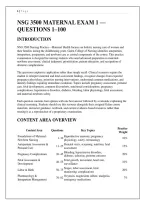
CONTENT AREA OVERVIEW
Practice
Content Area Questions Key Topics
Weight
Foundations of Maternal- Reproductive anatomy, pregnancy
1–10 10%
Newborn Nursing physiology, safety, terminology
Antepartum Assessment & Prenatal visits, screening, nutrition, fetal
11–25 15%
Prenatal Care assessment
Bleeding, hypertensive disorders,
Pregnancy Complications 26–45 20%
diabetes, infection, preterm concerns
Fetal Assessment & Fetal growth, movement, heart rate,
46–55 10%
Development surveillance
Stages, labor assessment, fetal
Labor & Birth 56–75 20%
monitoring, complications
Pharmacology & Oxytocin, magnesium sulfate, analgesia,
76–82 7%
Intrapartum Management emergency medications
, 2|Page
Practice
Content Area Questions Key Topics
Weight
Postpartum & Newborn Maternal recovery, newborn transition,
83–92 10%
Foundations feeding, safety
Clinical Judgment & Patient Prioritization, discharge, warning signs,
93–100 8%
Education family education
QUESTIONS 1–100
FOUNDATIONS OF MATERNAL-NEWBORN NURSING
Q1:
A client asks the nurse why pregnancy causes an increase in cardiac output. Which explanation is
most accurate?
A) The maternal heart must compensate for permanent myocardial damage.
B) Increased blood volume and metabolic demands support maternal tissues and
uteroplacental circulation.
C) Pregnancy causes the heart to pump less blood but at a higher pressure.
D) Cardiac output increases only because the fetus directly pumps blood into the maternal
circulation.
Rationale: The correct answer is B because pregnancy produces cardiovascular adaptations that
increase circulating volume and cardiac output to meet maternal metabolic demands and
support uteroplacental perfusion. Option A is incorrect because normal pregnancy does not
cause myocardial damage. Option C incorrectly describes the expected hemodynamic changes.
Option D is incorrect because maternal and fetal circulations remain separate.
Q2:
A pregnant client reports becoming mildly short of breath while climbing stairs but denies chest
pain, cyanosis, or severe symptoms. Which interpretation is most appropriate?
A) The finding automatically indicates pulmonary embolism.
B) Mild dyspnea can occur as a normal physiologic adaptation during pregnancy.
C) Dyspnea proves the fetus is receiving inadequate oxygen.
D) Dyspnea is diagnostic of maternal anemia.
Rationale: The correct answer is B because increased oxygen consumption, progesterone-
related respiratory changes, and mechanical changes can produce physiologic dyspnea. Option
A is too absolute; pulmonary embolism usually presents with acute concerning symptoms.
NSG 3500 MATERNAL EXAM 1 —
QUESTIONS 1–100
INTRODUCTION
NSG 3500 Nursing Practice—Maternal Health focuses on holistic nursing care of women and
their families during the childbearing years. Galen College of Nursing identifies antepartum,
intrapartum, postpartum, and newborn care as central components of the course. This practice
examination is designed for nursing students who need advanced preparation in maternal-
newborn assessment, clinical judgment, prioritization, patient education, and recognition of
obstetric complications.
The questions emphasize application rather than simple recall. Clinical scenarios require the
student to interpret maternal and fetal assessment findings, recognize changes from expected
pregnancy physiology, prioritize nursing interventions, understand common medications, and
identify findings requiring immediate escalation. Topics include pregnancy assessment, prenatal
care, fetal development, common discomforts, nutritional considerations, pregnancy
complications, hypertensive disorders, diabetes, bleeding, labor physiology, fetal assessment,
and maternal-newborn safety.
Each question contains four options with one best answer followed by a rationale explaining the
clinical reasoning. Students should use this resource alongside their assigned Galen course
materials, instructor guidance, textbook, and current evidence-based resources rather than
treating it as a reproduction of a proprietary examination.
CONTENT AREA OVERVIEW
Practice
Content Area Questions Key Topics
Weight
Foundations of Maternal- Reproductive anatomy, pregnancy
1–10 10%
Newborn Nursing physiology, safety, terminology
Antepartum Assessment & Prenatal visits, screening, nutrition, fetal
11–25 15%
Prenatal Care assessment
Bleeding, hypertensive disorders,
Pregnancy Complications 26–45 20%
diabetes, infection, preterm concerns
Fetal Assessment & Fetal growth, movement, heart rate,
46–55 10%
Development surveillance
Stages, labor assessment, fetal
Labor & Birth 56–75 20%
monitoring, complications
Pharmacology & Oxytocin, magnesium sulfate, analgesia,
76–82 7%
Intrapartum Management emergency medications
, 2|Page
Practice
Content Area Questions Key Topics
Weight
Postpartum & Newborn Maternal recovery, newborn transition,
83–92 10%
Foundations feeding, safety
Clinical Judgment & Patient Prioritization, discharge, warning signs,
93–100 8%
Education family education
QUESTIONS 1–100
FOUNDATIONS OF MATERNAL-NEWBORN NURSING
Q1:
A client asks the nurse why pregnancy causes an increase in cardiac output. Which explanation is
most accurate?
A) The maternal heart must compensate for permanent myocardial damage.
B) Increased blood volume and metabolic demands support maternal tissues and
uteroplacental circulation.
C) Pregnancy causes the heart to pump less blood but at a higher pressure.
D) Cardiac output increases only because the fetus directly pumps blood into the maternal
circulation.
Rationale: The correct answer is B because pregnancy produces cardiovascular adaptations that
increase circulating volume and cardiac output to meet maternal metabolic demands and
support uteroplacental perfusion. Option A is incorrect because normal pregnancy does not
cause myocardial damage. Option C incorrectly describes the expected hemodynamic changes.
Option D is incorrect because maternal and fetal circulations remain separate.
Q2:
A pregnant client reports becoming mildly short of breath while climbing stairs but denies chest
pain, cyanosis, or severe symptoms. Which interpretation is most appropriate?
A) The finding automatically indicates pulmonary embolism.
B) Mild dyspnea can occur as a normal physiologic adaptation during pregnancy.
C) Dyspnea proves the fetus is receiving inadequate oxygen.
D) Dyspnea is diagnostic of maternal anemia.
Rationale: The correct answer is B because increased oxygen consumption, progesterone-
related respiratory changes, and mechanical changes can produce physiologic dyspnea. Option
A is too absolute; pulmonary embolism usually presents with acute concerning symptoms.


