
1|Page
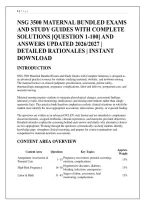
NSG 3500 MATERNAL BUNDLED EXAMS
AND STUDY GUIDES WITH COMPLETE
SOLUTIONS [QUESTION 1-100] AND
ANSWERS UPDATED 2026/2027 |
DETAILED RATIONALES | INSTANT
DOWNLOAD
INTRODUCTION
NSG 3500 Maternal Bundled Exams and Study Guides with Complete Solutions is designed as
an advanced practice resource for students studying maternal, obstetric, and newborn nursing.
The material focuses on clinical judgment, prioritization, assessment, patient safety,
pharmacologic management, pregnancy complications, labor and delivery, postpartum care, and
neonatal nursing.
Maternal nursing requires students to integrate physiological changes, assessment findings,
laboratory results, fetal monitoring, medications, and nursing interventions rather than simply
memorize facts. This practice bank therefore emphasizes realistic clinical situations in which the
student must identify the most appropriate assessment, intervention, priority, or expected finding.
The questions are written in an advanced NCLEX-style format and are intended to complement
classroom lectures, assigned textbooks, clinical experiences, and instructor-provided objectives.
Detailed rationales explain the reasoning behind each answer and clarify why alternative choices
are less appropriate. Working through the questions systematically can help students identify
knowledge gaps, strengthen clinical reasoning, and prepare for course examinations and
comprehensive maternal-newborn assessments.
CONTENT AREA OVERVIEW
Approx.
Content Area Questions Key Topics
Weight
Antepartum Assessment & Pregnancy assessment, prenatal screening,
1–15 15%
Prenatal Care nutrition, complications
Hypertensive disorders, diabetes,
High-Risk Pregnancy 16–30 15%
bleeding, infections, emergencies
Stages of labor, assessment, fetal
Labor & Birth 31–45 15%
monitoring, complications
,2|Page
Approx.
Content Area Questions Key Topics
Weight
Intrapartum Nursing & Analgesia, anesthesia, induction,
46–55 10%
Medications augmentation, safety
Assessment, hemorrhage, infection,
Postpartum Care 56–70 15%
lactation, complications
Newborn Assessment & Transition, assessment, thermoregulation,
71–82 12%
Adaptation feeding
Respiratory problems, hypoglycemia,
Neonatal Complications 83–92 10%
jaundice, infection
Family-Centered Maternal- Education, discharge, psychosocial care,
93–100 8%
Newborn Care safety
QUESTIONS 1–100
ANTEPARTUM ASSESSMENT & PRENATAL CARE
Q1:
A client at 10 weeks' gestation reports persistent nausea and vomiting. The client has lost 4 kg
since becoming pregnant, has dry mucous membranes, and reports urinating only twice during
the previous 24 hours. Which finding should the nurse recognize as the greatest concern?
A) Increased sensitivity to odors
B) Evidence of significant dehydration and possible hyperemesis gravidarum
C) Mild morning nausea occurring before breakfast
D) Increased salivation during pregnancy
Rationale: The correct answer is B because substantial weight loss, oliguria, and dehydration
suggest hyperemesis gravidarum, which can cause electrolyte abnormalities, nutritional
deficiencies, and maternal complications. Option A is a common pregnancy-related symptom but
does not indicate severity. Option C is common during early pregnancy and is generally self-
limited. Option D, increased salivation or ptyalism, may occur during pregnancy but does not
explain the client's signs of significant fluid deficit.
Q2:
A pregnant client at 24 weeks asks why the provider ordered a glucose screening test despite
having no history of diabetes. Which response by the nurse is most appropriate?
A) "The test determines whether your fetus has developed diabetes."
B) "Pregnancy-related insulin resistance can develop even when you have no previous
,3|Page
history of diabetes."
C) "The test is performed primarily to identify type 1 diabetes."
D) "The test is necessary only when excessive fetal growth has already occurred."
Rationale: The correct answer is B because placental hormones increase insulin resistance as
pregnancy progresses, creating a risk for gestational diabetes mellitus. Option A is incorrect
because the test evaluates maternal glucose regulation. Option C is incorrect because routine
pregnancy screening primarily addresses gestational diabetes rather than specifically
diagnosing type 1 diabetes. Option D is incorrect because screening is performed before fetal
overgrowth necessarily becomes apparent.
Q3:
A client at 28 weeks' gestation reports a sudden gush of clear fluid from the vagina followed by
continued leakage. Which action should the nurse take first?
A) Encourage the client to ambulate to determine whether additional fluid is released.
B) Assess fetal heart rate and maternal status promptly.
C) Perform repeated digital vaginal examinations.
D) Ask the client to return home and monitor the amount of leakage.
Rationale: The correct answer is B because suspected rupture of membranes can increase the
risk of infection, cord prolapse, and preterm birth, making immediate maternal and fetal
assessment a priority. Option A is inappropriate because ambulation is unnecessary and could
increase complications. Option C is incorrect because unnecessary digital examinations can
increase infection risk after membrane rupture. Option D delays assessment of potentially
serious complications.
Q4:
A pregnant client asks why folic acid is recommended before conception and during early
pregnancy. Which explanation is most accurate?
A) It prevents gestational hypertension.
B) It reduces the risk of neural tube defects.
C) It prevents maternal anemia in every pregnancy.
D) It eliminates the risk of fetal chromosomal abnormalities.
Rationale: The correct answer is B because adequate folate before conception and during early
pregnancy reduces the risk of neural tube defects. Option A is incorrect because folic acid is not
primarily used to prevent hypertensive disorders. Option C is incorrect because folate supports
red blood cell production but does not eliminate all causes of anemia. Option D is incorrect
because folic acid does not prevent chromosomal abnormalities.
Q5:
, 4|Page
A client at 32 weeks' gestation reports painless bright-red vaginal bleeding. The uterus is soft and
nontender, and fetal heart rate is currently reassuring. Which condition should the nurse suspect?
A) Placental abruption
B) Placenta previa
C) Uterine rupture
D) Preterm labor with cervical dilation
Rationale: The correct answer is B because placenta previa classically presents with painless,
bright-red vaginal bleeding, particularly in the later stages of pregnancy. Option A commonly
produces painful bleeding, uterine tenderness, and increased uterine tone. Option C is an
obstetric emergency generally associated with severe abdominal pain, abnormal fetal heart rate,
and maternal instability. Option D is more commonly associated with regular contractions and
cervical changes rather than isolated painless bleeding.
Q6:
A client at 34 weeks' gestation reports severe headache, blurred vision, and epigastric
discomfort. Blood pressure is 168/112 mm Hg. Which nursing action has the highest priority?
A) Encourage oral fluids.
B) Place the client in a brightly lit room for continued assessment.
C) Initiate seizure precautions and notify the provider immediately.
D) Encourage the client to ambulate to decrease blood pressure.
Rationale: The correct answer is C because severe hypertension accompanied by neurologic and
epigastric symptoms indicates severe preeclampsia and a significant risk for seizure and other
complications. Seizure precautions and immediate escalation are appropriate. Option A does not
address the acute danger. Option B may worsen discomfort and does not provide appropriate
safety measures. Option D is inappropriate because ambulation may increase risk of injury if
seizure or acute deterioration occurs.
Q7:
A pregnant client with iron-deficiency anemia is prescribed oral ferrous sulfate. Which statement
indicates appropriate understanding?
A) "I should take the medication with an antacid."
B) "Taking it with a source of vitamin C can improve iron absorption."
C) "I should stop taking it when my fatigue improves."
D) "Black stools mean that I am having gastrointestinal bleeding."
Rationale: The correct answer is B because vitamin C enhances absorption of nonheme iron.
Option A is incorrect because antacids can decrease iron absorption. Option C is incorrect
because treatment generally continues as prescribed to replenish iron stores, not merely until
NSG 3500 MATERNAL BUNDLED EXAMS
AND STUDY GUIDES WITH COMPLETE
SOLUTIONS [QUESTION 1-100] AND
ANSWERS UPDATED 2026/2027 |
DETAILED RATIONALES | INSTANT
DOWNLOAD
INTRODUCTION
NSG 3500 Maternal Bundled Exams and Study Guides with Complete Solutions is designed as
an advanced practice resource for students studying maternal, obstetric, and newborn nursing.
The material focuses on clinical judgment, prioritization, assessment, patient safety,
pharmacologic management, pregnancy complications, labor and delivery, postpartum care, and
neonatal nursing.
Maternal nursing requires students to integrate physiological changes, assessment findings,
laboratory results, fetal monitoring, medications, and nursing interventions rather than simply
memorize facts. This practice bank therefore emphasizes realistic clinical situations in which the
student must identify the most appropriate assessment, intervention, priority, or expected finding.
The questions are written in an advanced NCLEX-style format and are intended to complement
classroom lectures, assigned textbooks, clinical experiences, and instructor-provided objectives.
Detailed rationales explain the reasoning behind each answer and clarify why alternative choices
are less appropriate. Working through the questions systematically can help students identify
knowledge gaps, strengthen clinical reasoning, and prepare for course examinations and
comprehensive maternal-newborn assessments.
CONTENT AREA OVERVIEW
Approx.
Content Area Questions Key Topics
Weight
Antepartum Assessment & Pregnancy assessment, prenatal screening,
1–15 15%
Prenatal Care nutrition, complications
Hypertensive disorders, diabetes,
High-Risk Pregnancy 16–30 15%
bleeding, infections, emergencies
Stages of labor, assessment, fetal
Labor & Birth 31–45 15%
monitoring, complications
,2|Page
Approx.
Content Area Questions Key Topics
Weight
Intrapartum Nursing & Analgesia, anesthesia, induction,
46–55 10%
Medications augmentation, safety
Assessment, hemorrhage, infection,
Postpartum Care 56–70 15%
lactation, complications
Newborn Assessment & Transition, assessment, thermoregulation,
71–82 12%
Adaptation feeding
Respiratory problems, hypoglycemia,
Neonatal Complications 83–92 10%
jaundice, infection
Family-Centered Maternal- Education, discharge, psychosocial care,
93–100 8%
Newborn Care safety
QUESTIONS 1–100
ANTEPARTUM ASSESSMENT & PRENATAL CARE
Q1:
A client at 10 weeks' gestation reports persistent nausea and vomiting. The client has lost 4 kg
since becoming pregnant, has dry mucous membranes, and reports urinating only twice during
the previous 24 hours. Which finding should the nurse recognize as the greatest concern?
A) Increased sensitivity to odors
B) Evidence of significant dehydration and possible hyperemesis gravidarum
C) Mild morning nausea occurring before breakfast
D) Increased salivation during pregnancy
Rationale: The correct answer is B because substantial weight loss, oliguria, and dehydration
suggest hyperemesis gravidarum, which can cause electrolyte abnormalities, nutritional
deficiencies, and maternal complications. Option A is a common pregnancy-related symptom but
does not indicate severity. Option C is common during early pregnancy and is generally self-
limited. Option D, increased salivation or ptyalism, may occur during pregnancy but does not
explain the client's signs of significant fluid deficit.
Q2:
A pregnant client at 24 weeks asks why the provider ordered a glucose screening test despite
having no history of diabetes. Which response by the nurse is most appropriate?
A) "The test determines whether your fetus has developed diabetes."
B) "Pregnancy-related insulin resistance can develop even when you have no previous
,3|Page
history of diabetes."
C) "The test is performed primarily to identify type 1 diabetes."
D) "The test is necessary only when excessive fetal growth has already occurred."
Rationale: The correct answer is B because placental hormones increase insulin resistance as
pregnancy progresses, creating a risk for gestational diabetes mellitus. Option A is incorrect
because the test evaluates maternal glucose regulation. Option C is incorrect because routine
pregnancy screening primarily addresses gestational diabetes rather than specifically
diagnosing type 1 diabetes. Option D is incorrect because screening is performed before fetal
overgrowth necessarily becomes apparent.
Q3:
A client at 28 weeks' gestation reports a sudden gush of clear fluid from the vagina followed by
continued leakage. Which action should the nurse take first?
A) Encourage the client to ambulate to determine whether additional fluid is released.
B) Assess fetal heart rate and maternal status promptly.
C) Perform repeated digital vaginal examinations.
D) Ask the client to return home and monitor the amount of leakage.
Rationale: The correct answer is B because suspected rupture of membranes can increase the
risk of infection, cord prolapse, and preterm birth, making immediate maternal and fetal
assessment a priority. Option A is inappropriate because ambulation is unnecessary and could
increase complications. Option C is incorrect because unnecessary digital examinations can
increase infection risk after membrane rupture. Option D delays assessment of potentially
serious complications.
Q4:
A pregnant client asks why folic acid is recommended before conception and during early
pregnancy. Which explanation is most accurate?
A) It prevents gestational hypertension.
B) It reduces the risk of neural tube defects.
C) It prevents maternal anemia in every pregnancy.
D) It eliminates the risk of fetal chromosomal abnormalities.
Rationale: The correct answer is B because adequate folate before conception and during early
pregnancy reduces the risk of neural tube defects. Option A is incorrect because folic acid is not
primarily used to prevent hypertensive disorders. Option C is incorrect because folate supports
red blood cell production but does not eliminate all causes of anemia. Option D is incorrect
because folic acid does not prevent chromosomal abnormalities.
Q5:
, 4|Page
A client at 32 weeks' gestation reports painless bright-red vaginal bleeding. The uterus is soft and
nontender, and fetal heart rate is currently reassuring. Which condition should the nurse suspect?
A) Placental abruption
B) Placenta previa
C) Uterine rupture
D) Preterm labor with cervical dilation
Rationale: The correct answer is B because placenta previa classically presents with painless,
bright-red vaginal bleeding, particularly in the later stages of pregnancy. Option A commonly
produces painful bleeding, uterine tenderness, and increased uterine tone. Option C is an
obstetric emergency generally associated with severe abdominal pain, abnormal fetal heart rate,
and maternal instability. Option D is more commonly associated with regular contractions and
cervical changes rather than isolated painless bleeding.
Q6:
A client at 34 weeks' gestation reports severe headache, blurred vision, and epigastric
discomfort. Blood pressure is 168/112 mm Hg. Which nursing action has the highest priority?
A) Encourage oral fluids.
B) Place the client in a brightly lit room for continued assessment.
C) Initiate seizure precautions and notify the provider immediately.
D) Encourage the client to ambulate to decrease blood pressure.
Rationale: The correct answer is C because severe hypertension accompanied by neurologic and
epigastric symptoms indicates severe preeclampsia and a significant risk for seizure and other
complications. Seizure precautions and immediate escalation are appropriate. Option A does not
address the acute danger. Option B may worsen discomfort and does not provide appropriate
safety measures. Option D is inappropriate because ambulation may increase risk of injury if
seizure or acute deterioration occurs.
Q7:
A pregnant client with iron-deficiency anemia is prescribed oral ferrous sulfate. Which statement
indicates appropriate understanding?
A) "I should take the medication with an antacid."
B) "Taking it with a source of vitamin C can improve iron absorption."
C) "I should stop taking it when my fatigue improves."
D) "Black stools mean that I am having gastrointestinal bleeding."
Rationale: The correct answer is B because vitamin C enhances absorption of nonheme iron.
Option A is incorrect because antacids can decrease iron absorption. Option C is incorrect
because treatment generally continues as prescribed to replenish iron stores, not merely until


