
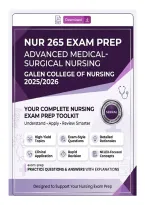
,NUR 265 Advanced Medical-Surgical
Nursing Exam Prep — Comprehensive
Review + Practice MCQs — Galen
College of Nursing 2025/2026
1. A nurse is completing a preoperative assessment on a client scheduled for an open cholecystectomy. Which
finding requires immediate notification of the surgeon?
A. Blood pressure 138/86 mm Hg
B. Serum potassium 3.1 mEq/L
C. Hemoglobin 13.2 g/dL
D. Temperature 99.1°F (37.3°C)
Correct Answer: B
Rationale: Hypokalemia (potassium <3.5 mEq/L) increases the risk for cardiac dysrhythmias during anesthesia
and surgery. This value must be corrected before proceeding. Blood pressure and hemoglobin are within
acceptable ranges, and a low-grade temperature does not require immediate surgical cancellation.
2. A client who had a total knee replacement 6 hours ago reports sudden shortness of breath and chest pain.
Vital signs: HR 118, BP 98/62, RR 28, SpO₂ 88% on room air. What is the nurse’s priority action?
,A. Administer prescribed pain medication
B. Apply supplemental oxygen and notify the provider immediately
C. Elevate the affected leg
D. Encourage deep breathing exercises
Correct Answer: B
Rationale: These findings suggest pulmonary embolism, a life-threatening postoperative complication.
Immediate oxygen administration and provider notification are priority interventions. Pain medication and leg
elevation do not address the emergent respiratory compromise.
3. The nurse is preparing a client for surgery. Which statement by the client indicates a need for further
teaching regarding preoperative fasting?
A. “I can have clear liquids up to 2 hours before surgery.”
B. “I should not eat solid food after midnight.”
C. “I can chew gum to help with my dry mouth.”
D. “I will take my blood pressure medication with a sip of water.”
Correct Answer: C
Rationale: Chewing gum increases gastric volume and acidity, increasing aspiration risk during anesthesia.
Clear liquids are typically permitted up to 2 hours before surgery per ASA guidelines. Taking prescribed
medications with a sip of water is generally allowed.
4. A postoperative client has a Jackson-Pratt drain in place. Which assessment finding requires immediate
nursing intervention?
, A. 50 mL serosanguineous output in 8 hours
B. Drain tubing is looped below the insertion site
C. Drain bulb is fully compressed and secure
D. Insertion site is clean, dry, and intact
Correct Answer: B
Rationale: Looping the tubing below the insertion site creates a dependent loop that can allow fluid to flow
back into the wound, increasing infection risk. The drain tubing should be secured to prevent dependent loops.
Serosanguineous output is expected, and a compressed bulb creates suction.
5. The nurse is caring for a client who had abdominal surgery 2 days ago. The client’s wound edges are
approximated, and there is a small amount of serous drainage. Which nursing action is appropriate?
A. Apply a sterile dressing and change it every 24 hours
B. Leave the wound open to air to promote drying
C. Irrigate the wound with hydrogen peroxide
D. Notify the provider of wound dehiscence
Correct Answer: A
Rationale: A clean surgical wound with approximated edges and serous drainage requires a sterile dressing
that is changed per protocol (typically every 24 hours or when soiled). Leaving the wound open increases
infection risk. Hydrogen peroxide is cytotoxic and not recommended for clean surgical wounds.
6. A client is scheduled for an emergency appendectomy. The nurse notes the client signed the surgical
consent form 3 days ago during a previous hospital admission. What is the nurse’s best action?
A. Proceed with surgery since the consent is already signed
Nursing Exam Prep — Comprehensive
Review + Practice MCQs — Galen
College of Nursing 2025/2026
1. A nurse is completing a preoperative assessment on a client scheduled for an open cholecystectomy. Which
finding requires immediate notification of the surgeon?
A. Blood pressure 138/86 mm Hg
B. Serum potassium 3.1 mEq/L
C. Hemoglobin 13.2 g/dL
D. Temperature 99.1°F (37.3°C)
Correct Answer: B
Rationale: Hypokalemia (potassium <3.5 mEq/L) increases the risk for cardiac dysrhythmias during anesthesia
and surgery. This value must be corrected before proceeding. Blood pressure and hemoglobin are within
acceptable ranges, and a low-grade temperature does not require immediate surgical cancellation.
2. A client who had a total knee replacement 6 hours ago reports sudden shortness of breath and chest pain.
Vital signs: HR 118, BP 98/62, RR 28, SpO₂ 88% on room air. What is the nurse’s priority action?
,A. Administer prescribed pain medication
B. Apply supplemental oxygen and notify the provider immediately
C. Elevate the affected leg
D. Encourage deep breathing exercises
Correct Answer: B
Rationale: These findings suggest pulmonary embolism, a life-threatening postoperative complication.
Immediate oxygen administration and provider notification are priority interventions. Pain medication and leg
elevation do not address the emergent respiratory compromise.
3. The nurse is preparing a client for surgery. Which statement by the client indicates a need for further
teaching regarding preoperative fasting?
A. “I can have clear liquids up to 2 hours before surgery.”
B. “I should not eat solid food after midnight.”
C. “I can chew gum to help with my dry mouth.”
D. “I will take my blood pressure medication with a sip of water.”
Correct Answer: C
Rationale: Chewing gum increases gastric volume and acidity, increasing aspiration risk during anesthesia.
Clear liquids are typically permitted up to 2 hours before surgery per ASA guidelines. Taking prescribed
medications with a sip of water is generally allowed.
4. A postoperative client has a Jackson-Pratt drain in place. Which assessment finding requires immediate
nursing intervention?
, A. 50 mL serosanguineous output in 8 hours
B. Drain tubing is looped below the insertion site
C. Drain bulb is fully compressed and secure
D. Insertion site is clean, dry, and intact
Correct Answer: B
Rationale: Looping the tubing below the insertion site creates a dependent loop that can allow fluid to flow
back into the wound, increasing infection risk. The drain tubing should be secured to prevent dependent loops.
Serosanguineous output is expected, and a compressed bulb creates suction.
5. The nurse is caring for a client who had abdominal surgery 2 days ago. The client’s wound edges are
approximated, and there is a small amount of serous drainage. Which nursing action is appropriate?
A. Apply a sterile dressing and change it every 24 hours
B. Leave the wound open to air to promote drying
C. Irrigate the wound with hydrogen peroxide
D. Notify the provider of wound dehiscence
Correct Answer: A
Rationale: A clean surgical wound with approximated edges and serous drainage requires a sterile dressing
that is changed per protocol (typically every 24 hours or when soiled). Leaving the wound open increases
infection risk. Hydrogen peroxide is cytotoxic and not recommended for clean surgical wounds.
6. A client is scheduled for an emergency appendectomy. The nurse notes the client signed the surgical
consent form 3 days ago during a previous hospital admission. What is the nurse’s best action?
A. Proceed with surgery since the consent is already signed


