
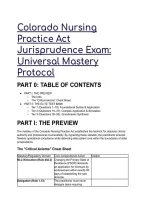
Colorado Nursing
Practice Act
Jurisprudence Exam:
Universal Mastery
Protocol
PART 0: TABLE OF CONTENTS
● PART I: THE PREVIEW
○ The Intro
○ The "Critical Axioms" Cheat Sheet
● PART II: THE ELITE TEST BANK
○ Tier 1 (Questions 1–18): Foundational Syntax & Application
○ Tier 2 (Questions 19–37): Complex Application & Simulation
○ Tier 3 (Questions 38–55): Grandmaster Synthesis
PART I: THE PREVIEW
The mastery of the Colorado Nursing Practice Act establishes the bedrock for absolute clinical
authority and professional invulnerability. By ingraining these statutes, the practitioner ensures
flawless operational compliance while delivering elite patient care within the boundaries of state
jurisprudence.
The "Critical Axioms" Cheat Sheet
Statutory/Regulatory Domain Core Jurisprudence Axiom Citation
NLC Relocation (Rule 402.2) Changing the Primary State of
Residence (PSOR) demands
an application for licensure by
endorsement within exactly 60
days of establishing the new
domicile.
Delegation (Rule 1.13) The practitioner must never
delegate tasks requiring
,Statutory/Regulatory Domain Core Jurisprudence Axiom Citation
nursing assessment,
decision-making, or
interpretation. Outcomes must
be entirely predictable.
APRN Prescribing (C.R.S. Advancing to Full Prescriptive
12-255-112) Authority (RXN) requires 750
hours of documented
mentorship within a maximum
of three years.
Disciplinary Reporting All convictions, pleas, or
adverse professional actions
must be reported to the Board
in writing within exactly 30
days.
Board Investigations Under C.R.S. 12-255-119,
refusing an Inquiry Panel's
order for a physical or mental
examination results in
immediate license suspension.
PART II: THE ELITE TEST BANK
Tier 1: Foundational Syntax & Application
Q1: A Registered Nurse holding a multistate license from Texas permanently relocates to
Colorado, securing a local driver's license. Based on the principles of the Nurse Licensure
Compact (NLC), which action is REQUIRED? A) Practice indefinitely under the Texas license as
long as it remains active and unencumbered. B) Apply for a single-state Colorado license within
90 days of changing residency. C) Apply for licensure by endorsement in Colorado within 60
days of establishing primary residency. D) Surrender the Texas license immediately upon
entering Colorado before applying for a new license.
● Answer: C (Apply for licensure by endorsement in Colorado within 60 days of establishing
primary residency.)
● Distractor Analysis:
○ A is incorrect: The NLC strictly limits multistate privileges to the nurse's Primary
State of Residence (PSOR). Relocating negates the former PSOR privilege
permanently.
○ B is incorrect: The statutory transition period under NLC Rule 402.2 is exactly 60
days, not 90 days.
○ D is incorrect: The nurse retains practice privileges under the former MSL during
the 60-day transition window; immediate surrender creates an illegal practice gap.
The Mentor's Analysis: When facing a permanent relocation across NLC lines, the immediate
priority is re-establishing the Primary State of Residence (PSOR) within the legal window. By
utilizing the 60-day endorsement protocol, the practitioner bypasses the common trap of
unauthorized practice via an invalidated compact privilege. Professional Intuition: A compact
license is anchored to the practitioner's legal domicile; the moment the domicile
, changes, the 60-day countdown begins.
Q2: A Registered Nurse delegates the administration of an over-the-counter medication to an
unlicensed assistive personnel (UAP) for a patient exhibiting erratic, unstable cardiac rhythms.
Based on the principles of Colorado Board of Nursing Rule 1.13, which conclusion is MOST
APPROPRIATE? A) The delegation is lawful if the RN provides continuous, direct line-of-sight
supervision. B) The delegation is lawful because over-the-counter medications do not require
prescriptive authority. C) The delegation is unlawful because the patient's condition is not stable
and the outcome is unpredictable. D) The delegation is unlawful because UAPs are strictly
forbidden from administering any medications in Colorado.
● Answer: C (The delegation is unlawful because the patient's condition is not stable and
the outcome is unpredictable.)
● Distractor Analysis:
○ A is incorrect: Direct supervision does not override the fundamental statutory
prohibition against delegating care for unstable patients.
○ B is incorrect: The classification of the medication is irrelevant; the instability of the
patient's underlying condition dictates a non-delegable need for clinical judgment.
○ D is incorrect: UAPs and certified medication aides can administer specific routine
medications under strict delegation protocols in stable settings.
The Mentor's Analysis: When facing a delegation decision, the immediate priority is assessing
patient stability and predictability of outcomes. By utilizing the predictability standard, the
clinician bypasses the common trap of delegating based merely on the simplicity of the task
rather than the complexity of the patient. Professional Intuition: The task may be delegated,
but the nursing process and the liability for an unstable patient remain non-transferable.
Q3: An Advanced Practice Registered Nurse (APRN) establishes an independent primary care
practice in Colorado. Based on the principles of C.R.S. 12-255-113, which action is the FIRST
legal prerequisite before initiating patient care? A) Submitting a collaborative practice
agreement to the Board of Nursing. B) Completing 3,000 hours of physician-supervised clinical
hours. C) Purchasing and maintaining professional liability insurance. D) Registering with the
Colorado Medical Board as an allied health provider.
● Answer: C (Purchasing and maintaining professional liability insurance.)
● Distractor Analysis:
○ A is incorrect: Colorado grants APRNs full independent practice authority;
collaborative agreements for general practice are an outdated legacy theory no
longer applicable.
○ B is incorrect: While 750 hours of mentorship are required specifically for
prescriptive authority, independent practice does not mandate 3,000
physician-supervised hours .
○ D is incorrect: APRNs are governed exclusively by the Board of Nursing, not the
Medical Board.
The Mentor's Analysis: When facing independent practice establishment, the immediate priority
is securing statutory financial protections. By utilizing the mandatory liability insurance
requirement, the practitioner bypasses the common trap of focusing solely on clinical credentials
while ignoring statutory operational mandates. Professional Intuition: Independent practice in
Colorado demands absolute compliance with professional liability coverage before a
single patient is evaluated.
Q4: A Colorado RN is convicted of a misdemeanor Driving Under the Influence (DUI). Based on
the principles of C.R.S. 12-255-120, what is the REQUIRED action? A) Report the conviction to
the Board of Nursing upon the next biennial license renewal. B) Surrender the nursing license
Practice Act
Jurisprudence Exam:
Universal Mastery
Protocol
PART 0: TABLE OF CONTENTS
● PART I: THE PREVIEW
○ The Intro
○ The "Critical Axioms" Cheat Sheet
● PART II: THE ELITE TEST BANK
○ Tier 1 (Questions 1–18): Foundational Syntax & Application
○ Tier 2 (Questions 19–37): Complex Application & Simulation
○ Tier 3 (Questions 38–55): Grandmaster Synthesis
PART I: THE PREVIEW
The mastery of the Colorado Nursing Practice Act establishes the bedrock for absolute clinical
authority and professional invulnerability. By ingraining these statutes, the practitioner ensures
flawless operational compliance while delivering elite patient care within the boundaries of state
jurisprudence.
The "Critical Axioms" Cheat Sheet
Statutory/Regulatory Domain Core Jurisprudence Axiom Citation
NLC Relocation (Rule 402.2) Changing the Primary State of
Residence (PSOR) demands
an application for licensure by
endorsement within exactly 60
days of establishing the new
domicile.
Delegation (Rule 1.13) The practitioner must never
delegate tasks requiring
,Statutory/Regulatory Domain Core Jurisprudence Axiom Citation
nursing assessment,
decision-making, or
interpretation. Outcomes must
be entirely predictable.
APRN Prescribing (C.R.S. Advancing to Full Prescriptive
12-255-112) Authority (RXN) requires 750
hours of documented
mentorship within a maximum
of three years.
Disciplinary Reporting All convictions, pleas, or
adverse professional actions
must be reported to the Board
in writing within exactly 30
days.
Board Investigations Under C.R.S. 12-255-119,
refusing an Inquiry Panel's
order for a physical or mental
examination results in
immediate license suspension.
PART II: THE ELITE TEST BANK
Tier 1: Foundational Syntax & Application
Q1: A Registered Nurse holding a multistate license from Texas permanently relocates to
Colorado, securing a local driver's license. Based on the principles of the Nurse Licensure
Compact (NLC), which action is REQUIRED? A) Practice indefinitely under the Texas license as
long as it remains active and unencumbered. B) Apply for a single-state Colorado license within
90 days of changing residency. C) Apply for licensure by endorsement in Colorado within 60
days of establishing primary residency. D) Surrender the Texas license immediately upon
entering Colorado before applying for a new license.
● Answer: C (Apply for licensure by endorsement in Colorado within 60 days of establishing
primary residency.)
● Distractor Analysis:
○ A is incorrect: The NLC strictly limits multistate privileges to the nurse's Primary
State of Residence (PSOR). Relocating negates the former PSOR privilege
permanently.
○ B is incorrect: The statutory transition period under NLC Rule 402.2 is exactly 60
days, not 90 days.
○ D is incorrect: The nurse retains practice privileges under the former MSL during
the 60-day transition window; immediate surrender creates an illegal practice gap.
The Mentor's Analysis: When facing a permanent relocation across NLC lines, the immediate
priority is re-establishing the Primary State of Residence (PSOR) within the legal window. By
utilizing the 60-day endorsement protocol, the practitioner bypasses the common trap of
unauthorized practice via an invalidated compact privilege. Professional Intuition: A compact
license is anchored to the practitioner's legal domicile; the moment the domicile
, changes, the 60-day countdown begins.
Q2: A Registered Nurse delegates the administration of an over-the-counter medication to an
unlicensed assistive personnel (UAP) for a patient exhibiting erratic, unstable cardiac rhythms.
Based on the principles of Colorado Board of Nursing Rule 1.13, which conclusion is MOST
APPROPRIATE? A) The delegation is lawful if the RN provides continuous, direct line-of-sight
supervision. B) The delegation is lawful because over-the-counter medications do not require
prescriptive authority. C) The delegation is unlawful because the patient's condition is not stable
and the outcome is unpredictable. D) The delegation is unlawful because UAPs are strictly
forbidden from administering any medications in Colorado.
● Answer: C (The delegation is unlawful because the patient's condition is not stable and
the outcome is unpredictable.)
● Distractor Analysis:
○ A is incorrect: Direct supervision does not override the fundamental statutory
prohibition against delegating care for unstable patients.
○ B is incorrect: The classification of the medication is irrelevant; the instability of the
patient's underlying condition dictates a non-delegable need for clinical judgment.
○ D is incorrect: UAPs and certified medication aides can administer specific routine
medications under strict delegation protocols in stable settings.
The Mentor's Analysis: When facing a delegation decision, the immediate priority is assessing
patient stability and predictability of outcomes. By utilizing the predictability standard, the
clinician bypasses the common trap of delegating based merely on the simplicity of the task
rather than the complexity of the patient. Professional Intuition: The task may be delegated,
but the nursing process and the liability for an unstable patient remain non-transferable.
Q3: An Advanced Practice Registered Nurse (APRN) establishes an independent primary care
practice in Colorado. Based on the principles of C.R.S. 12-255-113, which action is the FIRST
legal prerequisite before initiating patient care? A) Submitting a collaborative practice
agreement to the Board of Nursing. B) Completing 3,000 hours of physician-supervised clinical
hours. C) Purchasing and maintaining professional liability insurance. D) Registering with the
Colorado Medical Board as an allied health provider.
● Answer: C (Purchasing and maintaining professional liability insurance.)
● Distractor Analysis:
○ A is incorrect: Colorado grants APRNs full independent practice authority;
collaborative agreements for general practice are an outdated legacy theory no
longer applicable.
○ B is incorrect: While 750 hours of mentorship are required specifically for
prescriptive authority, independent practice does not mandate 3,000
physician-supervised hours .
○ D is incorrect: APRNs are governed exclusively by the Board of Nursing, not the
Medical Board.
The Mentor's Analysis: When facing independent practice establishment, the immediate priority
is securing statutory financial protections. By utilizing the mandatory liability insurance
requirement, the practitioner bypasses the common trap of focusing solely on clinical credentials
while ignoring statutory operational mandates. Professional Intuition: Independent practice in
Colorado demands absolute compliance with professional liability coverage before a
single patient is evaluated.
Q4: A Colorado RN is convicted of a misdemeanor Driving Under the Influence (DUI). Based on
the principles of C.R.S. 12-255-120, what is the REQUIRED action? A) Report the conviction to
the Board of Nursing upon the next biennial license renewal. B) Surrender the nursing license


