
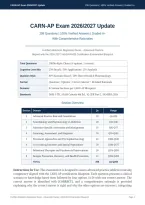
CARN-AP Exam 2026/2027 Update 208 Questions | 100% Verified Answers | Graded A+
CARN-AP Exam 2026/2027 Update
208 Questions | 100% Verified Answers | Graded A+
With Comprehensive Rationales
Certified Addictions Registered Nurse - Advanced Practice
Aligned with the 2026-2027 IntNSA/ANCB Certification Examination Blueprint
Total Questions 208 Multiple Choice (4 options, 1 correct)
Cognitive Level Mix 25% Recall / 50% Application / 25% Analysis
Question Style 80% Scenario-Based / 20% Direct Recall & Pharmacology
Format Question + Options + Correct Answer + Detailed Rationale
Domains 8 Content Sections per CARN-AP Blueprint
Standards DSM-5-TR, ASAM Criteria 4th Ed., 42 CFR Part 2, SAMHSA 2026
Section Overview
Section Domain Qs Range
1 Advanced Practice Role and Foundations 20 Q1-Q20
2 Neurobiology and Pharmacology of Addiction 20 Q21-Q40
3 Substance-Specific Assessment and Management 35 Q41-Q75
4 Screening, Assessment, and Diagnosis 30 Q76-Q105
5 Treatment Approaches and Psychopharmacology 40 Q106-Q145
6 Co-occurring Disorders and Special Populations 30 Q146-Q175
7 Behavioral Therapies and Psychosocial Interventions 20 Q176-Q195
8 Relapse Prevention, Recovery, and Health Promotion 13 Q196-Q208
TOTAL 208 Q1-Q208
Instructions for Use: This examination is designed to assess advanced practice addiction nursing
competency aligned with the CARN-AP certification blueprint. Each question presents a clinical
scenario or knowledge-based stem followed by four options (A-D) with one correct answer. The
correct answer is identified with [CORRECT], and a comprehensive rationale is provided
explaining why the correct answer is right and why the other options are incorrect, integrating
Certified Addictions Registered Nurse - Advanced Practice | 2026/2027 Examination Blueprint Page 1
,CARN-AP Exam 2026/2027 Update 208 Questions | 100% Verified Answers | Graded A+
neurobiological mechanisms, pharmacotherapy principles, ASAM criteria, legal/ethical
standards (including 42 CFR Part 2), and current evidence-based practice. This guide is intended
for use as a study reference for CARN-AP certification preparation and ongoing clinical
competency development.
Certified Addictions Registered Nurse - Advanced Practice | 2026/2027 Examination Blueprint Page 2
,CARN-AP Exam 2026/2027 Update 208 Questions | 100% Verified Answers | Graded A+
Section 1: Advanced Practice Role and Foundations of Addiction
Nursing
Q1: An APRN working in an Opioid Treatment Program (OTP) is establishing a
collaborative practice agreement with the medical director. Under federal regulations
(42 CFR Part 8) and the 2026 SAMHSA updates, which activity falls within the scope of an
addiction-prepared APRN regarding methadone dosing?
A. Independently ordering the initial methadone induction dose without physician
collaboration
B. Determining the daily methadone dose adjustments within an established
collaborative practice agreement after the initial physician order [CORRECT]
C. Authorizing take-home methadone doses for any patient during the first 14 days of
treatment
D. Prescribing methadone for opioid use disorder from an outpatient primary care office
outside a licensed OTP
Correct Answer: B
Rationale: Under 42 CFR Part 8 and the 2026 SAMHSA Final Rule, methadone for OUD may only be
dispensed through a SAMHSA-certified OTP. APRNs may manage daily dosing adjustments and
clinical decisions under a collaborative practice agreement, but the initial order requires OTP
physician involvement. Take-home privileges during the first 14 days are restricted by federal
stabilization criteria, and outpatient methadone prescribing outside an OTP remains prohibited.
Q2: A CARN-AP-certified nurse practitioner is asked to provide expert testimony in a civil
commitment hearing for a patient with severe alcohol use disorder. Which ethical
principle most directly supports the APRN's obligation to provide accurate, unbiased
testimony even when it may not support the petitioning party's position?
A. Beneficence only
B. Veracity [CORRECT]
C. Fidelity to the employer
D. Nonmaleficence toward the petitioner
Correct Answer: B
Rationale: Veracity is the ethical duty to tell the truth and provide accurate, complete information,
even when it conflicts with the interests of the petitioning party. Beneficence and nonmaleficence
are important but do not specifically address truth-telling. Fidelity to an employer is subordinate
to professional integrity and patient welfare. APRNs serving as expert witnesses must prioritize
objective, evidence-based testimony grounded in veracity.
Certified Addictions Registered Nurse - Advanced Practice | 2026/2027 Examination Blueprint Page 3
, CARN-AP Exam 2026/2027 Update 208 Questions | 100% Verified Answers | Graded A+
Q3: An APRN is consulted regarding a patient who is refusing medically supervised
withdrawal. The patient lacks decision-making capacity due to acute intoxication. Which
action best reflects the ethical principle of autonomy as preserved through the doctrine
of informed consent?
A. Proceeding with withdrawal management based on implied consent
B. Waiting until the patient regains capacity, then re-evaluating consent unless a
life-threatening emergency exists [CORRECT]
C. Asking a family member to sign consent on the patient's behalf without legal authority
D. Administering medications under the principle of beneficence only
Correct Answer: B
Rationale: Autonomy requires that consent be obtained from a patient with decision-making
capacity. Acute intoxication may temporarily impair capacity, so the APRN should wait until
capacity returns unless a true emergency exists. Implied consent does not apply to elective
withdrawal management. Family members cannot provide consent without legal authority such as
a healthcare proxy or guardianship, and beneficence alone does not override autonomy.
Q4: A patient with opioid use disorder requests that information about their
buprenorphine treatment not be shared with their primary care provider. Under 42 CFR
Part 2 (updated 2024-2026), which statement most accurately describes the APRN's legal
obligation?
A. Treatment information may be shared freely with any treating provider under HIPAA's
treatment exception
B. A written patient consent specifying the recipient, purpose, and expiration of
authorization is required before disclosure [CORRECT]
C. Verbal consent is sufficient for sharing records with another treating provider
D. Part 2 protections were eliminated in 2024, aligning fully with HIPAA
Correct Answer: B
Rationale: 42 CFR Part 2 provides heightened confidentiality protection for substance use disorder
treatment records. Even after 2024-2026 updates that aligned Part 2 more closely with HIPAA,
written patient consent specifying the recipient, purpose, and expiration remains required for
most disclosures to other providers. HIPAA's treatment exception does not automatically override
Part 2. The 2024 Final Rule harmonized Part 2 with HIPAA but did not eliminate the consent
requirement for SUD records.
Q5: An APRN is developing a continuing education module for nursing staff on
professional boundaries in addiction treatment. Which scenario represents the
highest-risk boundary violation requiring immediate intervention?
A. A nurse attending the same 12-step meeting as a former patient who completed treatment
two years ago
B. A nurse lending a personal cell phone to a patient in crisis to call a family member
C. A nurse accepting a $200 gift card from a patient in gratitude for successful recovery
[CORRECT]
D. A nurse providing brief, evidence-based self-disclosure about a family member's recovery
to support therapeutic alliance
Correct Answer: C
Certified Addictions Registered Nurse - Advanced Practice | 2026/2027 Examination Blueprint Page 4
CARN-AP Exam 2026/2027 Update
208 Questions | 100% Verified Answers | Graded A+
With Comprehensive Rationales
Certified Addictions Registered Nurse - Advanced Practice
Aligned with the 2026-2027 IntNSA/ANCB Certification Examination Blueprint
Total Questions 208 Multiple Choice (4 options, 1 correct)
Cognitive Level Mix 25% Recall / 50% Application / 25% Analysis
Question Style 80% Scenario-Based / 20% Direct Recall & Pharmacology
Format Question + Options + Correct Answer + Detailed Rationale
Domains 8 Content Sections per CARN-AP Blueprint
Standards DSM-5-TR, ASAM Criteria 4th Ed., 42 CFR Part 2, SAMHSA 2026
Section Overview
Section Domain Qs Range
1 Advanced Practice Role and Foundations 20 Q1-Q20
2 Neurobiology and Pharmacology of Addiction 20 Q21-Q40
3 Substance-Specific Assessment and Management 35 Q41-Q75
4 Screening, Assessment, and Diagnosis 30 Q76-Q105
5 Treatment Approaches and Psychopharmacology 40 Q106-Q145
6 Co-occurring Disorders and Special Populations 30 Q146-Q175
7 Behavioral Therapies and Psychosocial Interventions 20 Q176-Q195
8 Relapse Prevention, Recovery, and Health Promotion 13 Q196-Q208
TOTAL 208 Q1-Q208
Instructions for Use: This examination is designed to assess advanced practice addiction nursing
competency aligned with the CARN-AP certification blueprint. Each question presents a clinical
scenario or knowledge-based stem followed by four options (A-D) with one correct answer. The
correct answer is identified with [CORRECT], and a comprehensive rationale is provided
explaining why the correct answer is right and why the other options are incorrect, integrating
Certified Addictions Registered Nurse - Advanced Practice | 2026/2027 Examination Blueprint Page 1
,CARN-AP Exam 2026/2027 Update 208 Questions | 100% Verified Answers | Graded A+
neurobiological mechanisms, pharmacotherapy principles, ASAM criteria, legal/ethical
standards (including 42 CFR Part 2), and current evidence-based practice. This guide is intended
for use as a study reference for CARN-AP certification preparation and ongoing clinical
competency development.
Certified Addictions Registered Nurse - Advanced Practice | 2026/2027 Examination Blueprint Page 2
,CARN-AP Exam 2026/2027 Update 208 Questions | 100% Verified Answers | Graded A+
Section 1: Advanced Practice Role and Foundations of Addiction
Nursing
Q1: An APRN working in an Opioid Treatment Program (OTP) is establishing a
collaborative practice agreement with the medical director. Under federal regulations
(42 CFR Part 8) and the 2026 SAMHSA updates, which activity falls within the scope of an
addiction-prepared APRN regarding methadone dosing?
A. Independently ordering the initial methadone induction dose without physician
collaboration
B. Determining the daily methadone dose adjustments within an established
collaborative practice agreement after the initial physician order [CORRECT]
C. Authorizing take-home methadone doses for any patient during the first 14 days of
treatment
D. Prescribing methadone for opioid use disorder from an outpatient primary care office
outside a licensed OTP
Correct Answer: B
Rationale: Under 42 CFR Part 8 and the 2026 SAMHSA Final Rule, methadone for OUD may only be
dispensed through a SAMHSA-certified OTP. APRNs may manage daily dosing adjustments and
clinical decisions under a collaborative practice agreement, but the initial order requires OTP
physician involvement. Take-home privileges during the first 14 days are restricted by federal
stabilization criteria, and outpatient methadone prescribing outside an OTP remains prohibited.
Q2: A CARN-AP-certified nurse practitioner is asked to provide expert testimony in a civil
commitment hearing for a patient with severe alcohol use disorder. Which ethical
principle most directly supports the APRN's obligation to provide accurate, unbiased
testimony even when it may not support the petitioning party's position?
A. Beneficence only
B. Veracity [CORRECT]
C. Fidelity to the employer
D. Nonmaleficence toward the petitioner
Correct Answer: B
Rationale: Veracity is the ethical duty to tell the truth and provide accurate, complete information,
even when it conflicts with the interests of the petitioning party. Beneficence and nonmaleficence
are important but do not specifically address truth-telling. Fidelity to an employer is subordinate
to professional integrity and patient welfare. APRNs serving as expert witnesses must prioritize
objective, evidence-based testimony grounded in veracity.
Certified Addictions Registered Nurse - Advanced Practice | 2026/2027 Examination Blueprint Page 3
, CARN-AP Exam 2026/2027 Update 208 Questions | 100% Verified Answers | Graded A+
Q3: An APRN is consulted regarding a patient who is refusing medically supervised
withdrawal. The patient lacks decision-making capacity due to acute intoxication. Which
action best reflects the ethical principle of autonomy as preserved through the doctrine
of informed consent?
A. Proceeding with withdrawal management based on implied consent
B. Waiting until the patient regains capacity, then re-evaluating consent unless a
life-threatening emergency exists [CORRECT]
C. Asking a family member to sign consent on the patient's behalf without legal authority
D. Administering medications under the principle of beneficence only
Correct Answer: B
Rationale: Autonomy requires that consent be obtained from a patient with decision-making
capacity. Acute intoxication may temporarily impair capacity, so the APRN should wait until
capacity returns unless a true emergency exists. Implied consent does not apply to elective
withdrawal management. Family members cannot provide consent without legal authority such as
a healthcare proxy or guardianship, and beneficence alone does not override autonomy.
Q4: A patient with opioid use disorder requests that information about their
buprenorphine treatment not be shared with their primary care provider. Under 42 CFR
Part 2 (updated 2024-2026), which statement most accurately describes the APRN's legal
obligation?
A. Treatment information may be shared freely with any treating provider under HIPAA's
treatment exception
B. A written patient consent specifying the recipient, purpose, and expiration of
authorization is required before disclosure [CORRECT]
C. Verbal consent is sufficient for sharing records with another treating provider
D. Part 2 protections were eliminated in 2024, aligning fully with HIPAA
Correct Answer: B
Rationale: 42 CFR Part 2 provides heightened confidentiality protection for substance use disorder
treatment records. Even after 2024-2026 updates that aligned Part 2 more closely with HIPAA,
written patient consent specifying the recipient, purpose, and expiration remains required for
most disclosures to other providers. HIPAA's treatment exception does not automatically override
Part 2. The 2024 Final Rule harmonized Part 2 with HIPAA but did not eliminate the consent
requirement for SUD records.
Q5: An APRN is developing a continuing education module for nursing staff on
professional boundaries in addiction treatment. Which scenario represents the
highest-risk boundary violation requiring immediate intervention?
A. A nurse attending the same 12-step meeting as a former patient who completed treatment
two years ago
B. A nurse lending a personal cell phone to a patient in crisis to call a family member
C. A nurse accepting a $200 gift card from a patient in gratitude for successful recovery
[CORRECT]
D. A nurse providing brief, evidence-based self-disclosure about a family member's recovery
to support therapeutic alliance
Correct Answer: C
Certified Addictions Registered Nurse - Advanced Practice | 2026/2027 Examination Blueprint Page 4


