
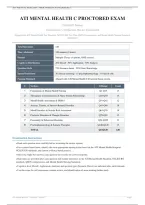
ATI MENTAL HEALTH C PROCTORED EXAM (2026/2027) 120-Question Comprehensive Practice Exam
ATI MENTAL HEALTH C PROCTORED EXAM
(2026/2027 Edition)
Comprehensive 120-Question Practice Examination
Aligned with ATI Mental Health Test Blueprint, NCLEX-RN Test Plan, QSEN Competencies, and Mental Health Nursing Standards
(2026/2027)
Total Questions 120
Time Allotment 180 minutes (3 hours)
Format Multiple Choice (4 options, ONE correct)
Cognitive Distribution 20% Recall · 50% Application · 30% Analysis
Question Style 75% Scenario-based · 25% Direct Knowledge
Special Inclusions 20 clinical reasoning · 15 psychopharmacology · 10 suicide risk
Passing Standard Aligned with ATI Mental Health C Proctored Exam criteria
# Section Q Range Count
1 Foundations of Mental Health Nursing Q1-Q15 15
2 Therapeutic Communication & Nurse-Patient Relationship Q16-Q30 15
3 Mental Health Assessment & DSM-5 Q31-Q42 12
4 Anxiety, Trauma, & Stressor-Related Disorders Q43-Q60 18
5 Mood Disorders & Suicide Risk Assessment Q61-Q78 18
6 Psychotic Disorders & Thought Disorders Q79-Q93 15
7 Personality & Behavioral Disorders Q94-Q105 12
8 Psychopharmacology & Somatic Therapies Q106-Q120 15
TOTAL Q1-Q120 120
Examination Instructions
• Read each question stem carefully before reviewing the answer options.
• For scenario-based items, identify the most appropriate nursing action based on the ATI Mental Health blueprint,
NCLEX-RN standards, and current evidence-based practice.
• Select the single best answer; each question has exactly one correct response.
• Rationales are provided after each question and include references to the ATI Mental Health blueprint, NCLEX-RN
standards, QSEN competencies, and Mental Health Nursing Standards.
• Cognitive level (Recall, Application, Analysis) and question type (Scenario, Direct) are indicated after each rationale.
• Use this exam for self-assessment, content review, and identification of areas needing further study.
ATI Mental Health C - 2026/2027 Edition Page 1
,ATI MENTAL HEALTH C PROCTORED EXAM (2026/2027) 120-Question Comprehensive Practice Exam
Section 1: Foundations of Mental Health Nursing
Q1. Which statement best reflects the contemporary nursing definition of mental health?
A. Mental health is the absence of any diagnosable psychiatric disorder.
B. Mental health is a state of well-being in which an individual realizes personal potential, copes with
normal stressors, works productively, and contributes to community. [CORRECT]
C. Mental health is achieved only when a person reports consistent happiness and life satisfaction.
D. Mental health is determined solely by genetic predisposition and biochemical brain function.
Correct Answer: B
Rationale: The WHO/ANA-aligned definition of mental health emphasizes functional capacity across cognitive, emotional,
social, and productive domains, not merely absence of illness. Option A reflects an outdated medical-model view; C equates
health with constant happiness (unrealistic); D ignores psychosocial determinants central to the recovery model and QSEN
patient-centered care.
Cognitive Level: Recall | Question Type: Direct
Q2. A nurse educator is explaining the difference between mental health and mental illness to a group of
nursing students. Which statement by a student indicates the need for further teaching?
A. Mental illness involves clinically significant disturbances in cognition, emotion regulation, or behavior.
B. Mental health and mental illness exist on a continuum rather than as mutually exclusive categories.
C. Mental illness is solely determined by the presence of a DSM-5 diagnosis reported by the patient.
[CORRECT]
D. Cultural context influences what behaviors are interpreted as pathological versus normative.
Correct Answer: C
Rationale: Mental illness is determined by clinical assessment using DSM-5 criteria, behavioral observation, and functional
impairment, not by patient self-report alone. Statements A, B, and D reflect accurate, recovery-oriented, culturally humble
principles consistent with the ATI Mental Health blueprint.
Cognitive Level: Recall | Question Type: Direct
Q3. A 28-year-old patient newly diagnosed with schizophrenia tells the nurse, 'I'll never be able to have a job
or a family. I'm broken.' Which response best applies the recovery model principle?
A. Let's focus on getting your symptoms under control before worrying about the future.
B. Many people with schizophrenia live meaningful lives with work, relationships, and community
involvement; let's explore what recovery looks like for you. [CORRECT]
C. That kind of negative thinking is a symptom of your illness that we need to treat.
D. I understand you feel hopeless, but try to remain positive and things will get better.
Correct Answer: B
Rationale: The recovery model emphasizes hope, empowerment, person-centered goals, and meaningful life roles despite
chronic illness. Option B validates and reframes while offering concrete possibility. A delays future planning; C pathologizes
the patient's expression of grief; D offers false reassurance and dismisses the patient's expressed feelings.
Cognitive Level: Application | Question Type: Scenario
Q4. A nurse is caring for a patient with severe depression who has refused to participate in any unit activities
for three days. Which intervention reflects the principle of least restrictive environment?
A. Place the patient on one-to-one observation to ensure engagement in activities.
B. Restrict the patient to their room until they agree to attend group therapy.
ATI Mental Health C - 2026/2027 Edition Page 2
,ATI MENTAL HEALTH C PROCTORED EXAM (2026/2027) 120-Question Comprehensive Practice Exam
C. Offer the patient a choice between two low-demand activities and respect their right to decline.
[CORRECT]
D. Administer a PRN sedative to reduce the patient's resistance to participation.
Correct Answer: C
Rationale: Least restrictive environment requires that interventions impose the minimum limitation on patient autonomy
necessary to maintain safety and therapeutic benefit. Offering choices preserves autonomy and supports the recovery model. A,
B, and D impose escalating restrictions without clinical justification for safety, violating patient rights and ethical principles of
mental health nursing.
Cognitive Level: Application | Question Type: Scenario
Q5. A nurse on an inpatient psychiatric unit is developing a plan for a patient with a history of severe
childhood trauma and current PTSD. Which approach best demonstrates trauma-informed care?
A. Confronting the patient about avoidance behaviors to promote processing of trauma.
B. Explaining all procedures in advance, allowing the patient to choose their preferred de-escalation
strategy, and asking permission before any physical contact. [CORRECT]
C. Encouraging the patient to disclose trauma details during the first session to build trust.
D. Limiting the patient's choices to reduce cognitive overload during the admission process.
Correct Answer: B
Rationale: Trauma-informed care operationalizes the SAMHSA principles: safety, trustworthiness/transparency, peer support,
collaboration, empowerment, and attention to cultural issues. Option B reflects transparency, choice/voice, and bodily
autonomy. A risks re-traumatization through premature confrontation; C pushes disclosure before trust is established; D
removes choice and replicates the powerlessness characteristic of trauma.
Cognitive Level: Analysis | Question Type: Scenario
Q6. A 19-year-old patient with anorexia nervosa is admitted involuntarily after a 30% body weight loss. The
patient states, 'You can't force me to eat. I know my rights.' Which statement by the nurse is most accurate
regarding patient rights during involuntary commitment?
A. Involuntary commitment removes all of your rights, including refusal of treatment.
B. Involuntary commitment preserves your right to refuse treatment, receive humane care, communicate
with an attorney, and appeal the commitment. [CORRECT]
C. Involuntary commitment only removes your right to leave the facility; all treatment decisions rest with the
team.
D. Your rights depend on the attending psychiatrist's assessment each shift.
Correct Answer: B
Rationale: Even under involuntary commitment, patients retain the right to refuse treatment (except in emergencies), humane
care, attorney access, communication, and due process/appeal. Options A and C overstate the loss of rights; D incorrectly
suggests rights fluctuate by clinician judgment. This reflects ATI Mental Health blueprint content on patient rights and
legal/ethical principles.
Cognitive Level: Recall | Question Type: Direct
Q7. A 65-year-old patient with newly diagnosed moderate depression is asked to sign a consent form for
fluoxetine therapy. The patient says, 'I'll sign whatever you want, I trust the doctor.' Which action by the
nurse best protects the principle of informed consent?
A. Witness the signature and document that the patient agreed to treatment.
ATI Mental Health C - 2026/2027 Edition Page 3
, ATI MENTAL HEALTH C PROCTORED EXAM (2026/2027) 120-Question Comprehensive Practice Exam
B. Assess the patient's understanding of the medication's purpose, risks, benefits, and alternatives before
signing. [CORRECT]
C. Ask the psychiatrist to explain the medication again and then witness the signature.
D. Refuse to witness the signature because the patient has depression and cannot give consent.
Correct Answer: B
Rationale: Informed consent requires capacity, disclosure, understanding, voluntariness, and consent. The patient's passive
statement raises concern about understanding and voluntariness. The nurse's role is to assess comprehension and ensure the
consent is truly informed, not merely to witness a signature. Option C delegates but does not verify understanding; D
incorrectly assumes depression automatically voids capacity.
Cognitive Level: Application | Question Type: Scenario
Q8. A nursing student is completing a clinical rotation on a psychiatric unit and wants to discuss an
interesting patient case on personal social media, using only the patient's first name. What is the most
appropriate action?
A. Post the case using only the first name since this protects the patient's identity.
B. Discuss the case in a private, professional de-identified manner during clinical post-conference only.
[CORRECT]
C. Post the case with a disclaimer that the content is educational.
D. Share the case with classmates via text message to ensure privacy.
Correct Answer: B
Rationale: HIPAA protects all individually identifiable health information, including first names combined with clinical
details (re-identification risk). Discussion in supervised clinical post-conference, fully de-identified, is the only acceptable
channel. A, C, and D all constitute HIPAA violations with potential civil and criminal penalties, and violate the ANA Code of
Ethics regarding confidentiality.
Cognitive Level: Analysis | Question Type: Scenario
Q9. A school nurse suspects that a 7-year-old child is being physically abused based on patterned bruising and
the child's fearful behavior around the father. Which action is legally required?
A. Interview the child in private and, if the child denies abuse, take no further action.
B. Notify Child Protective Services (CPS) within the legally mandated time frame and document
objective findings. [CORRECT]
C. Confront the father to gather more information before reporting.
D. Wait until there is definitive proof of abuse before making a report.
Correct Answer: B
Rationale: Mandatory reporting laws require nurses to report suspected child abuse; reporting is required on reasonable
suspicion, not definitive proof. Confronting the parent (C) risks the child's safety, and waiting for proof (D) violates the legal
mandate and places the child at ongoing risk. Objective documentation (B) supports both the legal report and any subsequent
investigation.
Cognitive Level: Analysis | Question Type: Scenario
Q10. A patient with paranoid schizophrenia tells the nurse, 'When I get out of here, I'm going to kill my
neighbor. He's been putting thoughts in my head for years.' Which nursing action reflects the duty to
warn/protect (Tarasoff principle)?
A. Document the statement but maintain strict confidentiality to preserve the therapeutic relationship.
B. Notify the identifiable victim (neighbor) and law enforcement, and notify the prescriber. [CORRECT]
ATI Mental Health C - 2026/2027 Edition Page 4


