
ATI Mental Health B Proctored Exam (2026/2027) Nursing Education & Mental Health Nursing
ATI Mental Health B Proctored Exam
(2026/2027)
Comprehensive 120-Question Proctored Examination Aligned with ATI Mental Health
Test Blueprint, NCLEX-RN Test Plan, QSEN Competencies, and Mental Health Nursing
Standards
Examination Overview: This proctored examination consists of 120 multiple-choice questions
covering eight core content areas aligned with the ATI Mental Health B test blueprint and the
NCLEX-RN Test Plan. Cognitive level distribution is approximately 20% recall, 50% application,
and 30% analysis. Approximately 75% of items are scenario-based, requiring clinical reasoning,
prioritization, and therapeutic judgment; 25% assess foundational knowledge. Each question has
four options (A-D) with one correct answer. Rationales reference the ATI Mental Health
blueprint, NCLEX-RN standards, QSEN competencies, and current mental health nursing
principles. Special focus areas include 20 scenario-based clinical reasoning questions, 15
psychopharmacology questions, and 10 suicide risk assessment and safety planning questions.
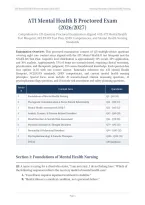
Sectio
Content Area Questions
n
1 Foundations of Mental Health Nursing Q1 - Q15 (15)
2 Therapeutic Communication & Nurse-Patient Relationship Q16 - Q30 (15)
3 Mental Health Assessment & DSM-5 Q31 - Q42 (12)
4 Anxiety, Trauma, & Stressor-Related Disorders Q43 - Q60 (18)
5 Mood Disorders & Suicide Risk Assessment Q61 - Q78 (18)
6 Psychotic Disorders & Thought Disorders Q79 - Q93 (15)
7 Personality & Behavioral Disorders Q94 - Q105 (12)
8 Psychopharmacology & Somatic Therapies Q106 - Q120 (15)
TOTAL 120 Questions
Section 1: Foundations of Mental Health Nursing
Q1: A nurse is caring for a client who states, "I am not crazy, I do not belong here." Which of
the following responses reflects the recovery model of mental health care?
A. "Your illness requires inpatient treatment to stabilize."
B. "Mental illness is a medical condition, not a personal failure."
Page 1
,ATI Mental Health B Proctored Exam (2026/2027) Nursing Education & Mental Health Nursing
C. "You have the right to participate in your treatment planning and goal setting."
*[CORRECT]*
D. "The psychiatrist will determine when you are ready for discharge."
Correct Answer: C
Rationale: The recovery model emphasizes client empowerment, self-direction, and active
participation in treatment decisions. Option C validates the client's autonomy and supports
collaborative goal setting, which are core recovery-oriented principles. Options A, B, and D reflect a
paternalistic, provider-driven model that contradicts recovery principles and QSEN
patient-centered care competencies.
Q2: A nurse witnesses a colleague tell a client, "If you do not take your medication, the
doctor will not let you leave." This statement violates which ethical principle?
A. Beneficence
B. Autonomy *[CORRECT]*
C. Justice
D. Nonmaleficence
Correct Answer: B
Rationale: Autonomy respects the client's right to self-determination and informed
decision-making. The colleague's statement uses coercion, which violates autonomy by threatening
consequences to force compliance. Beneficence (doing good), nonmaleficence (avoiding harm),
and justice (fairness) are not the primary principles violated here. ATI Mental Health blueprint
emphasizes ethical practice and patient rights in all psychiatric settings.
Q3: A client with severe depression refuses to eat, stating, "I do not deserve to live." The
provider plans to initiate involuntary commitment. Which criterion must be met for this
process to be legally valid?
A. The client has a diagnosed mental illness and lacks insurance.
B. The client poses a danger to self or others and is unable to meet basic needs.
*[CORRECT]*
C. The client has been offered voluntary admission and refused.
D. The client has a family member who supports hospitalization.
Correct Answer: B
Rationale: Involuntary commitment requires evidence that the client poses a danger to self or
others, is gravely disabled and unable to meet basic survival needs, or is unable to make informed
decisions about care. Option B reflects these legal criteria. Options A, C, and D do not satisfy the
legal thresholds established by mental health statutes and patient rights protections under the ATI
Mental Health blueprint.
Q4: A nurse is caring for a client who reveals intentions to harm a specific coworker. Which
action by the nurse fulfills the duty to warn (Tarasoff)?
A. Document the statement and notify the treatment team during rounds.
B. Maintain confidentiality because the client is in active treatment.
C. Warn the identified victim and notify law enforcement as required by state law.
*[CORRECT]*
Page 2
,ATI Mental Health B Proctored Exam (2026/2027) Nursing Education & Mental Health Nursing
D. Increase the client's medication dosage to reduce violent thoughts.
Correct Answer: C
Rationale: The Tarasoff duty requires the nurse to warn the identifiable victim and notify law
enforcement when a client makes a credible threat against a specific person. This duty overrides
confidentiality in cases of imminent harm. Option A delays protective action, B incorrectly
prioritizes confidentiality over safety, and D addresses treatment but not the immediate duty to
warn. ATI emphasizes duty to protect in ethical/legal content.
Q5: A nurse is preparing to administer a newly prescribed antipsychotic to a client who has
been declared incompetent. Which statement about informed consent is correct?
A. Informed consent is not required for incompetent clients.
B. The client's legally appointed guardian must provide informed consent.
*[CORRECT]*
C. The attending psychiatrist can consent on the client's behalf.
D. The nurse can administer the medication under implied consent.
Correct Answer: B
Rationale: Informed consent is required for all clients, including those declared incompetent.
When a client lacks decision-making capacity, a legally appointed guardian or surrogate
decision-maker must provide consent. Options A, C, and D are incorrect because they bypass the
legal protections designed to safeguard incompetent clients' rights. ATI blueprint emphasizes
informed consent and patient advocacy competencies.
Q6: A client from a cultural background that views mental illness as a spiritual imbalance
tells the nurse, "I want to see my traditional healer before starting medication." Which
response demonstrates cultural competence?
A. "Medication is more evidence-based and should be started first."
B. "I will coordinate your psychiatric care with your traditional healer so both can be
involved." *[CORRECT]*
C. "Your traditional healer cannot treat a chemical imbalance in the brain."
D. "You need to choose between Western medicine and traditional healing."
Correct Answer: B
Rationale: Cultural competence involves respecting and integrating the client's cultural beliefs and
healing practices into the plan of care. Option B demonstrates this by coordinating Western
psychiatric treatment with traditional healing, supporting health equity and patient-centered care.
The other options dismiss, contradict, or force a choice that undermines the therapeutic
relationship and violates cultural humility principles.
Q7: A psychiatric-mental health nurse is establishing a therapeutic milieu on an inpatient
unit. Which intervention best reflects the principle of least restrictive environment?
A. Using physical restraints routinely for all newly admitted clients.
B. Trying verbal de-escalation before considering seclusion or restraint. *[CORRECT]*
C. Administering PRN medication to all clients during shift change.
D. Locking all client rooms during group therapy sessions.
Correct Answer: B
Page 3
, ATI Mental Health B Proctored Exam (2026/2027) Nursing Education & Mental Health Nursing
Rationale: The least restrictive environment principle requires that interventions be the minimum
necessary to maintain safety. Verbal de-escalation should always be attempted before seclusion or
restraint, which are last-resort interventions. Options A, C, and D impose unnecessary restrictions
that violate client rights and recovery-oriented care principles emphasized in the ATI Mental
Health blueprint.
Q8: A nurse is providing discharge teaching to a client with schizophrenia. The client's
family asks where they can find ongoing support. The nurse refers them to NAMI. This
referral best demonstrates which QSEN competency?
A. Safety
B. Informatics
C. Teamwork and collaboration
D. Community-based care coordination *[CORRECT]*
Correct Answer: D
Rationale: Referring the family to NAMI (National Alliance on Mental Illness) demonstrates
community-based care coordination, an ATI Mental Health blueprint concept that emphasizes
linking clients and families with community resources for ongoing support. While teamwork is
involved, the primary competency demonstrated is connecting clients to community support
systems, which is essential for continuity of care and recovery.
Q9: A nurse is caring for an adolescent client who discloses that her uncle sexually abuses
her. The nurse's legal obligation is to:
A. Maintain confidentiality because the client is an adolescent.
B. Discuss the disclosure only with the client's parents.
C. Report the suspected abuse to the appropriate child protective agency. *[CORRECT]*
D. Counsel the client to confront the uncle when she feels ready.
Correct Answer: C
Rationale: Mandatory reporting laws require nurses to report suspected child abuse or neglect to
the appropriate protective agency. This legal obligation overrides confidentiality in cases involving
minors. Option A incorrectly prioritizes confidentiality, B fails to fulfill the legal duty, and D places
the burden on the victim. ATI Mental Health blueprint emphasizes mandatory reporting and
patient protection obligations.
Q10: A nurse is reviewing HIPAA regulations with a new staff member. Which statement by
the staff member indicates understanding?
A. "I can discuss client information with anyone in the facility who asks."
B. "I can share client information only with staff directly involved in the client's care."
*[CORRECT]*
C. "I can post about interesting cases on social media if I do not use names."
D. "I can give client information to family members without the client's permission."
Correct Answer: B
Rationale: HIPAA's minimum necessary standard requires that protected health information be
shared only with healthcare professionals directly involved in the client's care for treatment,
payment, or operations. Option A violates the minimum necessary principle, C violates HIPAA
Page 4


