
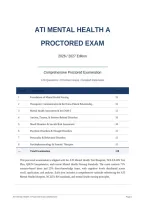
ATI MENTAL HEALTH A
PROCTORED EXAM
Edition
Comprehensive Proctored Examination
120 Questions • 8 Content Areas • Detailed Rationales
Section Content Area Items
1 Foundations of Mental Health Nursing 15
2 Therapeutic Communication & the Nurse-Patient Relationship 15
3 Mental Health Assessment & the DSM-5 12
4 Anxiety, Trauma, & Stressor-Related Disorders 18
5 Mood Disorders & Suicide Risk Assessment 18
6 Psychotic Disorders & Thought Disorders 15
7 Personality & Behavioral Disorders 12
8 Psychopharmacology & Somatic Therapies 15
— Total Examination 120
This proctored examination is aligned with the ATI Mental Health Test Blueprint, NCLEX-RN Test
Plan, QSEN Competencies, and current Mental Health Nursing Standards. The exam contains 75%
scenario-based items and 25% direct-knowledge items, with cognitive levels distributed across
recall, application, and analysis. Each item includes a comprehensive rationale referencing the ATI
Mental Health blueprint, NCLEX-RN standards, and mental health nursing principles.
ATI Mental Health A Proctored Exam (2026/2027) Page 1
, ATI Mental Health A | 2026/2027
Special inclusions: 20 scenario-based clinical reasoning items, 15 psychopharmacology &
medication management items, and 10+ suicide risk assessment & safety planning items.
ATI Mental Health A Proctored Exam (2026/2027) Page 2
, ATI Mental Health A | 2026/2027
Section 1: Foundations of Mental Health Nursing
Content focus: Mental health definition, mental illness definition, stigma, recovery model, trauma-informed care,
patient rights, ethical/legal issues, informed consent, confidentiality, HIPAA, mandatory reporting, duty to
warn/protect, involuntary commitment, patient advocacy, cultural competence, health equity, interdisciplinary
collaboration, community resources, therapeutic milieu, least restrictive environment, QSEN competencies,
evidence-based practice.
Q1 • Recall / Direct item
*Q1:* Which of the following BEST describes the principle of "least restrictive environment" in mental
health nursing?
A. Patients must always be placed in the most open setting available regardless of risk
B. Interventions should use the minimal coercion necessary to keep the patient and others safe while
preserving autonomy [CORRECT]
C. Restraints and seclusion are prohibited under all clinical circumstances
D. Patients have the right to refuse all medications until a court hearing occurs
Correct Answer: B
Rationale: The least restrictive environment doctrine requires that clinicians use the least coercive intervention that still
ensures safety, balancing patient autonomy with risk to self or others. ATI Mental Health blueprint and QSEN
patient-centered care standards emphasize that restraints/seclusion are last-resort interventions, not categorically
prohibited. Refusal rights are balanced against commitment statutes and imminent-danger exceptions.
Q2 • Application / Scenario item
*Q2:* A nurse working on an inpatient psychiatric unit is caring for a 28-year-old patient with major
depressive disorder who states, "I don't want to take my medication anymore; it makes me numb."
Which action reflects a trauma-informed care approach?
A. Educate the patient on the consequences of nonadherence and document the refusal
B. Explore the patient's experience with the medication, validate the feeling, and involve the patient in
shared decision-making [CORRECT]
C. Notify the provider to switch to a long-acting injectable to ensure adherence
D. Remind the patient that the court order requires medication compliance
Correct Answer: B
Rationale: Trauma-informed care emphasizes safety, trustworthiness, choice, collaboration, and empowerment. The nurse
should explore the patient's experience, validate concerns, and partner in shared decision-making rather than coerce. The
ATI blueprint frames this as patient advocacy and cultural competence. Forcing medication or invoking legal authority
bypasses patient autonomy unless strict emergency criteria are met.
ATI Mental Health A Proctored Exam (2026/2027) Page 3
, ATI Mental Health A | 2026/2027
Q3 • Recall / Direct item
*Q3:* Which statement accurately differentiates the medical (recovery) model from the recovery model
in mental health?
A. The medical model focuses on symptom elimination; the recovery model focuses on building a
meaningful life despite illness [CORRECT]
B. The medical model emphasizes peer support; the recovery model emphasizes pharmacotherapy
C. The medical model is patient-driven; the recovery model is clinician-driven
D. The medical model and recovery model are interchangeable terms
Correct Answer: A
Rationale: The medical model targets symptom reduction and clinical remission, while the recovery model focuses on
hope, identity, empowerment, and meaningful life roles despite ongoing symptoms. ATI Mental Health blueprint and
SAMHSA's recovery principles emphasize that recovery is patient-driven and holistic. The other options misattribute the
defining features of each model.
Q4 • Application / Scenario item
*Q4:* A psychiatric-mental health nurse is caring for a patient who confides, "I'm going to kill my
ex-partner when I get out of here." The patient has a specific plan and means. Which action by the nurse
fulfills the duty to warn (Tarasoff)?
A. Document the statement but maintain strict confidentiality to preserve trust
B. Warn the identifiable victim and notify law enforcement, then document actions taken [CORRECT]
C. Increase the patient's sedation and place on one-to-one observation only
D. Discuss the statement only with the treatment team during rounds
Correct Answer: B
Rationale: Under the Tarasoff duty to warn/protect, when a serious, specific threat against an identifiable victim is made,
the clinician must take reasonable steps to protect the victim, including warning them and notifying law enforcement. ATI
Mental Health blueprint and NCLEX-RN standards identify this as a mandatory exception to confidentiality.
Documentation alone or team-only discussion does not satisfy the duty.
ATI Mental Health A Proctored Exam (2026/2027) Page 4


