
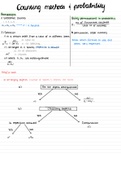
☒tluxtiniq methods & # rrotleabilitcy
Permutations
successive choices
1)
Using permutations in probability
1. 2,3 4,5
of favourable outcomes
. .
ne
.
,
M ,
✗ Mz ✗ Ms
'
n! =
n factorial P =
total ne of outcomes
2.) Selection *
permutation ; order matters
it in a certain order , from a total of m different items
m : total he know which formula to use and
m !
m
Pn =
(m -
m n :
ne
selecting when , very important .
ii )
arranged in n spaces ( repetition is allowed )
m : ne of selections
Mn n :
choices
iiil Where n, ,
nz . . . are
indistinguishable
m !
M , ! nz !
Helpful Note :
a)
arranging objects ( number of spaces & objects the same
a) Are the objects distinguishable
YES NO
!
m
< -
n! M ! ✗ nz !
,
. . .
b)
choosingob.ie#ts
YES NO
< -
is repetition allowed combination
ncr
YES NO
r v
n
r
n Pm


