
EMPLOYMENT & LABOR LAW A+
VERIFIED
WGU D352 - Final Exam:
Employment and Labor Law
Western Governors University - Original Study Question Bank
EXAM CODE: WGU D352 / FINAL ACADEMIC SESSION: 2026 - 2027
60 75m 70%
Original MCQs Recommended Time Suggested Pass Mark
No official exam content Approx 75s per item Course review threshold
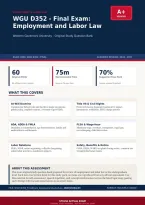
WHAT THIS COVERS
At-Will Doctrine Title VII & Civil Rights
Common law default rule and the three major exceptions: Protected classes, disparate treatment vs impact,
public policy, implied contract, covenant of good faith. harassment, retaliation, EEOC charge process.
ADA, ADEA & FMLA FLSA & Wage-Hour
Disability accommodation, age discrimination, family and Minimum wage, overtime, exemptions, equal pay,
medical leave entitlements. recordkeeping, child labor rules.
Labor Relations Safety, Benefits & Notice
NLRA, NLRB, union organizing, collective bargaining, OSHA, ERISA, WARN Act plant closing notice, common law
unfair labor practices, mandatory subjects. wrongful discharge claims.
ABOUT THIS ASSESSMENT
This is an original study question bank prepared for review of employment and labor law at the undergraduate
level. Each item was written fresh for this study pack; no items are reproduced from any official assessment. Use
this material for self-assessment, spaced repetition, and concept reinforcement across the listed topic map, pairing
each attempt with focused remediation on incorrect items.
FILE: WGU_D352_FinalExam_EmploymentLaborLaw_2026_2027.pdf
QUESTIONS: 60 FORMAT: MULTIPLE CHOICE
STUVIA ACTUAL EXAM
ORIGINAL STUDY MATERIAL - NOT AN OFFICIAL EXAM
,WGU D352 / FINAL WGU D352 - Final Exam: Employment and Labor Law PAGE
SECTION A - 60 QUESTIONS - MULTIPLE CHOICE
QUESTION 01
Q1. An employee works without a written contract in most U.S. states. The default common-law rule
governing the employment relationship is best described as which of the following?
A. Employment at-will, allowing either party to terminate the relationship at any time for any lawful
reason.
B. Lifetime employment guaranteed by statute.
C. Termination only by mutual agreement.
D. Termination only after union grievance.
Correct Answer: A
Rationale: Employment at-will is the U.S. common-law default. Either the employer or the employee may
terminate the relationship at any time, with or without notice, for any lawful reason or no reason at all.
QUESTION 02
Q2. An employee is fired for refusing to violate a state law at the employer's direction. The employee
sues under which exception to at-will employment?
A. Covenant of good faith exception.
B. Public policy exception.
C. Implied contract exception.
D. Statutory exception under Title VII.
Correct Answer: B
Rationale: The public policy exception protects employees from termination for refusing to commit an illegal act
or for exercising a statutory right. Discharge for refusing to violate the law violates established public policy.
QUESTION 03
Q3. An employee handbook states that termination will occur only for cause after a documented
progressive discipline process. Several courts would treat such statements as creating which exception
to at-will employment?
A. Implied contract exception.
B. Covenant of good faith exception.
C. Statutory FMLA exception.
D. Public policy exception.
Correct Answer: A
Rationale: Handbook provisions describing progressive discipline or 'for cause' termination may form an implied
contract limiting the employer's at-will rights. Many courts have recognized such handbook statements as
enforceable.
QUESTION 04
STUVIA ACTUAL EXAM WGU D352 / FINAL | ORIGINAL STUDY MATERIAL 2026 - 2027
, WGU D352 / FINAL WGU D352 - Final Exam: Employment and Labor Law PAGE
Q4. An employer terminates a long-tenured employee without any prior warnings. The state
recognizes the covenant of good faith exception. Which principle does this exception impose?
A. Employers must have just cause before termination and act in good faith in employment decisions.
B. Employers may terminate for any reason without review.
C. Employees must give two weeks notice.
D. Termination requires union approval.
Correct Answer: A
Rationale: The covenant of good faith and fair dealing implies a duty of fairness in employment decisions.
Recognized in a minority of states, it can require just cause for termination even without an explicit contract.
QUESTION 05
Q5. A manager fires an employee one day after she filed a workers' compensation claim. Which
exception to at-will employment most directly applies?
A. Implied contract exception.
B. No exception; termination is permitted.
C. Public policy exception for exercising a statutory right.
D. Covenant of good faith exception.
Correct Answer: C
Rationale: Filing a workers' compensation claim is a statutory right. Retaliatory discharge for exercising statutory
rights violates the public policy exception recognized in most U.S. jurisdictions.
QUESTION 06
Q6. An employer terminates an employee for reporting unsafe conditions to OSHA. The employee's
primary statutory protection comes from which source?
A. WARN Act.
B. OSHA Section 11(c) anti-retaliation protection.
C. NLRA Section 7 only.
D. FLSA anti-retaliation provision.
Correct Answer: B
Rationale: OSHA Section 11(c) prohibits retaliation against employees who report unsafe working conditions or
exercise rights under the Act. The employee has 30 days to file a retaliation complaint with OSHA.
QUESTION 07
Q7. An employee is misclassified as an independent contractor when she actually works under the
employer's direction and control. The most likely consequence for the employer is:
A. Refund of contractor fees only.
B. Liability for back taxes, unpaid wages, overtime, and benefits, plus potential statutory penalties.
C. Requirement to hire additional contractors.
STUVIA ACTUAL EXAM WGU D352 / FINAL | ORIGINAL STUDY MATERIAL 2026 - 2027


