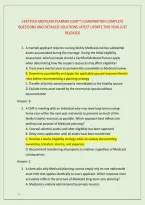
CERTIFIED MEDICAID PLANNER (CMP™) EXAMINATION COMPLETE
QUESTIONS AND DETAILED SOLUTIONS LATEST UPDATE THIS YEAR JUST
RELEASED
1. A married applicant requires nursing-facility Medicaid and has substantial
assets accumulated during the marriage. During the initial eligibility
assessment, which principle should a Certified Medicaid Planner apply
when determining how the couple’s resources may affect eligibility?
A. Treat every marital asset as permanently unavailable to Medicaid review
B. Determine countability and apply the applicable spousal-impoverishment
rules before recommending a planning strategy
C. Transfer all jointly owned property immediately to the healthy spouse
D. Exclude every asset owned by the community spouse without
documentation
Answer: B
2. A CMP is meeting with an individual who may need long-term nursing-
home care within the next year and wants to preserve as much of the
family’s lawful resources as possible. Which approach best reflects the
professional purpose of Medicaid planning?
A. Conceal selected assets until after eligibility has been approved
B. Delay every application until all assets have been transferred
C. Develop a lawful eligibility strategy while accurately documenting
ownership, transfers, income, and expenses
D. Recommend transferring all property to relatives regardless of Medicaid
consequences
Answer: C
3. A client asks why Medicaid planning cannot simply rely on one nationwide
asset limit that applies identically to every applicant. Which response most
accurately reflects the structure of Medicaid long-term-care planning?
A. Medicaid is entirely administered by private insurers
pg. 1
, B. Federal requirements establish the framework, while state Medicaid
programs implement rules and procedures that can differ by state
C. Every Medicaid category uses the same eligibility methodology
D. State Medicaid agencies have no discretion concerning program
administration
Answer: B
4. An older adult is receiving Social Security income and may soon require
institutional care. The family assumes that Medicare and Medicaid are
interchangeable because both are government programs. Which distinction
should the CMP emphasize?
A. Medicare and Medicaid have identical financial eligibility requirements
B. Medicaid generally has no role in long-term-care services
C. Medicare is primarily a means-tested long-term-care program
D. Medicaid may provide coverage for qualifying long-term-care services
subject to applicable financial and nonfinancial eligibility requirements
Answer: D
5. A CMP begins an eligibility assessment for a prospective nursing-home
resident. Which information should be gathered before recommending a
specific asset-planning strategy?
A. Only the applicant’s checking-account balance
B. Assets, income, marital status, transfers, ownership interests, real
property, insurance, trusts, and relevant state-specific circumstances
C. Only the applicant’s monthly medical expenses
D. Only the value of the applicant’s primary residence
Answer: B
6. A client has recently transferred money to an adult child and now wants to
apply for long-term-care Medicaid. Why is the transfer particularly
important to investigate?
A. Any transfer automatically permanently disqualifies the applicant
B. Transfers may be subject to Medicaid transfer-of-assets rules and can
pg. 2
, potentially result in a period of ineligibility
C. Transfers are irrelevant if the recipient is a family member
D. Transfers are reviewed only after Medicaid coverage has ended
Answer: B
7. A CMP is reviewing a client’s financial history and discovers several
unexplained withdrawals. What should the planner do before submitting
the Medicaid application?
A. Ignore the withdrawals because bank statements are not relevant
B. Report the withdrawals only if the applicant remembers them
C. Investigate and document the transactions so their Medicaid treatment
can be accurately determined
D. Reclassify the withdrawals as medical expenses without supporting
evidence
Answer: C
8. A married couple is planning for one spouse’s anticipated nursing-home
admission. Which concept is central to protecting the financial resources of
the spouse who remains in the community?
A. Community spouse resource protections
B. Elimination of all household income
C. Automatic exclusion of every jointly owned asset
D. Permanent transfer of all assets to the institutionalized spouse
Answer: A
9. A CMP is determining whether a particular resource should be counted for
Medicaid eligibility. Which question is most important?
A. Whether the client personally considers the asset valuable
B. Whether the asset is owned, available, and treated as countable or
exempt under the applicable Medicaid rules
C. Whether the asset was purchased more than five years ago
D. Whether the asset is physically located inside the applicant’s home
Answer: B
pg. 3
, 10. An applicant owns a vehicle used for transportation. Which statement best
describes the CMP’s approach to evaluating the vehicle?
A. Every vehicle is automatically countable at full market value
B. Every vehicle is automatically exempt regardless of circumstances
C. The vehicle should be evaluated under the applicable Medicaid vehicle-
exclusion rules and the applicant’s circumstances
D. Vehicles are evaluated only after estate recovery begins
Answer: C
11. A client owns a life-insurance policy and asks whether its face value alone
determines Medicaid treatment. What should the CMP recognize?
A. Face value alone always determines countability
B. Life insurance is never relevant to Medicaid eligibility
C. The policy must be evaluated under the applicable Medicaid rules,
including policy characteristics and any applicable exemption
D. Only the beneficiary designation determines whether the policy is
countable
Answer: C
12. A client owns a bank account jointly with another individual. What should
the planner establish before determining the Medicaid treatment of the
account?
A. Only the name printed on the account
B. The ownership arrangement, source of funds, access to the account, and
applicable Medicaid rules
C. Whether the other owner is a relative
D. Whether the account has existed for more than one year
Answer: B
13. A Medicaid applicant owns a home that has been used as the applicant’s
residence. Which issue should receive careful consideration before
concluding that the property is countable?
A. The color and condition of the house
pg. 4
QUESTIONS AND DETAILED SOLUTIONS LATEST UPDATE THIS YEAR JUST
RELEASED
1. A married applicant requires nursing-facility Medicaid and has substantial
assets accumulated during the marriage. During the initial eligibility
assessment, which principle should a Certified Medicaid Planner apply
when determining how the couple’s resources may affect eligibility?
A. Treat every marital asset as permanently unavailable to Medicaid review
B. Determine countability and apply the applicable spousal-impoverishment
rules before recommending a planning strategy
C. Transfer all jointly owned property immediately to the healthy spouse
D. Exclude every asset owned by the community spouse without
documentation
Answer: B
2. A CMP is meeting with an individual who may need long-term nursing-
home care within the next year and wants to preserve as much of the
family’s lawful resources as possible. Which approach best reflects the
professional purpose of Medicaid planning?
A. Conceal selected assets until after eligibility has been approved
B. Delay every application until all assets have been transferred
C. Develop a lawful eligibility strategy while accurately documenting
ownership, transfers, income, and expenses
D. Recommend transferring all property to relatives regardless of Medicaid
consequences
Answer: C
3. A client asks why Medicaid planning cannot simply rely on one nationwide
asset limit that applies identically to every applicant. Which response most
accurately reflects the structure of Medicaid long-term-care planning?
A. Medicaid is entirely administered by private insurers
pg. 1
, B. Federal requirements establish the framework, while state Medicaid
programs implement rules and procedures that can differ by state
C. Every Medicaid category uses the same eligibility methodology
D. State Medicaid agencies have no discretion concerning program
administration
Answer: B
4. An older adult is receiving Social Security income and may soon require
institutional care. The family assumes that Medicare and Medicaid are
interchangeable because both are government programs. Which distinction
should the CMP emphasize?
A. Medicare and Medicaid have identical financial eligibility requirements
B. Medicaid generally has no role in long-term-care services
C. Medicare is primarily a means-tested long-term-care program
D. Medicaid may provide coverage for qualifying long-term-care services
subject to applicable financial and nonfinancial eligibility requirements
Answer: D
5. A CMP begins an eligibility assessment for a prospective nursing-home
resident. Which information should be gathered before recommending a
specific asset-planning strategy?
A. Only the applicant’s checking-account balance
B. Assets, income, marital status, transfers, ownership interests, real
property, insurance, trusts, and relevant state-specific circumstances
C. Only the applicant’s monthly medical expenses
D. Only the value of the applicant’s primary residence
Answer: B
6. A client has recently transferred money to an adult child and now wants to
apply for long-term-care Medicaid. Why is the transfer particularly
important to investigate?
A. Any transfer automatically permanently disqualifies the applicant
B. Transfers may be subject to Medicaid transfer-of-assets rules and can
pg. 2
, potentially result in a period of ineligibility
C. Transfers are irrelevant if the recipient is a family member
D. Transfers are reviewed only after Medicaid coverage has ended
Answer: B
7. A CMP is reviewing a client’s financial history and discovers several
unexplained withdrawals. What should the planner do before submitting
the Medicaid application?
A. Ignore the withdrawals because bank statements are not relevant
B. Report the withdrawals only if the applicant remembers them
C. Investigate and document the transactions so their Medicaid treatment
can be accurately determined
D. Reclassify the withdrawals as medical expenses without supporting
evidence
Answer: C
8. A married couple is planning for one spouse’s anticipated nursing-home
admission. Which concept is central to protecting the financial resources of
the spouse who remains in the community?
A. Community spouse resource protections
B. Elimination of all household income
C. Automatic exclusion of every jointly owned asset
D. Permanent transfer of all assets to the institutionalized spouse
Answer: A
9. A CMP is determining whether a particular resource should be counted for
Medicaid eligibility. Which question is most important?
A. Whether the client personally considers the asset valuable
B. Whether the asset is owned, available, and treated as countable or
exempt under the applicable Medicaid rules
C. Whether the asset was purchased more than five years ago
D. Whether the asset is physically located inside the applicant’s home
Answer: B
pg. 3
, 10. An applicant owns a vehicle used for transportation. Which statement best
describes the CMP’s approach to evaluating the vehicle?
A. Every vehicle is automatically countable at full market value
B. Every vehicle is automatically exempt regardless of circumstances
C. The vehicle should be evaluated under the applicable Medicaid vehicle-
exclusion rules and the applicant’s circumstances
D. Vehicles are evaluated only after estate recovery begins
Answer: C
11. A client owns a life-insurance policy and asks whether its face value alone
determines Medicaid treatment. What should the CMP recognize?
A. Face value alone always determines countability
B. Life insurance is never relevant to Medicaid eligibility
C. The policy must be evaluated under the applicable Medicaid rules,
including policy characteristics and any applicable exemption
D. Only the beneficiary designation determines whether the policy is
countable
Answer: C
12. A client owns a bank account jointly with another individual. What should
the planner establish before determining the Medicaid treatment of the
account?
A. Only the name printed on the account
B. The ownership arrangement, source of funds, access to the account, and
applicable Medicaid rules
C. Whether the other owner is a relative
D. Whether the account has existed for more than one year
Answer: B
13. A Medicaid applicant owns a home that has been used as the applicant’s
residence. Which issue should receive careful consideration before
concluding that the property is countable?
A. The color and condition of the house
pg. 4