
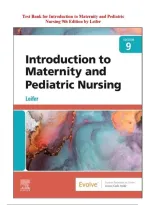
Introduction to Maternity and Pediatric Nursing
Introduction to Maternity and Pediatric Nursing Introduction to Maternity and Pediatric Nursing is a comprehensive nursing textbook designed to introduce students and healthcare learners to the principles of caring for women, newborns, infants, children, and families. It provides a foundation in maternity and pediatric nursing while helping learners develop an understanding of the physiological, developmental, clinical, and educational needs of patients across different stages of life. Maternity and pediatric nursing are important areas of healthcare because they involve caring for patients during significant periods of physical, emotional, and developmental change. This textbook provides educational coverage of pregnancy, childbirth, postpartum care, newborn care, child health, growth and development, common pediatric conditions, family-centered care, and nursing responsibilities. The maternity nursing section introduces essential concepts related to pregnancy and maternal health. Students can learn about normal pregnancy, maternal physiological changes, prenatal assessment, health education, nutrition, common pregnancy concerns, and preparation for childbirth. Understanding these concepts gives nursing students a foundation for providing safe and supportive care throughout the antenatal period. The book also addresses the process of labor and birth. Students are introduced to the stages of labor, maternal and fetal assessment, nursing care during childbirth, pain management, and the immediate care needs of mothers and newborns. The material can help learners understand the importance of monitoring maternal and fetal well-being and recognizing situations that require additional clinical attention. Postpartum nursing is another important component of maternity care. The textbook provides educational coverage of maternal recovery following childbirth, postpartum assessment, breastfeeding, newborn feeding, maternal education, and common postpartum concerns. It emphasizes the role of nurses in supporting mothers and families as they adjust to life with a newborn. Newborn nursing introduces students to the unique healthcare needs of infants immediately after birth and during the early neonatal period. Topics may include newborn assessment, normal adaptation after birth, thermoregulation, feeding, hygiene, safety, and identification of common newborn health concerns. Students can use these concepts to build a foundation for providing appropriate newborn care. The pediatric nursing component focuses on children from infancy through adolescence. Pediatric patients have healthcare needs that differ from those of adults, and effective nursing care requires an understanding of normal growth and development. The textbook introduces developmental concepts and helps learners consider age-appropriate communication, assessment, nutrition, safety, health promotion, and family involvement. Growth and development are central themes in pediatric nursing. Students can explore physical, cognitive, emotional, and social development throughout childhood. Understanding developmental milestones helps nurses provide age-appropriate care and recognize variations that may require further assessment. The book also introduces common pediatric health conditions and nursing care principles. Depending on the edition, topics may include respiratory disorders, gastrointestinal problems, infectious diseases, neurological conditions, cardiovascular disorders, endocrine conditions, developmental concerns, and other common childhood health problems. Nursing students can use this material to understand assessment, patient care, education, and family support. Family-centered care is an important principle throughout maternity and pediatric nursing. Children depend on parents, guardians, and caregivers for much of their healthcare, while new mothers and newborns often require coordinated support. The textbook encourages learners to consider the family as an important part of the healthcare process and to communicate respectfully with parents and caregivers. Health promotion and disease prevention are also important components of maternity and pediatric nursing. Nurses play an essential role in educating families about nutrition, immunization, injury prevention, hygiene, developmental health, breastfeeding, safe sleep, and other aspects of healthy living. These preventive approaches can help families make informed healthcare decisions and support healthy development. The textbook is suitable for nursing students beginning their study of maternity and pediatric nursing. It can be used as a primary course textbook, supplementary learning resource, examination preparation tool, or clinical reference. It may also be useful for nursing educators and healthcare professionals who want to review fundamental concepts related to maternal and child health. Key Features Introduction to maternity and pediatric nursing Covers pregnancy, childbirth, postpartum, and newborn care Provides a foundation in pediatric nursing Discusses growth and development from infancy through adolescence Covers maternal and newborn assessment Introduces labor and delivery nursing care Addresses breastfeeding and newborn feeding Includes pediatric health assessment concepts Discusses common pediatric health conditions Emphasizes family-centered nursing care Covers health promotion and disease prevention Supports patient and family education Useful for nursing students and healthcare learners Suitable for coursework, clinical preparation, and examination review Ideal For This textbook can be useful for: Nursing students Diploma nursing students Bachelor of Science in Nursing students Maternal-child nursing students Pediatric nursing students Midwifery students Community health nursing students Healthcare students Nursing educators Clinical instructors Healthcare professionals reviewing maternity and pediatric nursing Maternity Nursing Topics The maternity component provides a foundation for understanding maternal care throughout pregnancy, labor, birth, and the postpartum period. Students can explore prenatal assessment, maternal health, pregnancy changes, fetal development, labor and delivery, postpartum recovery, breastfeeding, newborn care, and patient education. Pediatric Nursing Topics The pediatric component introduces learners to the physical, emotional, cognitive, and social needs of children. Students can study child growth and development, pediatric assessment, communication with children and families, nutrition, safety, common childhood illnesses, nursing interventions, health promotion, and family-centered care. Study and Clinical Use Students can use Introduction to Maternity and Pediatric Nursing when preparing for classroom examinations, clinical rotations, assignments, care plans, and nursing assessments. The material can help connect theoretical knowledge with practical nursing responsibilities and provide a foundation for more advanced study in maternal-child health. A strong understanding of maternity and pediatric nursing is essential for nurses who care for mothers, newborns, children, and families. By studying normal pregnancy and development alongside common health concerns, nursing students can build knowledge that supports comprehensive and age-appropriate patient care. Product note: Edition, publisher, publication year, ISBN, page count, binding, cover design, and supplementary materials may vary depending on the specific version. Customers should review the individual product listing carefully to confirm the exact edition and condition before purchasing.
Document information
- Uploaded on
- October 2, 2026
- Number of pages
- 334
- Written in
- 2026/2027
- Type
- Exam (elaborations)
- Contains
- Questions & answers


