
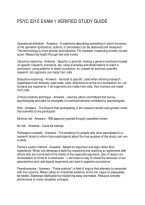
PSYC 2210 EXAM 1 VERIFIED STUDY GUIDE
Operational definition - Answers - A statement describing something in which the terms
of the operation (procedure, actions, or processes) can be observed and measured.
This terminology is more precise and objective. For example, measuring anxiety via test
score. Measuring height through feet and inches.
Inductive reasoning - Answers - Specific to general; making a general conclusion based
on specific research, scenarios, etc; using examples and observations to reach a
conclusion; using patterns to reach conclusion; ex.) based on previous scientific
research, all organisms are made from cells
Deductive reasoning - Answers - General to specific; used when deriving research
hypotheses from theories; uses facts, rules, definitions to arrive at a conclusion; ex.) all
humans are organisms. If all organisms are made from cells, then humans are made
from cells.
Critical incidents technique - Answers - Used by ethics committees that survey
psychologists and asks for examples of unethical behavior exhibited by psychologists;
Risk - Answers - The chance that participating in the research would have greater costs
than benefits to the participant
Minimal risk - Answers - IRB approval granted through expedited review
No risk - Answers - Could be exempt
Participant crosstalk - Answers - The tendency for people who have participated in a
research study to inform future participants about the true purpose of the study; can ruin
a study
Peirce's a priori method - Answers - Based on argument and logic rather than
experience; When one develops a belief by reasoning and reaching an agreement with
others who are convinced of the merits of the reasoned argument; Use of reason via
conversation to come to a conclusion --> we have no way to check the accuracy of our
assumptions and valid logical arguments can lead to opposite conclusions
Pesudoscience - Answers - "False science"; a field of inquiry that attempts to associate
with true science; Relies solely on anecdotal evidence and is too vague to adequately
be tested. Sidesteps falsification by explaining away anomalies. Reduces complex
phenomena to overly simplistic concepts.
Operational definition - Answers - A statement describing something in which the terms
of the operation (procedure, actions, or processes) can be observed and measured.
This terminology is more precise and objective. For example, measuring anxiety via test
score. Measuring height through feet and inches.
Inductive reasoning - Answers - Specific to general; making a general conclusion based
on specific research, scenarios, etc; using examples and observations to reach a
conclusion; using patterns to reach conclusion; ex.) based on previous scientific
research, all organisms are made from cells
Deductive reasoning - Answers - General to specific; used when deriving research
hypotheses from theories; uses facts, rules, definitions to arrive at a conclusion; ex.) all
humans are organisms. If all organisms are made from cells, then humans are made
from cells.
Critical incidents technique - Answers - Used by ethics committees that survey
psychologists and asks for examples of unethical behavior exhibited by psychologists;
Risk - Answers - The chance that participating in the research would have greater costs
than benefits to the participant
Minimal risk - Answers - IRB approval granted through expedited review
No risk - Answers - Could be exempt
Participant crosstalk - Answers - The tendency for people who have participated in a
research study to inform future participants about the true purpose of the study; can ruin
a study
Peirce's a priori method - Answers - Based on argument and logic rather than
experience; When one develops a belief by reasoning and reaching an agreement with
others who are convinced of the merits of the reasoned argument; Use of reason via
conversation to come to a conclusion --> we have no way to check the accuracy of our
assumptions and valid logical arguments can lead to opposite conclusions
Pesudoscience - Answers - "False science"; a field of inquiry that attempts to associate
with true science; Relies solely on anecdotal evidence and is too vague to adequately
be tested. Sidesteps falsification by explaining away anomalies. Reduces complex
phenomena to overly simplistic concepts.


