
OR I GI NAL S T UD Y QUES T I ON B ANK - 20 26/20 27 ORIG INAL CONTE NT
EDITION
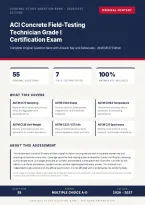
ACI Concrete Field-Testing
Technician Grade I
Certification Exam
Complete Original Question Bank with Answer Key and Rationales - 2026/2027 Edition
55 7 100%
O RIGIN AL Q UE STIO N S F IE LD TE STIN G TO PICS AN SW E R KE Y IN CLUDE D
WHAT T HI S COVE R S
ASTM C172 Sampling ASTM C143 Slump ASTM C1064 Temperature
Representative sampling from truck, Cone procedures, tamping rates, Thermometer accuracy, sensor
mixer, and aggregate plant measurement, and invalid test placement, and recording
discharge points. conditions. requirements.
ASTM C138 Unit Weight ASTM C231 / C173 Air ASTM C31 Specimens
Density, yield, relative yield, and Pressure method and volumetric Molding, initial and final curing,
gravimetric air content calculations. method apparatus, steps, and limits. transport, and strength acceptance.
AB OU T T HI S AS S E S S ME NT
This review bank contains 55 newly written original multiple-choice questions with a complete answer key and
teaching rationale for every item. Coverage spans the field-testing scope reviewed for Grade I certification: sampling,
slump, temperature, unit weight and yield, air content, and standard-cured specimens. Each item is written for this
edition to reinforce procedures, standard values, and the reasoning behind every answer. This material is an
independent study aid and is not the official examination; it is not affiliated with or endorsed by the certifying body.
All 55 questions are newly written original items for independent study and self-assessment. This bank is not the official American Concrete
Institute (ACI) examination and contains no official exam content.
Q UES T I O N S F O R M AT EDIT IO N
55 MULTIPLE CHOICE A-D 2026 - 2027
O R I G I N A L S T U D Y Q U ES T I O N B A N K - FO R EXA M P R EPA R AT I O N
,ACI Grade I - Concrete Field Testing
ACI Concrete Field-Testing Technician Grade I Certification Exam
Choose the single best answer for each item. The correct answer and a teaching rationale follow every question, so each
page doubles as a focused review session.
QUESTIONS 1 - 10 SECTION 1 OF 6
Q1. A ready-mix truck arrives on site and the technician must obtain a composite sample for casting
compressive strength cylinders. According to ASTM C172, from what portion of the truck's discharge
should the sample be taken?
A. The first portion discharged, so the sample is captured before any segregation can occur.
B. The middle portion of the load, after the first portion and before the last portion are excluded.
C. The last portion discharged, because it is the most thoroughly mixed concrete in the drum.
D. Any portion of the load, provided the total volume collected is at least 1 cubic foot.
Correct Answer: B
Rationale: ASTM C172 requires sampling from the middle portion of the load from revolving drum trucks, and
the first and last portions must never be taken because they are the most segregated. The 1 cubic foot minimum
does not license sampling from either end of the load. Two or more portions are combined into a composite
sample from the middle of the discharge.
Q2. A technician positions a wheeled container beneath the chute of a revolving drum truck to obtain a
composite sample. Which procedure does ASTM C172 require when collecting the portions that make
up the sample?
A. Hold the container under one edge of the stream and fill it from a single pour without moving
it.
B. Pass the container across the entire width of the discharge stream repeatedly to collect two or
more portions from the middle of the load.
C. Scoop concrete from the chute with a shovel after the drum has stopped turning completely.
D. Let the full load discharge onto the ground and collect concrete from the resulting pile.
Correct Answer: B
Rationale: ASTM C172 requires the receptacle to be passed through the entire width of the discharge stream so
each portion is representative, with two or more portions taken at regularly spaced intervals from the middle
portion of the load. Scooping from a stopped chute is not a permitted technique. Collecting from a discharged
pile applies only to paving mixers after the entire batch has been discharged.
ORIGINAL STUDY QUESTION BANK 1
, ACI Grade I - Concrete Field Testing
Q3. A project specification requires compressive strength specimens, and the concrete has a nominal
maximum coarse aggregate size of 1 in. What minimum composite sample size does ASTM C172
require for this strength testing?
A. About 0.25 cubic foot, which is enough concrete to fill a single 4 by 8 in. cylinder.
B. About 0.5 cubic foot, which is enough concrete to fill two 4 by 8 in. cylinders.
C. At least 1 cubic foot (28 L) of concrete for the composite sample.
D. At least 2 cubic feet, regardless of which tests are to be performed.
Correct Answer: C
Rationale: ASTM C172 requires a composite sample of at least 28 L (1 cubic foot) for strength tests when the
nominal maximum aggregate size is 1-1/2 in. or less, which includes this 1 in. concrete. Volumes that fill only
one or two cylinders leave nothing for the companion slump, air, and temperature tests. The larger 2 cubic foot
minimum is not a requirement of the standard.
Q4. At 1:00 p.m. a technician finishes obtaining a composite sample from a truck mixer and plans to
run temperature, slump, and air content tests and to cast strength cylinders. Which time limits does
ASTM C172 place on beginning these activities?
A. All tests and cylinder casting must begin within 30 minutes after sampling is complete.
B. Temperature must begin within 5 minutes, but slump, air, and casting may wait up to 20
minutes.
C. All tests and cylinder casting must begin within 5 minutes after sampling is complete.
D. Slump, temperature, and air content must begin within 5 minutes, and strength specimens must
be molded within 15 minutes.
Correct Answer: D
Rationale: ASTM C172 requires tests for slump, temperature, and air content to start within 5 minutes after
obtaining the final portion of the composite sample, and molding of strength specimens must be completed
within 15 minutes. Applying the 5 minute limit to cylinder casting is stricter than the standard requires. Waiting
20 or 30 minutes violates both limits and allows slump loss and air changes.
ORIGINAL STUDY QUESTION BANK 2
EDITION
ACI Concrete Field-Testing
Technician Grade I
Certification Exam
Complete Original Question Bank with Answer Key and Rationales - 2026/2027 Edition
55 7 100%
O RIGIN AL Q UE STIO N S F IE LD TE STIN G TO PICS AN SW E R KE Y IN CLUDE D
WHAT T HI S COVE R S
ASTM C172 Sampling ASTM C143 Slump ASTM C1064 Temperature
Representative sampling from truck, Cone procedures, tamping rates, Thermometer accuracy, sensor
mixer, and aggregate plant measurement, and invalid test placement, and recording
discharge points. conditions. requirements.
ASTM C138 Unit Weight ASTM C231 / C173 Air ASTM C31 Specimens
Density, yield, relative yield, and Pressure method and volumetric Molding, initial and final curing,
gravimetric air content calculations. method apparatus, steps, and limits. transport, and strength acceptance.
AB OU T T HI S AS S E S S ME NT
This review bank contains 55 newly written original multiple-choice questions with a complete answer key and
teaching rationale for every item. Coverage spans the field-testing scope reviewed for Grade I certification: sampling,
slump, temperature, unit weight and yield, air content, and standard-cured specimens. Each item is written for this
edition to reinforce procedures, standard values, and the reasoning behind every answer. This material is an
independent study aid and is not the official examination; it is not affiliated with or endorsed by the certifying body.
All 55 questions are newly written original items for independent study and self-assessment. This bank is not the official American Concrete
Institute (ACI) examination and contains no official exam content.
Q UES T I O N S F O R M AT EDIT IO N
55 MULTIPLE CHOICE A-D 2026 - 2027
O R I G I N A L S T U D Y Q U ES T I O N B A N K - FO R EXA M P R EPA R AT I O N
,ACI Grade I - Concrete Field Testing
ACI Concrete Field-Testing Technician Grade I Certification Exam
Choose the single best answer for each item. The correct answer and a teaching rationale follow every question, so each
page doubles as a focused review session.
QUESTIONS 1 - 10 SECTION 1 OF 6
Q1. A ready-mix truck arrives on site and the technician must obtain a composite sample for casting
compressive strength cylinders. According to ASTM C172, from what portion of the truck's discharge
should the sample be taken?
A. The first portion discharged, so the sample is captured before any segregation can occur.
B. The middle portion of the load, after the first portion and before the last portion are excluded.
C. The last portion discharged, because it is the most thoroughly mixed concrete in the drum.
D. Any portion of the load, provided the total volume collected is at least 1 cubic foot.
Correct Answer: B
Rationale: ASTM C172 requires sampling from the middle portion of the load from revolving drum trucks, and
the first and last portions must never be taken because they are the most segregated. The 1 cubic foot minimum
does not license sampling from either end of the load. Two or more portions are combined into a composite
sample from the middle of the discharge.
Q2. A technician positions a wheeled container beneath the chute of a revolving drum truck to obtain a
composite sample. Which procedure does ASTM C172 require when collecting the portions that make
up the sample?
A. Hold the container under one edge of the stream and fill it from a single pour without moving
it.
B. Pass the container across the entire width of the discharge stream repeatedly to collect two or
more portions from the middle of the load.
C. Scoop concrete from the chute with a shovel after the drum has stopped turning completely.
D. Let the full load discharge onto the ground and collect concrete from the resulting pile.
Correct Answer: B
Rationale: ASTM C172 requires the receptacle to be passed through the entire width of the discharge stream so
each portion is representative, with two or more portions taken at regularly spaced intervals from the middle
portion of the load. Scooping from a stopped chute is not a permitted technique. Collecting from a discharged
pile applies only to paving mixers after the entire batch has been discharged.
ORIGINAL STUDY QUESTION BANK 1
, ACI Grade I - Concrete Field Testing
Q3. A project specification requires compressive strength specimens, and the concrete has a nominal
maximum coarse aggregate size of 1 in. What minimum composite sample size does ASTM C172
require for this strength testing?
A. About 0.25 cubic foot, which is enough concrete to fill a single 4 by 8 in. cylinder.
B. About 0.5 cubic foot, which is enough concrete to fill two 4 by 8 in. cylinders.
C. At least 1 cubic foot (28 L) of concrete for the composite sample.
D. At least 2 cubic feet, regardless of which tests are to be performed.
Correct Answer: C
Rationale: ASTM C172 requires a composite sample of at least 28 L (1 cubic foot) for strength tests when the
nominal maximum aggregate size is 1-1/2 in. or less, which includes this 1 in. concrete. Volumes that fill only
one or two cylinders leave nothing for the companion slump, air, and temperature tests. The larger 2 cubic foot
minimum is not a requirement of the standard.
Q4. At 1:00 p.m. a technician finishes obtaining a composite sample from a truck mixer and plans to
run temperature, slump, and air content tests and to cast strength cylinders. Which time limits does
ASTM C172 place on beginning these activities?
A. All tests and cylinder casting must begin within 30 minutes after sampling is complete.
B. Temperature must begin within 5 minutes, but slump, air, and casting may wait up to 20
minutes.
C. All tests and cylinder casting must begin within 5 minutes after sampling is complete.
D. Slump, temperature, and air content must begin within 5 minutes, and strength specimens must
be molded within 15 minutes.
Correct Answer: D
Rationale: ASTM C172 requires tests for slump, temperature, and air content to start within 5 minutes after
obtaining the final portion of the composite sample, and molding of strength specimens must be completed
within 15 minutes. Applying the 5 minute limit to cylinder casting is stricter than the standard requires. Waiting
20 or 30 minutes violates both limits and allows slump loss and air changes.
ORIGINAL STUDY QUESTION BANK 2


