
• Wrong document? Swap it for free
  • Written by students who passed
  • Immediately available after payment
  • Read online or as PDF
Sell
Where do you study
Your language
Document preview thumbnail
Preview 3 out of 24 pages
Exam (elaborations)

Spaud 505 Final Exam Questions With Verified Solutions Latest Update 2026

Document preview thumbnail
Preview 3 out of 24 pages

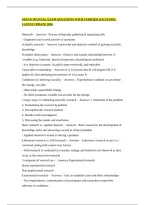
SPAUD 505 FINAL EXAM QUESTIONS WITH VERIFIED SOLUTIONS LATEST UPDATE 2026 Research - Answers - Process of logically gathering & organizing info - Organized way to seek answers to questions Scientific research - Answers A powerful and objective method of gaining scientific knowledge Scientific observation - Answers - Observe and explain relationship between 2+ variables (e.g. behaviors, physical properties, physiological attributes) - It is objective in nature, its public (peer-reviewed), and replicable Cause-effect relationship - Answers If A is present, then B will happen OR if A implies B, then attributing the presence of A to cause B Conditions for inferring causality - Answers - Experimental condition occurs before the change, not after - Observable, quantifiable change - No other extraneous variable can account for the change 5 major steps of conducting scientific research - Answers 1. Statement of the problem 2. Formulating the research hypothesis 3. Description the research method 4. Results of the investigation 5. Discussing the results and conclusion Basic research vs. applied research - Answers - Basic research is the development of knowledge and is not answering a social or clinical problem - Applied research is aimed at solving a problem Laboratory research vs. field research - Answers - Laboratory research occurs in a contrived setting with control over factors - Field research is conducted in everyday settings and behaviors are observed as they occur in the natural environment 3 categories of research are: - Answers Experimental research Quasi experimental research Non-experimental research Experimental research - Answers - Aim: to establish cause and effect relationships - Two requirements: randomization of participants and researchers control the selection of conditions Non-experimental/descriptive research - Answers - Aim: to observe group differences, developmental trends, or establishing relationships between variables - May or may not have a comparison not necessarily a control group, extraneous factors cannot be controlled Quasi-experimental research - Answers - Aim: to explain cause and effect relationships - May have control group like experimental design - Can't manipulate IV - More similar to experimental than non-experimental Qualitative research - Answers often includes verbal info; description-rich Quantitative research - Answers numerical info from participants Mixed-method research - Answers can get both quantitative and qualitative info independent variable - Answers the presumed cause of the dependent variable, the presumed effect dependent variable - Answers - the behavior that is changed -the focus of the study - can be qualitative, quantitative, or combo "Delayed auditory feedback can cause a change in the speech rate." IV? DV? Data categorization? - Answers IV: delayed auditory feedback DV: speech rate Quantitative data "Masking noise may cause a change in the auditory threshold." IV? DV? Data categorization? - Answers IV: masking noise DV: auditory threshold Quantitative data Active variable - Answers variable that CAN be manipulated Attribute variable - Answers variable that CANNOT be manipulated (age, gender, etc.) IV in experimental research has to be an - Answers active variable IV in descriptive/non-experimental research has to be an - Answers attribute variable Continuous variable - Answers a quantitative value that can be rank ordered Categorical variable - Answers a variable that can be categorized or named and cannot be rank ordered Extraneous variables - Answers - unwanted variables that could influence the dependent variable - mediates the relationship between IV & DV Primary source - Answers First appearance of research that results from literature in the original form (peer-reviewed journal article); most reliable Secondary source - Answers Describes, explains, or interprets information contained in the primary source (textbook, literature review) Tertiary source - Answers Presents information collated from various sources to present a very broad overview of the topic (Wikipedia, blog post) Components of EBP - Answers Client perspectives, clinical expertise, evidence (both internal and external) Efficacy - Answers - the ability to produce a desired or intended result. - likelihood that a protocol will bring out the desired outcome in highly CONTROLLED CONDITIONS (laboratory) - establishes the potential for beneficial change Effectiveness - Answers The likelihood that a protocol or treatment will be beneficial in a certain clinical population in the REAL WORLD Four steps of the EBP Process - Answers 1. Frame a clinical question 2. Gather evidence 3. Assess the evidence 4. Make a clinical decision (DECIDE Framework) PICO - Answers Population- age sex, culture, ethnicity, health status, disorder, disability, etc. Intervention- therapeutic strategy, risk factor, assessment tool, service delivery, etc. Comparison- alt. therapeutic strategy, placebo, no intervention, alt. assessment tool, no risk behavior, etc. Outcome- short-term goal, long-term goal, function, normalcy, ability, mastery or accuracy, cost effectiveness, satisfaction, Q of L, employability, etc. Tuskegee Study - Answers Syphilis study in which Black men were not given available treatment. Only black men were examined, they were lied to about their diagnosis, and they did not give informed consent Tudor Study - Answers Wanted to prove that telling orphans they had a stutter could make them develop a stutter. It had no potential benefits and children were not informed about the intent of the study Nazi Medical Atrocities - Answers Nonconsensual, ill-informed, not intended to preserve health Nuremburg code - Answers Adopted following World War II. Important for free choice and voluntary participation Establishment of the Institutional Review Boards (IRB) - Answers Independent review bodies at institutions that are involved in research with human subjects or animals. Made up of 5 or more members with diverse backgrounds who must give a statement of approval before the initiation of participant recruitment Belmont Report - Answers US standard. Focuses on three basic ethical principles: respect for persons (informed consent), beneficence (maximize possible benefits and minimize possible harms), and justice (fair and unbiased selection of participants/distribution of benefits) Declaration of Helsinki - Answers International standard, similar to the Belmont Report 4 main principles of the ASHA code of ethics - Answers - Prioritize the welfare of individuals who are served - Maintain the highest level of professional competence - Advocate for needs and provide accurate information - Uphold dignity, maintain harmonious relationships, and accept self-imposed standards Fabrication - Answers Making up data or results Falsification - Answers Manipulating data or results Plagiarism - Answers Taking someone else's work/ideas and passing them as one's own Paraphrasing - Answers way to use a text in your own writing without directly quoting source material DEI in research design - Answers Diversity of participants, Equity, Inclusion Goal of measurement in CSD - Answers To measure speech, language, and hearing variables with a clear and practical set of rules Process of measurement - Answers Identify, collect, organize, analyze, interpret Instrumental measures - Answers Physical variables that can be measured instrumentally Observer measures - Answers Behavioral variables that cannot be measured instrumentally Classifications of data - Answers Nominal-level, ordinal-level, interval-level, ratio-level Nominal-level data - Answers - Attributes of objects or events categorized into mutually exclusive, named categories - Mathematical property: identity Examples: pass/fail, diagnostic category, correct vs incorrect Ordinal-level data - Answers - Rank order of mutually exclusive categories, but the difference between the categories cannot actually be measured - Mathematical property: inequality Examples: severity groups (mild, moderate, severe), likert scales Interval-level data - Answers - Rank ordered, mutually exclusive categories with equal intervals between, but no true zero (arbitrary) Examples: temperature scales, standard score on a behavioral test (e.g. PPVT, TOLD, CELF) Ratio-level data - Answers - Ratio-level data - Rank ordered, mutually exclusive categories with equal intervals between and a true zero (not arbitrary) Examples: frequency of disfluencies, air pressure, stuttering frequency, speech intelligibility, pulse, weight, height Histogram - Answers -graphical representations of continuous variables - Frequency tables X-axis: intervals chosen for analysis Y-axis: measurements - No space between intervals Bar graph - Answers - Display categorical variables - Frequency tables X-axis: intervals chosen for analysis Y-axis: measurements - Space between intervals box and whisker plot - Answers - Displays continuous variables - Shows median (50th percentile), upper boundary (75th percentile), and lower boundary (25th percentile) - Whiskers represent the highest and lowest values from the upper and lower limits - Outliers represent values that fall beyond the whiskers stem and leaf plot - Answers Stems: analogous to intervals on histogram Leaves: units within the interval scatterplot - Answers displays the relationship between two quantitative variables measured on the same individuals Data transformation - Answers Ensures symmetrical distribution of data and helps reduce variability across variables by converting one type of data to another Normal distribution of data - Answers Bell-shaped curve with higher frequency of middle scores and lower frequency of both higher and lower scores Positive skew - Answers - One in which most scores cluster around the low value but a small number of scores spread out into the very high scores - Tail towards the positive score - A lot of people have gotten lower scores Negative skew - Answers - One in which most scores cluster around the high value but a small number of scores spread out into the very low scores - Tail towards the negative scores - A lot of people have gotten higher scores mean - Answers AVERAGE -Tail towards the negative scores. A lot of people have gotten higher scores median - Answers middle-most score in a set of data mode - Answers the most frequently occurring score(s) in a distribution range - Answers Difference between the highest and lowest values variance - Answers Mean of the values and how far each value is from the mean, then the average sum of deviances; takes into account the spread of all data points in a data set. standard deviation - Answers Square root of the variance - Small SD: data is very close to the mean - Large SD: data is very far from the mean components of introduction statement - Answers General statement of the problem, rationale, relevant review of literature, conclusion of section, research questions Four step funnel model for the introduction - Answers History Importance of research Gaps in literature Purpose of the study Research questions - Answers Descriptive, difference, establishing a relationship deductive reasoning approach - Answers general to specific theory, hypothesis, observation, confirmation Inductive reasoning approach - Answers specific to general confirmation, observation, hypothesis, theory Aim of qualitative research - Answers To explore and gain insight into a topic, generally through inductive reasoning Ethnography - Answers - Qualitative research - Focus: studying participant behavior to explore the CULTURE of people - Methods: participant observation, focus groups, in-depth interview - Typically combined with another method Phenomenology - Answers - Qualitative research - Focus: understand how the world appears to others by understanding their experiences, perspectives, and interpretations of the world Field research - Answers - Qualitative research - Focus: observing phenomena in their natural state or context Grounded theory - Answers - Qualitative research - Focus: develop theories about phenomenon of interest grounded in observation Qualitative methods - Answers Case study, narrative research, direct observation, participant observation, interview method Case study method - Answers - Qualitative method - Intense observation of a person, object, or event - Intrinsic: looking at a specific person or place - Instrumental: collecting behaviors to develop or modify a theory - Collective: combine cases to investigate a phenomenon at large Advantages and disadvantages of case studies - Answers - Advantages: challenge accepted norms in practice, rare occurrences, develop clinical insights - Disadvantages: subject selection, experimenter bias, generalization of results narrative research - Answers - Qualitative method - Narrative: set of words derived from stories, interviews, experiences - Oral, written, and visual narratives: explain and interpret events - Therapeutic discourse: narrative research in clinical backgrounds direct observation - Answers - Qualitative research method - Detailed systematic observations about people, location, events - Detached: subjects are unaware that they are being observed - Overt/direct/reactive: subjects are aware that they are being observed Participant observation - Answers - Qualitative method - The researcher becomes a participant in the culture and context - More challenging interview method - Answers - Qualitative method - Structured: set questions, formal standardized manner - Unstructured: driven by the interviewee, more of a conversation, more suitable for exploring sensitive, emotional, and personal topics - Semi structured: organized by topic, general open-ended questions - Focus group: relatively small homogenous group of participants that meet specific criteria ethnographic interviewing - Answers Designed to understand the lived experience of the interviewee things used to evaluate qualitative methods - Answers - Credibility: criteria used for evaluating believability of results - Transferability: extent to which results can be generalized triangulation - Answers Corroborate data using a range of techniques Mixed method analysis - Answers - Both quantitative and qualitative methodology - Sequential, parallel, coordinated substudies, integrated broad quantitative classifications - Answers - Group designs: 1 or more groups of subjects exposed to one or more levels of IV, does not report individual data - Focuses on the relationship between the IV and - - DVSingle-subject designs: focus on behavior of individual or small groups, with data from each subject evaluated individually group design types - Answers Between subjects (BSD) or within subjects (WSD) Between-subjects design (BSD) - Answers - Quantitative method - Performance of separate groups measured - The groups are exposed to different treatments or levels of the IV - Bivalent: two groups - Multivalent: more than two groups Within-subject design (WSD) - Answers - Quantitative method - Performance of same subjects on different levels of the IV - Subject serves as their own control Sequencing effect - Answers - Performance in an earlier condition may influence performance on a subsequent condition - Order effect: familiarity with tasks may influence performance - Carryover effect: results of one condition may carry over to the next condition Counterbalancing - Answers Experimenter arranges all possible sequences of condition and randomly assigns participants Longitudinal study - Answers Follows participants over a period of time Correlational study - Answers Different measures obtained from the same group of participants to determine the relationship between variables

Content preview

SPAUD 505 FINAL EXAM QUESTIONS WITH VERIFIED SOLUTIONS
LATEST UPDATE 2026


Research - Answers - Process of logically gathering & organizing info
- Organized way to seek answers to questions
Scientific research - Answers A powerful and objective method of gaining scientific
knowledge
Scientific observation - Answers - Observe and explain relationship between 2+
variables (e.g. behaviors, physical properties, physiological attributes)
- It is objective in nature, its public (peer-reviewed), and replicable
Cause-effect relationship - Answers If A is present, then B will happen OR if A
implies B, then attributing the presence of A to cause B
Conditions for inferring causality - Answers - Experimental condition occurs before
the change, not after
- Observable, quantifiable change
- No other extraneous variable can account for the change
5 major steps of conducting scientific research - Answers 1. Statement of the problem
2. Formulating the research hypothesis
3. Description the research method
4. Results of the investigation
5. Discussing the results and conclusion
Basic research vs. applied research - Answers - Basic research is the development of
knowledge and is not answering a social or clinical problem
- Applied research is aimed at solving a problem
Laboratory research vs. field research - Answers - Laboratory research occurs in a
contrived setting with control over factors
- Field research is conducted in everyday settings and behaviors are observed as they
occur in the natural environment
3 categories of research are: - Answers Experimental research
Quasi experimental research
Non-experimental research
Experimental research - Answers - Aim: to establish cause and effect relationships
- Two requirements: randomization of participants and researchers control the
selection of conditions

,Non-experimental/descriptive research - Answers - Aim: to observe group
differences, developmental trends, or establishing relationships between variables
- May or may not have a comparison not necessarily a control group, extraneous
factors cannot be controlled
Quasi-experimental research - Answers - Aim: to explain cause and effect
relationships
- May have control group like experimental design
- Can't manipulate IV
- More similar to experimental than non-experimental
Qualitative research - Answers often includes verbal info; description-rich
Quantitative research - Answers numerical info from participants
Mixed-method research - Answers can get both quantitative and qualitative info
independent variable - Answers the presumed cause of the dependent variable, the
presumed effect
dependent variable - Answers - the behavior that is changed
-the focus of the study
- can be qualitative, quantitative, or combo
"Delayed auditory feedback can cause a change in the speech rate." IV? DV? Data
categorization? - Answers IV: delayed auditory feedback
DV: speech rate
Quantitative data
"Masking noise may cause a change in the auditory threshold." IV? DV? Data
categorization? - Answers IV: masking noise
DV: auditory threshold
Quantitative data
Active variable - Answers variable that CAN be manipulated
Attribute variable - Answers variable that CANNOT be manipulated (age, gender,
etc.)
IV in experimental research has to be an - Answers active variable
IV in descriptive/non-experimental research has to be an - Answers attribute variable
Continuous variable - Answers a quantitative value that can be rank ordered
Categorical variable - Answers a variable that can be categorized or named and
cannot be rank ordered

, Extraneous variables - Answers - unwanted variables that could influence the
dependent variable
- mediates the relationship between IV & DV
Primary source - Answers First appearance of research that results from literature in
the original form (peer-reviewed journal article); most reliable
Secondary source - Answers Describes, explains, or interprets information contained
in the primary source (textbook, literature review)
Tertiary source - Answers Presents information collated from various sources to
present a very broad overview of the topic (Wikipedia, blog post)
Components of EBP - Answers Client perspectives, clinical expertise, evidence (both
internal and external)
Efficacy - Answers - the ability to produce a desired or intended result.
- likelihood that a protocol will bring out the desired outcome in highly
CONTROLLED CONDITIONS (laboratory)
- establishes the potential for beneficial change
Effectiveness - Answers The likelihood that a protocol or treatment will be beneficial
in a certain clinical population in the REAL WORLD
Four steps of the EBP Process - Answers 1. Frame a clinical question
2. Gather evidence
3. Assess the evidence
4. Make a clinical decision (DECIDE Framework)
PICO - Answers Population- age sex, culture, ethnicity, health status, disorder,
disability, etc.


Intervention- therapeutic strategy, risk factor, assessment tool, service delivery, etc.


Comparison- alt. therapeutic strategy, placebo, no intervention, alt. assessment tool,
no risk behavior, etc.


Outcome- short-term goal, long-term goal, function, normalcy, ability, mastery or
accuracy, cost effectiveness, satisfaction, Q of L, employability, etc.
Tuskegee Study - Answers Syphilis study in which Black men were not given
available treatment. Only black men were examined, they were lied to about their
diagnosis, and they did not give informed consent


Document information

Uploaded on
October 2, 2026
Number of pages
24
Written in
2026/2027
Type
Exam (elaborations)
Contains
Questions & answers
$12.49

Wrong document? Swap it for free Within 14 days of purchase and before downloading, you can choose a different document. You can simply spend the amount again.
Written by students who passed
Immediately available after payment
Read online or as PDF

Seller avatar
Reputation scores are based on the amount of documents a seller has sold for a fee and the reviews they have received for those documents. There are three levels: Bronze, Silver and Gold. The better the reputation, the more your can rely on the quality of the sellers work.
joshuawesonga22
3.6
(15)
Sold
143
Followers
2
Items
15836
Last sold
12 hours ago


Why students choose Stuvia

Created by fellow students, verified by reviews

Quality you can trust: written by students who passed their tests and reviewed by others who've used these notes.

Didn't get what you expected? Choose another document

No worries! You can instantly pick a different document that better fits what you're looking for.

Pay as you like, start learning right away

No subscription, no commitments. Pay the way you're used to via credit card and download your PDF document instantly.

Student with book image

“Bought, downloaded, and aced it. It really can be that simple.”

Alisha Student

Working on your references?

Create accurate citations in APA, MLA and Harvard with our free citation generator.

Working on your references?

Frequently asked questions
