
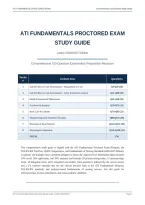
ATI FUNDAMENTALS PROCTORED EXAM Comprehensive 150-Question Study Guide
ATI FUNDAMENTALS PROCTORED EXAM
STUDY GUIDE
Latest 2026/2027 Edition
Comprehensive 150-Question Examination Preparation Resource
Sectio
Content Area Questions
n
1 Safe & Effective Care Environment - Management of Care Q1-Q20 (20)
2 Safe & Effective Care Environment - Safety & Infection Control Q21-Q40 (20)
3 Health Promotion & Maintenance Q41-Q58 (18)
4 Psychosocial Integrity Q59-Q73 (15)
5 Basic Care & Comfort Q74-Q95 (22)
6 Pharmacological & Parenteral Therapies Q96-Q115 (20)
7 Reduction of Risk Potential Q116-Q135 (20)
8 Physiological Adaptation Q136-Q150 (15)
TOTAL 150
This comprehensive study guide is aligned with the ATI Fundamentals Proctored Exam Blueprint, the
NCLEX-RN Test Plan, QSEN Competencies, and Fundamentals of Nursing Standards (2026/2027 Edition).
It contains 150 multiple-choice questions designed to mirror the cognitive-level distribution (approximately
20% recall, 50% application, and 30% analysis) and includes 20 priority-setting items, 15 pharmacology
items, 10 delegation items, and 5 integrated case studies. Each question is followed by the correct answer
and a 2-4 sentence rationale that ties the clinical decision back to the ATI Fundamentals blueprint,
NCLEX-RN standards, and evidence-based fundamentals of nursing practice. Use this guide for
self-assessment, focused remediation, and exam-readiness validation.
ATI Fundamentals Proctored Exam Study Guide | Latest 2026/2027 Page 1
,ATI FUNDAMENTALS PROCTORED EXAM Comprehensive 150-Question Study Guide
150 Questions 8 Content Areas 5 Case Studies 2026/2027 Edition
ATI Fundamentals Proctored Exam Study Guide | Latest 2026/2027 Page 2
,ATI FUNDAMENTALS PROCTORED EXAM Comprehensive 150-Question Study Guide
Section 1: Safe & Effective Care Environment - Management of Care
This section covers client rights, advocacy, legal and ethical principles, informed consent, advance directives, delegation
and assignment across RN, LPN, and UAP scope of practice, prioritization using ABCs and Maslow, interdisciplinary
collaboration, SBAR communication, documentation, incident reporting, HIPAA, mandatory reporting, and the Nurse
Practice Act. Questions include priority-setting, delegation scenarios, and one integrated case study. (20 questions)
Q1: A nurse on a medical-surgical unit is caring for four clients. Which client should the nurse assess first?
A. A client who is 2 days postoperative requesting pain medication for incisional pain rated 6/10.
B. A client with chronic heart failure whose respiratory rate is 28/min and oxygen saturation is 90% on room air.
[CORRECT]
C. A client with type 1 diabetes mellitus who is scheduled to receive insulin lispro with breakfast in 30 minutes.
D. A client newly admitted with pneumonia who has a temperature of 100.4 F (38 C).
Correct Answer: B
Rationale: Using the ABC priority-setting framework and the concept of clinical deterioration, the client with respiratory
compromise (RR 28, SpO2 90%) must be assessed first because respiratory distress can rapidly progress to arrest. The
NCLEX-RN Test Plan emphasizes prioritization using ABCs; an elevated respiratory rate with hypoxemia signals a
potentially life-threatening gas exchange problem. The other clients are stable or have needs that can be delayed briefly
(postoperative pain, scheduled insulin, low-grade fever).
Q2: A charge nurse is delegating care for the shift. Which task is most appropriate to assign to a licensed
practical nurse (LPN)?
A. Performing the initial admission assessment of a client transferred from the ICU.
B. Administering an IV push of morphine sulfate to a client with acute pain.
C. Reinforcing discharge teaching about wound care for a client who is 24 hours postoperative. [CORRECT]
D. Developing a plan of care for a newly admitted client with acute pancreatitis.
Correct Answer: C
Rationale: Per the Nurse Practice Act and ATI delegation guidelines, the LPN scope includes caring for stable clients with
predictable outcomes and reinforcing (not initiating) teaching that was developed by an RN. Initial admission assessments,
IV push medications (depending on state law, often RN-only), and developing the plan of care are RN responsibilities
requiring clinical judgment outside the LPN scope. Reinforcing established discharge teaching fits the LPN's scope.
Q3: Which of the following tasks can the RN safely delegate to unlicensed assistive personnel (UAP)?
A. Measuring vital signs on a client who is one hour post-cardiac catheterization.
B. Ambulating a stable client who is 2 days postoperative from an appendectomy. [CORRECT]
C. Assessing a client's surgical incision for signs of infection.
D. Teaching a client about a low-sodium diet prior to discharge.
Correct Answer: B
Rationale: The Five Rights of Delegation require that the task match the delegatee's scope, the client's condition be stable,
and the outcome be predictable. Ambulating a stable postoperative client is a routine ADL task within UAP scope. The
client one hour post-cardiac catheterization requires close monitoring for bleeding and is unstable for UAP. Assessment,
teaching, and evaluation of clinical findings are non-delegable RN responsibilities per the ATI Fundamentals blueprint.
ATI Fundamentals Proctored Exam Study Guide | Latest 2026/2027 Page 3
, ATI FUNDAMENTALS PROCTORED EXAM Comprehensive 150-Question Study Guide
Q4: A client is scheduled for an elective cholecystectomy. The surgeon explains the procedure, risks, and
alternatives, and the client signs the consent form. The client later tells the nurse, 'I'm not really sure what
they're going to do.' What is the nurse's best action?
A. Reassure the client that the surgeon has explained everything and the procedure will go as planned.
B. Notify the surgeon so they can return and re-explain the procedure before the surgery proceeds. [CORRECT]
C. Explain the surgical procedure to the client using a nursing textbook reference.
D. Document the client's statement in the medical record and proceed with preoperative preparation.
Correct Answer: B
Rationale: Informed consent requires that the client understand the procedure, risks, benefits, and alternatives; it is the
surgeon's legal and ethical responsibility to obtain consent. When the nurse identifies that the client does not understand,
the nurse must act as client advocate by notifying the surgeon so the consent can be properly re-obtained. Proceeding
without true informed consent violates autonomy and constitutes battery. The nurse's role is to verify and witness, not to
provide the consent explanation.
Q5: A nurse is caring for a client whose family member calls the unit to ask about the client's condition.
Which response by the nurse is appropriate?
A. Provide a brief update on the client's condition because the caller is a family member.
B. Ask the caller to verify the client's date of birth before sharing any information.
C. Explain that client information cannot be shared without the client's permission. [CORRECT]
D. Transfer the call to the unit secretary, who can release limited information.
Correct Answer: C
Rationale: HIPAA protects the privacy of protected health information (PHI). The nurse may not disclose information to
anyone, including family, without the client's explicit authorization. Verifying identifiers does not authorize disclosure. The
nurse should ask the client at admission who may receive information and document those preferences. The ATI
Fundamentals blueprint emphasizes confidentiality and HIPAA compliance.
Q6: An older adult client with capacity refuses a recommended blood transfusion on religious grounds,
stating, 'My faith does not allow it.' The client's adult child begs the nurse to give the transfusion anyway.
Which ethical principle is being upheld by respecting the client's refusal?
A. Beneficence
B. Nonmaleficence
C. Autonomy [CORRECT]
D. Justice
Correct Answer: C
Rationale: Autonomy respects the client's right to self-determination, including the right to refuse treatment, even when the
refusal may result in harm or death. A competent adult's informed refusal must be honored. Beneficence and
nonmaleficence would favor the transfusion, but they yield to autonomy in a capacitated adult. Justice concerns fair
distribution of resources. The ATI blueprint stresses ethical principles applied in clinical practice.
ATI Fundamentals Proctored Exam Study Guide | Latest 2026/2027 Page 4


