
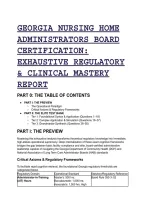
GEORGIA NURSING HOME
ADMINISTRATORS BOARD
CERTIFICATION:
EXHAUSTIVE REGULATORY
& CLINICAL MASTERY
REPORT
PART 0: THE TABLE OF CONTENTS
● PART I: THE PREVIEW
○ The Operational Paradigm
○ Critical Axioms & Regulatory Frameworks
● PART II: THE ELITE TEST BANK
○ Tier 1: Foundational Syntax & Application (Questions 1–18)
○ Tier 2: Complex Application & Simulation (Questions 19–37)
○ Tier 3: Grandmaster Synthesis (Questions 38–55)
PART I: THE PREVIEW
Mastering this exhaustive analysis transforms theoretical regulatory knowledge into immediate,
high-stakes operational supremacy. Deep internalization of these exact cognitive frameworks
bridges the gap between basic facility compliance and elite, board-certified administrative
leadership capable of navigating the Georgia Department of Community Health (DCH) and
National Association of Long Term Care Administrator Boards (NAB) standards.
Critical Axioms & Regulatory Frameworks
To facilitate rapid cognitive retrieval, the foundational Georgia regulatory thresholds are
categorized below.
Regulatory Domain Operational Standard Statutory/Regulatory Reference
Administrator-in-Training Master's: 500 hrs; Board Rule 393-3-.02
(AIT) Hours Baccalaureate: 1,000 hrs;
Associate's: 1,500 hrs; High
,Regulatory Domain Operational Standard Statutory/Regulatory Reference
School: 2,000 hrs. Max 40
hrs/week.
Continuing Education (CE) 40 hours biennially for NHA; 30 Board Rule 393-13-.01
hours biennially for ALC/PCH.
Dietary Intervals Maximum 14 hours between DCH Rule 111-8-56-.06
evening meal and breakfast; 16
hours permissible only with
resident group approval and
substantial evening snack.
Mandatory Abuse Reporting Immediate verbal report to DCH O.C.G.A. § 31-8-82
and law enforcement; written
report strictly within 24 hours.
Background Screening Mandatory fingerprint-based O.C.G.A. § 31-7-250
(GAPS) check via GCHEXS for all direct
access staff prior to
employment.
ALC Nursing Staffing (Per 1-30 residents: 8 hrs; 31-60: 16 O.C.G.A. § 31-7-12.2
Week) hrs; 61-90: 24 hrs; 90+: 40 hrs.
PART II: THE ELITE TEST BANK
Tier 1: Foundational Syntax & Application
Q1: An applicant possessing a baccalaureate degree in healthcare administration applies for
licensure as a Georgia Nursing Home Administrator. Based on the principles of Georgia Board
Rule 393-3, which Administrator-in-Training (AIT) requirement is the MOST APPROPRIATE? A)
Completion of a 500-hour AIT program B) Completion of a 1,500-hour AIT program C)
Completion of a 1,000-hour AIT program D) Exemption from the AIT program due to the
specialized degree
● Answer: C (Completion of a 1,000-hour AIT program)
● Distractor Analysis:
○ A is incorrect: A 500-hour program is reserved exclusively for applicants holding a
Master's degree in a related field.
○ B is incorrect: A 1,500-hour program applies to candidates with an Associate
degree in nursing plus four years of facility experience.
○ D is incorrect: Georgia mandates an AIT program for all initial licensure applicants
lacking reciprocity.
The Mentor's Analysis: Georgia scales AIT hours inversely to formal educational attainment.
When facing licensure qualifications, the immediate priority is verifying the applicant's highest
degree. By utilizing the sliding hour scale, you bypass the common trap of assuming a related
degree waives practical training. Professional Intuition: Always map educational degrees to
the specific 500/1000/1500/2000 AIT hour tiers to validate eligibility.
Q2: A licensed nursing home administrator is preparing for biennial license renewal. Based on
the principles of Georgia Continuing Education requirements, which action is MANDATORY? A)
Submitting physical proof of 40 hours of CE to the Board prior to renewal B) Completing 30
clock hours of continuing education biennially C) Completing 40 clock hours of continuing
, education biennially D) Completing 40 clock hours annually
● Answer: C (Completing 40 clock hours of continuing education biennially)
● Distractor Analysis:
○ A is incorrect: Licensees only submit physical proof if randomly selected for an audit
or renewing late.
○ B is incorrect: 30 hours biennially is the requirement for ALC and PCH
administrators, not NHAs.
○ D is incorrect: The 40-hour requirement spans the entire two-year renewal cycle,
not annually.
The Mentor's Analysis: License renewal hinges on continuous professional development
measured across a biennial cycle. When facing license renewal, the immediate priority is
securing 40 approved hours within the odd-year expiration cycle. By utilizing digital attestation,
you bypass the common trap of unnecessarily mailing documents to the Board. Professional
Intuition: NHA requires 40 CE hours biennially; ALC requires 30. Never confuse the two.
Q3: A certified nursing assistant observes an unexplained fracture on a resident. Based on the
principles of the Long-term Care Facility Resident Abuse Reporting Act, what is the REQUIRED
timeline for the written report? A) Within 8 hours of the observation B) Within 48 hours of the
verbal report C) Within 24 hours of making the initial verbal report D) Within 5 business days to
the Ombudsman
● Answer: C (Within 24 hours of making the initial verbal report)
● Distractor Analysis:
○ A is incorrect: 8 hours is the OSHA requirement for reporting a work-related
employee fatality, not resident abuse.
○ B is incorrect: The statute dictates a 24-hour limit; 48 hours constitutes an illegal
delay.
○ D is incorrect: Reporting must go to DCH and law enforcement immediately, not just
the Ombudsman over 5 days.
The Mentor's Analysis: Suspected abuse triggers strict mandatory reporting protocols to protect
vulnerable adults. When facing potential abuse, the immediate priority is securing the resident
and notifying HFR and law enforcement. By utilizing the 24-hour written report rule, you bypass
the common trap of administrative delays resulting in criminal charges. Professional Intuition:
Verbal report immediately; written report within 24 hours. Failure to report is a
misdemeanor.
Q4: The dietary manager is establishing a new meal schedule. Based on the principles of DCH
Rule 111-8-56-.06, what is the MAXIMUM allowable time between the evening meal and
breakfast without a waiver? A) 12 hours B) 16 hours C) 14 hours D) 15 hours
● Answer: C (14 hours)
● Distractor Analysis:
○ A is incorrect: While 12 hours is acceptable, it is not the regulatory maximum.
○ B is incorrect: 16 hours is only permissible if a nourishing snack is provided and the
resident group formally agrees.
○ D is incorrect: 15 hours does not align with any state or federal dietary parameter.
The Mentor's Analysis: Nutritional pacing prevents hypoglycemia and prolonged fasting in
geriatric populations. When facing meal scheduling, the immediate priority is ensuring no more
than 14 hours elapse overnight. By utilizing strict kitchen scheduling, you bypass the common
trap of citing the 16-hour exception without proper authorization. Professional Intuition: The
hard deck is 14 hours; the conditional ceiling is 16 hours.
Q5: A facility is undergoing renovations. Based on the principles of Physical Plant Standards,
ADMINISTRATORS BOARD
CERTIFICATION:
EXHAUSTIVE REGULATORY
& CLINICAL MASTERY
REPORT
PART 0: THE TABLE OF CONTENTS
● PART I: THE PREVIEW
○ The Operational Paradigm
○ Critical Axioms & Regulatory Frameworks
● PART II: THE ELITE TEST BANK
○ Tier 1: Foundational Syntax & Application (Questions 1–18)
○ Tier 2: Complex Application & Simulation (Questions 19–37)
○ Tier 3: Grandmaster Synthesis (Questions 38–55)
PART I: THE PREVIEW
Mastering this exhaustive analysis transforms theoretical regulatory knowledge into immediate,
high-stakes operational supremacy. Deep internalization of these exact cognitive frameworks
bridges the gap between basic facility compliance and elite, board-certified administrative
leadership capable of navigating the Georgia Department of Community Health (DCH) and
National Association of Long Term Care Administrator Boards (NAB) standards.
Critical Axioms & Regulatory Frameworks
To facilitate rapid cognitive retrieval, the foundational Georgia regulatory thresholds are
categorized below.
Regulatory Domain Operational Standard Statutory/Regulatory Reference
Administrator-in-Training Master's: 500 hrs; Board Rule 393-3-.02
(AIT) Hours Baccalaureate: 1,000 hrs;
Associate's: 1,500 hrs; High
,Regulatory Domain Operational Standard Statutory/Regulatory Reference
School: 2,000 hrs. Max 40
hrs/week.
Continuing Education (CE) 40 hours biennially for NHA; 30 Board Rule 393-13-.01
hours biennially for ALC/PCH.
Dietary Intervals Maximum 14 hours between DCH Rule 111-8-56-.06
evening meal and breakfast; 16
hours permissible only with
resident group approval and
substantial evening snack.
Mandatory Abuse Reporting Immediate verbal report to DCH O.C.G.A. § 31-8-82
and law enforcement; written
report strictly within 24 hours.
Background Screening Mandatory fingerprint-based O.C.G.A. § 31-7-250
(GAPS) check via GCHEXS for all direct
access staff prior to
employment.
ALC Nursing Staffing (Per 1-30 residents: 8 hrs; 31-60: 16 O.C.G.A. § 31-7-12.2
Week) hrs; 61-90: 24 hrs; 90+: 40 hrs.
PART II: THE ELITE TEST BANK
Tier 1: Foundational Syntax & Application
Q1: An applicant possessing a baccalaureate degree in healthcare administration applies for
licensure as a Georgia Nursing Home Administrator. Based on the principles of Georgia Board
Rule 393-3, which Administrator-in-Training (AIT) requirement is the MOST APPROPRIATE? A)
Completion of a 500-hour AIT program B) Completion of a 1,500-hour AIT program C)
Completion of a 1,000-hour AIT program D) Exemption from the AIT program due to the
specialized degree
● Answer: C (Completion of a 1,000-hour AIT program)
● Distractor Analysis:
○ A is incorrect: A 500-hour program is reserved exclusively for applicants holding a
Master's degree in a related field.
○ B is incorrect: A 1,500-hour program applies to candidates with an Associate
degree in nursing plus four years of facility experience.
○ D is incorrect: Georgia mandates an AIT program for all initial licensure applicants
lacking reciprocity.
The Mentor's Analysis: Georgia scales AIT hours inversely to formal educational attainment.
When facing licensure qualifications, the immediate priority is verifying the applicant's highest
degree. By utilizing the sliding hour scale, you bypass the common trap of assuming a related
degree waives practical training. Professional Intuition: Always map educational degrees to
the specific 500/1000/1500/2000 AIT hour tiers to validate eligibility.
Q2: A licensed nursing home administrator is preparing for biennial license renewal. Based on
the principles of Georgia Continuing Education requirements, which action is MANDATORY? A)
Submitting physical proof of 40 hours of CE to the Board prior to renewal B) Completing 30
clock hours of continuing education biennially C) Completing 40 clock hours of continuing
, education biennially D) Completing 40 clock hours annually
● Answer: C (Completing 40 clock hours of continuing education biennially)
● Distractor Analysis:
○ A is incorrect: Licensees only submit physical proof if randomly selected for an audit
or renewing late.
○ B is incorrect: 30 hours biennially is the requirement for ALC and PCH
administrators, not NHAs.
○ D is incorrect: The 40-hour requirement spans the entire two-year renewal cycle,
not annually.
The Mentor's Analysis: License renewal hinges on continuous professional development
measured across a biennial cycle. When facing license renewal, the immediate priority is
securing 40 approved hours within the odd-year expiration cycle. By utilizing digital attestation,
you bypass the common trap of unnecessarily mailing documents to the Board. Professional
Intuition: NHA requires 40 CE hours biennially; ALC requires 30. Never confuse the two.
Q3: A certified nursing assistant observes an unexplained fracture on a resident. Based on the
principles of the Long-term Care Facility Resident Abuse Reporting Act, what is the REQUIRED
timeline for the written report? A) Within 8 hours of the observation B) Within 48 hours of the
verbal report C) Within 24 hours of making the initial verbal report D) Within 5 business days to
the Ombudsman
● Answer: C (Within 24 hours of making the initial verbal report)
● Distractor Analysis:
○ A is incorrect: 8 hours is the OSHA requirement for reporting a work-related
employee fatality, not resident abuse.
○ B is incorrect: The statute dictates a 24-hour limit; 48 hours constitutes an illegal
delay.
○ D is incorrect: Reporting must go to DCH and law enforcement immediately, not just
the Ombudsman over 5 days.
The Mentor's Analysis: Suspected abuse triggers strict mandatory reporting protocols to protect
vulnerable adults. When facing potential abuse, the immediate priority is securing the resident
and notifying HFR and law enforcement. By utilizing the 24-hour written report rule, you bypass
the common trap of administrative delays resulting in criminal charges. Professional Intuition:
Verbal report immediately; written report within 24 hours. Failure to report is a
misdemeanor.
Q4: The dietary manager is establishing a new meal schedule. Based on the principles of DCH
Rule 111-8-56-.06, what is the MAXIMUM allowable time between the evening meal and
breakfast without a waiver? A) 12 hours B) 16 hours C) 14 hours D) 15 hours
● Answer: C (14 hours)
● Distractor Analysis:
○ A is incorrect: While 12 hours is acceptable, it is not the regulatory maximum.
○ B is incorrect: 16 hours is only permissible if a nourishing snack is provided and the
resident group formally agrees.
○ D is incorrect: 15 hours does not align with any state or federal dietary parameter.
The Mentor's Analysis: Nutritional pacing prevents hypoglycemia and prolonged fasting in
geriatric populations. When facing meal scheduling, the immediate priority is ensuring no more
than 14 hours elapse overnight. By utilizing strict kitchen scheduling, you bypass the common
trap of citing the 16-hour exception without proper authorization. Professional Intuition: The
hard deck is 14 hours; the conditional ceiling is 16 hours.
Q5: A facility is undergoing renovations. Based on the principles of Physical Plant Standards,


