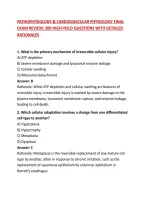
PATHOPHYSIOLOGY & CARDIOVASCULAR PHYSIOLOGY FINAL
EXAM REVIEW: 200 HIGH-YIELD QUESTIONS WITH DETAILED
RATIONALES
1. What is the primary mechanism of irreversible cellular injury?
A) ATP depletion
B) Severe membrane damage and lysosomal enzyme leakage
C) Cellular swelling
D) Ribosomal detachment
Answer: B
Rationale: While ATP depletion and cellular swelling are features of
reversible injury, irreversible injury is marked by severe damage to the
plasma membrane, lysosomal membrane rupture, and enzyme leakage,
leading to cell death.
2. Which cellular adaptation involves a change from one differentiated
cell type to another?
A) Hyperplasia
B) Hypertrophy
C) Metaplasia
D) Dysplasia
Answer: C
Rationale: Metaplasia is the reversible replacement of one mature cell
type by another, often in response to chronic irritation, such as the
replacement of squamous epithelium by columnar epithelium in
Barrett's esophagus.
,3. Which type of necrosis is typically associated with ischemic injury in
the heart?
A) Liquefactive necrosis
B) Coagulative necrosis
C) Caseous necrosis
D) Fat necrosis
Answer: B
Rationale: Coagulative necrosis is characterized by preservation of
tissue architecture for a few days and is classically seen in ischemic
injuries to solid organs like the heart, kidney, and spleen.
4. What is the primary role of the sodium-potassium pump in
maintaining cellular homeostasis?
A) Regulating intracellular calcium
B) Maintaining resting membrane potential and cell volume
C) Facilitating glucose uptake
D) Synthesizing proteins
Answer: B
Rationale: The sodium-potassium ATPase pump actively transports
sodium out of the cell and potassium into the cell, maintaining the
resting membrane potential and preventing cellular swelling by
regulating osmotic balance.
5. Which of the following is a hallmark of apoptosis?
A) Cellular swelling
B) Inflammation
C) Membrane blebbing and formation of apoptotic bodies
D) Random DNA degradation
Answer: C
Rationale: Apoptosis is programmed cell death characterized by cell
,shrinkage, chromatin condensation, membrane blebbing, and the
formation of apoptotic bodies without triggering an inflammatory
response.
6. Which chemical mediator is primarily responsible for vasodilation
and increased vascular permeability during acute inflammation?
A) Histamine
B) Thromboxane A2
C) Leukotriene B4
D) Platelet-activating factor
Answer: A
Rationale: Histamine, released by mast cells, is a major vasoactive
mediator in acute inflammation that causes arteriolar vasodilation and
increased venular permeability.
7. What is the primary mechanism of action of baroreceptors in blood
pressure regulation?
A) Direct regulation of heart rate via the vagus nerve
B) Sensing stretch in the carotid sinus and aortic arch
C) Releasing renin from the kidneys
D) Secreting aldosterone from the adrenal cortex
Answer: B
Rationale: Baroreceptors are stretch-sensitive mechanoreceptors
located in the carotid sinus and aortic arch that detect changes in
arterial blood pressure and send signals to the brainstem to adjust
sympathetic and parasympathetic outflow.
8. Which phase of the cardiac action potential is characterized by rapid
sodium influx?
A) Phase 0
, B) Phase 1
C) Phase 2
D) Phase 3
Answer: A
Rationale: Phase 0 of the cardiac action potential (the rapid
depolarization phase) is caused by a rapid influx of sodium ions through
voltage-gated sodium channels.
9. What is the primary determinant of myocardial oxygen
consumption?
A) Heart rate
B) Myocardial contractility
C) Wall tension (afterload)
D) All of the above
Answer: D
Rationale: Myocardial oxygen consumption is determined by heart rate,
contractility, and wall tension (which is related to afterload and
preload). All these factors increase the metabolic demand of the heart.
10. Which type of shock is characterized by massive vasodilation and
decreased systemic vascular resistance?
A) Cardiogenic shock
B) Hypovolemic shock
C) Distributive shock
D) Obstructive shock
Answer: C
Rationale: Distributive shock (e.g., septic, anaphylactic, neurogenic) is
characterized by severe vasodilation, leading to a drastic drop in
systemic vascular resistance and maldistribution of blood flow.
EXAM REVIEW: 200 HIGH-YIELD QUESTIONS WITH DETAILED
RATIONALES
1. What is the primary mechanism of irreversible cellular injury?
A) ATP depletion
B) Severe membrane damage and lysosomal enzyme leakage
C) Cellular swelling
D) Ribosomal detachment
Answer: B
Rationale: While ATP depletion and cellular swelling are features of
reversible injury, irreversible injury is marked by severe damage to the
plasma membrane, lysosomal membrane rupture, and enzyme leakage,
leading to cell death.
2. Which cellular adaptation involves a change from one differentiated
cell type to another?
A) Hyperplasia
B) Hypertrophy
C) Metaplasia
D) Dysplasia
Answer: C
Rationale: Metaplasia is the reversible replacement of one mature cell
type by another, often in response to chronic irritation, such as the
replacement of squamous epithelium by columnar epithelium in
Barrett's esophagus.
,3. Which type of necrosis is typically associated with ischemic injury in
the heart?
A) Liquefactive necrosis
B) Coagulative necrosis
C) Caseous necrosis
D) Fat necrosis
Answer: B
Rationale: Coagulative necrosis is characterized by preservation of
tissue architecture for a few days and is classically seen in ischemic
injuries to solid organs like the heart, kidney, and spleen.
4. What is the primary role of the sodium-potassium pump in
maintaining cellular homeostasis?
A) Regulating intracellular calcium
B) Maintaining resting membrane potential and cell volume
C) Facilitating glucose uptake
D) Synthesizing proteins
Answer: B
Rationale: The sodium-potassium ATPase pump actively transports
sodium out of the cell and potassium into the cell, maintaining the
resting membrane potential and preventing cellular swelling by
regulating osmotic balance.
5. Which of the following is a hallmark of apoptosis?
A) Cellular swelling
B) Inflammation
C) Membrane blebbing and formation of apoptotic bodies
D) Random DNA degradation
Answer: C
Rationale: Apoptosis is programmed cell death characterized by cell
,shrinkage, chromatin condensation, membrane blebbing, and the
formation of apoptotic bodies without triggering an inflammatory
response.
6. Which chemical mediator is primarily responsible for vasodilation
and increased vascular permeability during acute inflammation?
A) Histamine
B) Thromboxane A2
C) Leukotriene B4
D) Platelet-activating factor
Answer: A
Rationale: Histamine, released by mast cells, is a major vasoactive
mediator in acute inflammation that causes arteriolar vasodilation and
increased venular permeability.
7. What is the primary mechanism of action of baroreceptors in blood
pressure regulation?
A) Direct regulation of heart rate via the vagus nerve
B) Sensing stretch in the carotid sinus and aortic arch
C) Releasing renin from the kidneys
D) Secreting aldosterone from the adrenal cortex
Answer: B
Rationale: Baroreceptors are stretch-sensitive mechanoreceptors
located in the carotid sinus and aortic arch that detect changes in
arterial blood pressure and send signals to the brainstem to adjust
sympathetic and parasympathetic outflow.
8. Which phase of the cardiac action potential is characterized by rapid
sodium influx?
A) Phase 0
, B) Phase 1
C) Phase 2
D) Phase 3
Answer: A
Rationale: Phase 0 of the cardiac action potential (the rapid
depolarization phase) is caused by a rapid influx of sodium ions through
voltage-gated sodium channels.
9. What is the primary determinant of myocardial oxygen
consumption?
A) Heart rate
B) Myocardial contractility
C) Wall tension (afterload)
D) All of the above
Answer: D
Rationale: Myocardial oxygen consumption is determined by heart rate,
contractility, and wall tension (which is related to afterload and
preload). All these factors increase the metabolic demand of the heart.
10. Which type of shock is characterized by massive vasodilation and
decreased systemic vascular resistance?
A) Cardiogenic shock
B) Hypovolemic shock
C) Distributive shock
D) Obstructive shock
Answer: C
Rationale: Distributive shock (e.g., septic, anaphylactic, neurogenic) is
characterized by severe vasodilation, leading to a drastic drop in
systemic vascular resistance and maldistribution of blood flow.