
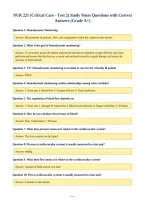
NUR 221 (Critical Care - Test 2) Study Notes Questions with Correct
Answers (Grade A+)
Question 1: Hemodynamic Monitoring
Answer: Measurement of pressure, flow, and oxygenation within the cardiovascular system
Question 2: What is the goal of hemodynamic monitoring?
Answer: To accurately assess the patient and provide therapies to optimize oxygen delivery and tissue
perfusion and ensure that the data are accurate and analyzed correctly to guide therapy and assess the
outcome of interventions
Question 3: T/F: Hemodynamic monitoring is essential to care for the critically ill patient
Answer: TRUE
Question 4: Hemodynamic monitoring studies relationships among what variables?
Answer: 1. Heart rate 2. Blood flow 3. Oxygen delivery 4. Tissue perfusion
Question 5: The regulation of blood flow depends on:
Answer: 1. Heart rate 2. Strength of contraction 3. Blood vessel diameter 4. Degree turbulence 5. Pressure
Question 6: How do you calculate the pressure of blood?
Answer: Flow X Resistance = Pressure
Question 7: What does pressure mean as it relates to the cardiovascular system?
Answer: The force exerted on the liquid
Question 8: Pressure (cardiovascular system) is usually measured in what unit?
Answer: mmHg
Question 9: What does flow mean as it relates to the cardiovascular system?
Answer: Amount of fluid moved over time
Question 10: Flow (cardiovascular system) is usually measured in what unit?
Answer: L/minute or mL/minute
Page 1
,Question 11: What does resistance mean as it relates to the cardiovascular system?
Answer: The measure of the ease with which the fluid flows through the lumen of a vessel
Question 12: T/F: The larger the diameter of a vessel the more resistance there is
Answer: FALSE **Smaller diameter = more resistance
Question 13: Cardiac output (CO)
Answer: The total volume of blood ejected from the heart per minute
Question 14: How do you calculate the cardiac output (CO)?
Answer: Heart rate (HR) X Stroke volume (SV)
Question 15: Stroke volume (SV)
Answer: The volume of blood ejected with each contraction (beat)
Question 16: What is the normal range for cardiac output (CO)?
Answer: 4 to 8 L/minute
Question 17: What 3 things can affect the stroke volume (SV)?
Answer: 1. Preload 2. Afterload 3. Contractility
Question 18: Why can a slow heart rate (HR) decrease cardiac output (CO)?
Answer: The body cannot compensate with an increased stroke volume (SV)
Question 19: Why can a fast heart rate (HR) decrease cardiac output (CO)?
Answer: The ventricles have less diastolic time and can result in poor ventricular filling causing a decrease
in stroke volume (SV)
Question 20: Preload (cardiovascular system)
Answer: The degree of ventricular stretch before the next contraction (beat)
Question 21: Afterload (cardiovascular system)
Answer: The amount of resistance the ventricles must overcome to deliver the stroke volume (SV) into the
receiving vasculture
Page 2
, Question 22: Contractility (cardiovascular system)
Answer: The strength of myocardial muscle fiber shortening during the systolic phase of the cardiac cycle
Question 23: Ejection fraction
Answer: The fraction of blood ejected with each beat
Question 24: What is the normal ejection fraction?
Answer: 60% to 70%
Question 25: What is the normal range of cardiac output (CO)?
Answer: 4 to 8 L/minute
Question 26: What is the normal range of cardiac input (CI)?
Answer: 2.5 to 4.2 L/m/m2
Question 27: What is the normal range of central venous pressure (CVP)?
Answer: 2 to 6 mmHg
Question 28: What is the normal range of right atrial pressure (RAP)?
Answer: 2 to 6 mmHg
Question 29: What is the normal range of left atrial pressure (LAP)?
Answer: 8 to 12 mmHg
Question 30: What is the normal range of pulmonary artery occlusion pressure (PAOP)?
Answer: 8 to 12 mmHg
Question 31: Systemic Vascular Resistance (SVR)
Answer: The pressure in the peripheral blood vessels that the heart must overcome to pump blood into the
system
Question 32: How is the arterial blood pressure measured?
Answer: Cardiac Output (CO) X Systemic Vascular Resistance (SVR)
Page 3
Answers (Grade A+)
Question 1: Hemodynamic Monitoring
Answer: Measurement of pressure, flow, and oxygenation within the cardiovascular system
Question 2: What is the goal of hemodynamic monitoring?
Answer: To accurately assess the patient and provide therapies to optimize oxygen delivery and tissue
perfusion and ensure that the data are accurate and analyzed correctly to guide therapy and assess the
outcome of interventions
Question 3: T/F: Hemodynamic monitoring is essential to care for the critically ill patient
Answer: TRUE
Question 4: Hemodynamic monitoring studies relationships among what variables?
Answer: 1. Heart rate 2. Blood flow 3. Oxygen delivery 4. Tissue perfusion
Question 5: The regulation of blood flow depends on:
Answer: 1. Heart rate 2. Strength of contraction 3. Blood vessel diameter 4. Degree turbulence 5. Pressure
Question 6: How do you calculate the pressure of blood?
Answer: Flow X Resistance = Pressure
Question 7: What does pressure mean as it relates to the cardiovascular system?
Answer: The force exerted on the liquid
Question 8: Pressure (cardiovascular system) is usually measured in what unit?
Answer: mmHg
Question 9: What does flow mean as it relates to the cardiovascular system?
Answer: Amount of fluid moved over time
Question 10: Flow (cardiovascular system) is usually measured in what unit?
Answer: L/minute or mL/minute
Page 1
,Question 11: What does resistance mean as it relates to the cardiovascular system?
Answer: The measure of the ease with which the fluid flows through the lumen of a vessel
Question 12: T/F: The larger the diameter of a vessel the more resistance there is
Answer: FALSE **Smaller diameter = more resistance
Question 13: Cardiac output (CO)
Answer: The total volume of blood ejected from the heart per minute
Question 14: How do you calculate the cardiac output (CO)?
Answer: Heart rate (HR) X Stroke volume (SV)
Question 15: Stroke volume (SV)
Answer: The volume of blood ejected with each contraction (beat)
Question 16: What is the normal range for cardiac output (CO)?
Answer: 4 to 8 L/minute
Question 17: What 3 things can affect the stroke volume (SV)?
Answer: 1. Preload 2. Afterload 3. Contractility
Question 18: Why can a slow heart rate (HR) decrease cardiac output (CO)?
Answer: The body cannot compensate with an increased stroke volume (SV)
Question 19: Why can a fast heart rate (HR) decrease cardiac output (CO)?
Answer: The ventricles have less diastolic time and can result in poor ventricular filling causing a decrease
in stroke volume (SV)
Question 20: Preload (cardiovascular system)
Answer: The degree of ventricular stretch before the next contraction (beat)
Question 21: Afterload (cardiovascular system)
Answer: The amount of resistance the ventricles must overcome to deliver the stroke volume (SV) into the
receiving vasculture
Page 2
, Question 22: Contractility (cardiovascular system)
Answer: The strength of myocardial muscle fiber shortening during the systolic phase of the cardiac cycle
Question 23: Ejection fraction
Answer: The fraction of blood ejected with each beat
Question 24: What is the normal ejection fraction?
Answer: 60% to 70%
Question 25: What is the normal range of cardiac output (CO)?
Answer: 4 to 8 L/minute
Question 26: What is the normal range of cardiac input (CI)?
Answer: 2.5 to 4.2 L/m/m2
Question 27: What is the normal range of central venous pressure (CVP)?
Answer: 2 to 6 mmHg
Question 28: What is the normal range of right atrial pressure (RAP)?
Answer: 2 to 6 mmHg
Question 29: What is the normal range of left atrial pressure (LAP)?
Answer: 8 to 12 mmHg
Question 30: What is the normal range of pulmonary artery occlusion pressure (PAOP)?
Answer: 8 to 12 mmHg
Question 31: Systemic Vascular Resistance (SVR)
Answer: The pressure in the peripheral blood vessels that the heart must overcome to pump blood into the
system
Question 32: How is the arterial blood pressure measured?
Answer: Cardiac Output (CO) X Systemic Vascular Resistance (SVR)
Page 3


