
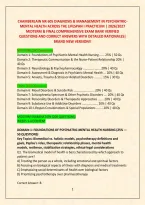
CHAMBERLAIN NR 605 DIAGNOSIS & MANAGEMENT IN PSYCHIATRIC-
MENTAL HEALTH ACROSS THE LIFESPAN I PRACTICUM | 2026/2027
MIDTERM & FINAL COMPREHENSIVE EXAM BANK VERIFIED
QUESTIONS AND CORRECT ANSWERS WITH DETAILED RATIONALES|
BRAND NEW VERSION!!
MIDTERM (200 Questions)
Domain 1: Foundations of Psychiatric-Mental Health Nursing ...... 25% | 50 Qs
Domain 2: Therapeutic Communication & the Nurse-Patient Relationship 20% |
40 Qs
Domain 3: Neurobiology & Psychopharmacology ..................... 20% | 40 Qs
Domain 4: Assessment & Diagnosis in Psychiatric Mental Health ... 20% | 40 Qs
Domain 5: Anxiety, Trauma & Stressor-Related Disorders .......... 15% | 30 Qs
FINAL (200 Questions)
Domain 6: Mood Disorders & Suicide Risk ......................... 20% | 40 Qs
Domain 7: Schizophrenia Spectrum & Other Psychotic Disorders .... 20% | 40 Qs
Domain 8: Personality Disorders & Therapeutic Approaches ....... 20% | 40 Qs
Domain 9: Substance Use & Addictive Disorders ................... 20% | 40 Qs
Domain 10: Lifespan Considerations & Special Populations ........ 20% | 40 Qs
MIDTERM EXAMINATION (200 QUESTIONS)
WEEKS 1-4 CONTENT
DOMAIN 1: FOUNDATIONS OF PSYCHIATRIC-MENTAL HEALTH NURSING (25% —
50 QUESTIONS)
Key Topics: Biomedical vs. holistic models, psychotherapy definitions and
goals, Peplau's roles, therapeutic relationship phases, mental health
models, resilience, stabilization strategies, ethical-legal considerations
Q1. The biomedical model of health is best characterized by which approach to
patient care?
A) Treating the person as a whole, including emotional and spiritual factors
B) Focusing on biological aspects of illness with diagnosis and medical treatments
C) Emphasizing social determinants of health over biological factors
D) Prioritizing psychotherapy over pharmacotherapy
Correct Answer: B
1
,Rationale: The biomedical model focuses on biological aspects of illness,
prioritizes diagnosis and medical treatments such as medications or surgeries, and
often excludes emotional, social, and spiritual influences. The holistic model, in
contrast, emphasizes treating the person as a whole.
Q2. Which model of care do PMHNPs embrace that focuses on healing rather
than cure?
A) Biomedical model
B) Holistic model
C) Behavioral model
D) Psychodynamic model
Correct Answer: B
Rationale: PMHNPs embrace a holistic model of care with a focus on healing, in
contrast to the cure-focused biomedical model. The holistic model includes
emotional well-being, social factors, spiritual health, and physical health.
Q3. What is the primary purpose of psychotherapy?
A) To guarantee a cure within a set number of sessions
B) To provide nonpharmacological intervention to help clients improve
functioning and well-being
C) To replace all pharmacological interventions
D) To diagnose medical conditions
Correct Answer: B
Rationale: Psychotherapy is a nonpharmacological intervention used to treat
mental health diagnoses or distress, helping clients improve functioning and well-
being. It is typically talk therapy provided by trained professionals.
Q4. Which theoretical framework organizes human needs into deficiency needs
and growth needs?
A) Erikson's Psychosocial Development
B) Maslow's Hierarchy of Needs
C) Freud's Psychoanalytic Theory
D) Piaget's Cognitive Development
Correct Answer: B
2
,Rationale: Maslow's Hierarchy of Needs organizes human needs into deficiency
needs (physiological, safety, love/belonging, esteem) and growth needs (self-
actualization).
Q5. According to Maslow, the first four levels of need are considered:
A) Growth needs
B) Deficiency needs
C) Self-actualization needs
D) Transcendence needs
Correct Answer: B
Rationale: The first four levels of Maslow's hierarchy are considered deficiency
needs (D-needs): physiological, safety, love/belonging, and esteem.
Q6. A patient who is not aware of or interested in changing a health behavior is in
which stage of the Transtheoretical Model?
A) Contemplation
B) Precontemplation
C) Preparation
D) Action
Correct Answer: B
Rationale: In the Precontemplation stage, the patient is not aware of or interested
in changing behavior. This is the first stage of the Transtheoretical Model of
Change.
Q7. A patient who is actively modifying behavior and developing new habits is in
which stage of change?
A) Precontemplation
B) Contemplation
C) Action
D) Maintenance
Correct Answer: C
Rationale: The Action stage is characterized by active modification of behavior
and development of new habits. This is the fourth stage of the Transtheoretical
Model.
3
, Q8. The Health Belief Model includes all of the following constructs EXCEPT:
A) Perceived susceptibility
B) Perceived severity
C) Transference
D) Cues to action
Correct Answer: C
Rationale: The Health Belief Model includes perceived susceptibility, perceived
severity, perceived benefits, perceived barriers, cues to action, and self-efficacy.
Transference is a psychoanalytic concept, not part of the Health Belief Model.
Q9. What are the elements of the Transtheoretical Model of Change?
A) Precontemplation, contemplation, preparation, action, and maintenance
B) Assessment, diagnosis, planning, intervention, and evaluation
C) Denial, anger, bargaining, depression, and acceptance
D) Oral, anal, phallic, latency, and genital
Correct Answer: A
Rationale: The Transtheoretical Model of Change includes five stages:
Precontemplation, Contemplation, Preparation, Action, and Maintenance.
Q10. What is the Health Belief Model?
A) A model that explains how personality develops through psychosexual stages
B) A model where perceived threat of illness combined with belief in effectiveness
of action predicts willingness to change
C) A model that organizes human needs into a hierarchy
D) A model that focuses on unconscious conflicts
Correct Answer: B
Rationale: The Health Belief Model posits that a person's perceived threat of
illness combined with their belief in the effectiveness of a recommended action
predicts their willingness to change behavior.
Q11. According to Maslow, self-actualization includes:
A) Safety and security
B) Belonging and love
C) Reaching one's full potential
4
MENTAL HEALTH ACROSS THE LIFESPAN I PRACTICUM | 2026/2027
MIDTERM & FINAL COMPREHENSIVE EXAM BANK VERIFIED
QUESTIONS AND CORRECT ANSWERS WITH DETAILED RATIONALES|
BRAND NEW VERSION!!
MIDTERM (200 Questions)
Domain 1: Foundations of Psychiatric-Mental Health Nursing ...... 25% | 50 Qs
Domain 2: Therapeutic Communication & the Nurse-Patient Relationship 20% |
40 Qs
Domain 3: Neurobiology & Psychopharmacology ..................... 20% | 40 Qs
Domain 4: Assessment & Diagnosis in Psychiatric Mental Health ... 20% | 40 Qs
Domain 5: Anxiety, Trauma & Stressor-Related Disorders .......... 15% | 30 Qs
FINAL (200 Questions)
Domain 6: Mood Disorders & Suicide Risk ......................... 20% | 40 Qs
Domain 7: Schizophrenia Spectrum & Other Psychotic Disorders .... 20% | 40 Qs
Domain 8: Personality Disorders & Therapeutic Approaches ....... 20% | 40 Qs
Domain 9: Substance Use & Addictive Disorders ................... 20% | 40 Qs
Domain 10: Lifespan Considerations & Special Populations ........ 20% | 40 Qs
MIDTERM EXAMINATION (200 QUESTIONS)
WEEKS 1-4 CONTENT
DOMAIN 1: FOUNDATIONS OF PSYCHIATRIC-MENTAL HEALTH NURSING (25% —
50 QUESTIONS)
Key Topics: Biomedical vs. holistic models, psychotherapy definitions and
goals, Peplau's roles, therapeutic relationship phases, mental health
models, resilience, stabilization strategies, ethical-legal considerations
Q1. The biomedical model of health is best characterized by which approach to
patient care?
A) Treating the person as a whole, including emotional and spiritual factors
B) Focusing on biological aspects of illness with diagnosis and medical treatments
C) Emphasizing social determinants of health over biological factors
D) Prioritizing psychotherapy over pharmacotherapy
Correct Answer: B
1
,Rationale: The biomedical model focuses on biological aspects of illness,
prioritizes diagnosis and medical treatments such as medications or surgeries, and
often excludes emotional, social, and spiritual influences. The holistic model, in
contrast, emphasizes treating the person as a whole.
Q2. Which model of care do PMHNPs embrace that focuses on healing rather
than cure?
A) Biomedical model
B) Holistic model
C) Behavioral model
D) Psychodynamic model
Correct Answer: B
Rationale: PMHNPs embrace a holistic model of care with a focus on healing, in
contrast to the cure-focused biomedical model. The holistic model includes
emotional well-being, social factors, spiritual health, and physical health.
Q3. What is the primary purpose of psychotherapy?
A) To guarantee a cure within a set number of sessions
B) To provide nonpharmacological intervention to help clients improve
functioning and well-being
C) To replace all pharmacological interventions
D) To diagnose medical conditions
Correct Answer: B
Rationale: Psychotherapy is a nonpharmacological intervention used to treat
mental health diagnoses or distress, helping clients improve functioning and well-
being. It is typically talk therapy provided by trained professionals.
Q4. Which theoretical framework organizes human needs into deficiency needs
and growth needs?
A) Erikson's Psychosocial Development
B) Maslow's Hierarchy of Needs
C) Freud's Psychoanalytic Theory
D) Piaget's Cognitive Development
Correct Answer: B
2
,Rationale: Maslow's Hierarchy of Needs organizes human needs into deficiency
needs (physiological, safety, love/belonging, esteem) and growth needs (self-
actualization).
Q5. According to Maslow, the first four levels of need are considered:
A) Growth needs
B) Deficiency needs
C) Self-actualization needs
D) Transcendence needs
Correct Answer: B
Rationale: The first four levels of Maslow's hierarchy are considered deficiency
needs (D-needs): physiological, safety, love/belonging, and esteem.
Q6. A patient who is not aware of or interested in changing a health behavior is in
which stage of the Transtheoretical Model?
A) Contemplation
B) Precontemplation
C) Preparation
D) Action
Correct Answer: B
Rationale: In the Precontemplation stage, the patient is not aware of or interested
in changing behavior. This is the first stage of the Transtheoretical Model of
Change.
Q7. A patient who is actively modifying behavior and developing new habits is in
which stage of change?
A) Precontemplation
B) Contemplation
C) Action
D) Maintenance
Correct Answer: C
Rationale: The Action stage is characterized by active modification of behavior
and development of new habits. This is the fourth stage of the Transtheoretical
Model.
3
, Q8. The Health Belief Model includes all of the following constructs EXCEPT:
A) Perceived susceptibility
B) Perceived severity
C) Transference
D) Cues to action
Correct Answer: C
Rationale: The Health Belief Model includes perceived susceptibility, perceived
severity, perceived benefits, perceived barriers, cues to action, and self-efficacy.
Transference is a psychoanalytic concept, not part of the Health Belief Model.
Q9. What are the elements of the Transtheoretical Model of Change?
A) Precontemplation, contemplation, preparation, action, and maintenance
B) Assessment, diagnosis, planning, intervention, and evaluation
C) Denial, anger, bargaining, depression, and acceptance
D) Oral, anal, phallic, latency, and genital
Correct Answer: A
Rationale: The Transtheoretical Model of Change includes five stages:
Precontemplation, Contemplation, Preparation, Action, and Maintenance.
Q10. What is the Health Belief Model?
A) A model that explains how personality develops through psychosexual stages
B) A model where perceived threat of illness combined with belief in effectiveness
of action predicts willingness to change
C) A model that organizes human needs into a hierarchy
D) A model that focuses on unconscious conflicts
Correct Answer: B
Rationale: The Health Belief Model posits that a person's perceived threat of
illness combined with their belief in the effectiveness of a recommended action
predicts their willingness to change behavior.
Q11. According to Maslow, self-actualization includes:
A) Safety and security
B) Belonging and love
C) Reaching one's full potential
4


